

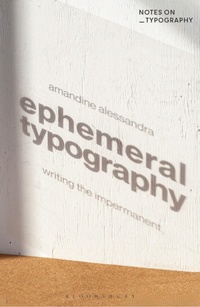
Ephemeral Typography
Writing the impermanent
Will be published approx. on 4. February 2027
Book
Paperback/Softback
176 pages
978-1-350-41751-9 (ISBN)
Description
Writing is usually understood as a tool for sharing information across distance and time. While it may feel counter-intuitive to envisage writing systems that are not for archiving knowledge or keeping traces of events, a large scope of existing typographic practices plays with evanescent letterform.
This book examines these in a variety of contexts: traditional, vernacular, activism, art and as graphic design experimentation. What happens when letters and words are ephemeral? How does impermanence tint readers' experience and understanding of the message? At a time when human activity has impacted the environment enough to form a distinct geological age, how can we design without systematically producing more things? We've been obsessed with leaving traces and testimonies of our presence on Earth, but can expression through writing find another purpose? How can typography specifically offer hyper contextual content and completely disappear a moment later?
Concrete examples explore how form is influenced by context of display, and how the fluctuant nature of materials (movement of the human body, drying moss, light-sensitive surfaces, crumbling sand...) enhances meaning and perception.
Drawing upon a variety of points of view issued from anthropology, sociology, history of art and graphic design, this book captures the interest of readers curious about typography, activism, performance, and design as a sustainable practice.
This book examines these in a variety of contexts: traditional, vernacular, activism, art and as graphic design experimentation. What happens when letters and words are ephemeral? How does impermanence tint readers' experience and understanding of the message? At a time when human activity has impacted the environment enough to form a distinct geological age, how can we design without systematically producing more things? We've been obsessed with leaving traces and testimonies of our presence on Earth, but can expression through writing find another purpose? How can typography specifically offer hyper contextual content and completely disappear a moment later?
Concrete examples explore how form is influenced by context of display, and how the fluctuant nature of materials (movement of the human body, drying moss, light-sensitive surfaces, crumbling sand...) enhances meaning and perception.
Drawing upon a variety of points of view issued from anthropology, sociology, history of art and graphic design, this book captures the interest of readers curious about typography, activism, performance, and design as a sustainable practice.
More details
Series
Language
English
Place of publication
London
United Kingdom
Publishing group
Bloomsbury Publishing PLC
Target group
College/higher education
Illustrations
40 colour illus
Dimensions
Height: 198 mm
Width: 129 mm
Thickness: 25 mm
Weight
454 gr
ISBN-13
978-1-350-41751-9 (9781350417519)
Copyright in bibliographic data and cover images is held by Nielsen Book Services Limited or by the publishers or by their respective licensors: all rights reserved.
Schweitzer Classification
Person
Amandine Alessandra is a designer, curator, and professor at the School of Design at the Universite du Quebec a Montreal, in Canada. Her practice-based research takes the form of textual messages set in multimedia collective performances taking place in cultural institutions (V&A Museum), environmental campaigns (WWF Berlin), or within local communities (primary schools).
Content
List of Illustrations
Acknowledgements
Introduction
Chapter 1. Impermanent Letterforms: Tracing Sites, Practices, and Meanings
Chapter 2. Performative Typography: Ephemeral Practice, Lasting Impact?
Chapter 3. The Dissolving Artefact: Beyond Object-Oriented Graphic Practices
Conclusion
Bibliography
Index
Acknowledgements
Introduction
Chapter 1. Impermanent Letterforms: Tracing Sites, Practices, and Meanings
Chapter 2. Performative Typography: Ephemeral Practice, Lasting Impact?
Chapter 3. The Dissolving Artefact: Beyond Object-Oriented Graphic Practices
Conclusion
Bibliography
Index