

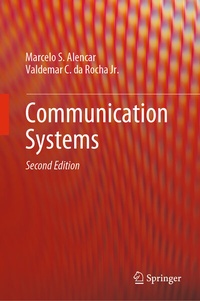
Communication Systems
Description
Communication Systems is as an introductory textbook, presenting Fourier transform, convolution, and definitions of autocorrelation and power spectral density. It also introduces concepts of probability, random variables, and stochastic processes and their applications to the analysis of linear systems.
Innovatively, the text treats the modulation process using stochastic processes as well as covers amplitude modulation, quadrature modulation, angle modulation, mobile cellular systems, propagation channels and more. Quantization and coding of analog signals is also treated, as well as speech coding.
Channel modeling, including channel characteristics and propagation, is covered with an emphasis on simple models. Transmission and reception of modulated carriers is included as well as the required transmitting and receiving equipment. Mobile communication is also covered and considers both analog and digital systems.
The authors provide five appendices which cover topics such as Fourier series and transforms, Hilbert transform, important formulae, and cellular systems including CDMA and GSM standards. Many examples are provided as well as problems at the end of each chapter to allow the reader to practice his acquired knowledge.
More details
Other editions
New editions
Additional editions
Previous edition
Persons
Marcelo Sampaio de Alencar received his Master Degree in Electrical Engineering, from Universidade Federal da Paraiba (UFPB), Brazil, 1988 and his Ph.D. from the University of Waterloo, Department of Electrical and Computer Engineering, Canada, 1993. For 18 years he worked for the Department of Electrical Engineering, Federal University of Paraiba, where he was Full Professor. From 2003 to 2017, he was Chair Professor at the Department of Electrical Engineering, Federal University of Campina Grande, Brazil. Between 1982 and 1984, he worked for the State University of Santa Catarina (UDESC). Since 2017 he is with the Federal University of Bahia. He spent some time working for MCI-Embratel and the University of Toronto, as Visiting Professor. He is founder and President of the Institute for Advanced Studies in Communications (Iecom), founder and Vice-president of the Academy of Sciences of Paraiba (ACParaiba). He has been awarded several scholarships and grants, from the Brazilian National Council for Scientific and Technological Research (CNPq), two grants from the IEEE Foundation, scholarships from the University of Waterloo and from the Federal University of Paraiba, an achievement award for contributions to the Brazilian Telecommunications Society (SBrT), an award from the Medicine College of the Federal University of Campina Grande (UFCG), and an achievement award from the College of Engineering of the Federal University of Pernambuco, during its 110th year celebration. He published over 450 engineering and scientific papers and 23 books. He also wrote chapters for 11 books. Marcelo S. Alencar has contributed in different capacities to the following scientific journals: Editor of the Journal of the Brazilian Telecommunication Society; Member of the International Editorial Board of the Journal of Communications Software and Systems (JCOMSS), published by the Croatian Communication and Information Society (CCIS); Member of the Editorial Board of the Journal of Networks (JNW), published by Academy Publisher; creator and Editor-in-Chief of the Journal of Communication and Information Systems (JCIS), a joint edition of the IEEE Communications Society (ComSoc) and SBrT. He also served on the Board of Directors of SBrT and on the SBMO Council. He is a Registered Professional Engineer, a columnist for the traditional Brazilian newspaper Jornal do Commercio, since April, 2000, and was Vice-President External Relations of SBrT.
Valdemar C. da Rocha, Jr. received his PhD degree in electronics from the University of Kent at Canterbury, England, in 1976. In 1976, he joined the faculty of the Federal University of Pernambuco, Recife, Brazil, as an Associate Professor and founded the Electrical Engineering Postgraduate Program. He has been a consultant to both the Brazilian Ministry of Education and the Ministry of Science and Technology on postgraduate education and research in electrical engineering. He was the Chairman of the Electrical Engineering Committee in the Brazilian National Council for Scientic and Technological Development for two terms. He is a founding member, former President and Emeritus Member of the Brazilian Telecommunications Society. He is also a Life Senior Member of the IEEE Information Theory Society and Communications Society, and a former member of the Alexander Graham Bell Medal Committee. He is a Fellow of the Institute of Mathematics and its Applications.