

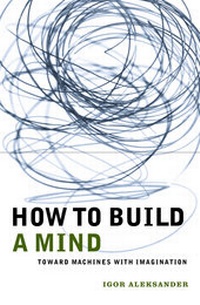
How to Build a Mind
Toward Machines with Imagination
Published on 5. November 2003
Book
Paperback/Softback
192 pages
978-0-231-12013-5 (ISBN)
Description
Igor Aleksander heads a major British team that has applied engineering principles to the understanding of the human brain and has built several pioneering machines, culminating in MAGNUS, which he calls a machine with imagination. When he asks it (in words) to produce an image of a banana that is blue with red spots, the image appears on the screen in seconds. The idea of such an apparently imaginative, even conscious machine seems heretical and its advocates are often accused of sensationalism, arrogance, or philosophical ignorance. Part of the problem, according to Aleksander, is that consciousness remains ill-defined. Interweaving anecdotes from his own life and research with imagined dialogues between historical figures-including Descartes, Locke, Hume, Kant, Wittgenstein, Francis Crick, and Steven Pinker-Aleksander leads readers toward an understanding of consciousness. He shows not only how the latest work with artificial neural systems suggests that an artificial form of consciousness is possible but also that its design would clarify many of the puzzles surrounding the murky concept of consciousness itself.
The book also looks at the presentation of "self" in robots, the learning of language, and the nature of emotion, will, instinct, and feelings.
The book also looks at the presentation of "self" in robots, the learning of language, and the nature of emotion, will, instinct, and feelings.
Reviews / Votes
Neatly illustrates how the field of artificial intelligence has mostly been leaping from enthusiasm to enthusiasm without any deep theoretical consideration of human brains or human consciousness... Written with warm amusement. The Guardian (London) A worthy trip for anybody who's wondered... just how the brain does it. -- Carl T. Hall San Francisco Chronicle This far-ranging book should interest readers at varying levels, from engineers and computer scientists to science fiction and psychology buffs. -- Hilary Burton, Lawrence Livermore National Lab, California Library Journal Igor Aleksander has spent most of his life in the frustrating attempt to develop intelligent machines. In doing so, he has been at the forefront of the Artificial Intelligence community for over four decades. How to Build a Mind is simultaneously a history of AI and an intellectual biography. Since designing thinking machines requires not just the ability to write computer programs but also an understanding of what we mean by 'consciousness,' 'mind,' and 'intelligence,' How to Build a Mind also takes up an inquiry into the history of philosophical explanations of those terms, from Miletus to Ludwig Wittgenstein. Tech DirectionsMore details
Series
Language
English
Place of publication
New York
United States
Target group
Professional and scholarly
Product notice
Paperback (trade)
Illustrations
3 illus
Weight
368 gr
ISBN-13
978-0-231-12013-5 (9780231120135)
Copyright in bibliographic data and cover images is held by Nielsen Book Services Limited or by the publishers or by their respective licensors: all rights reserved.
Schweitzer Classification
Other editions
Additional editions
Book
08/2001
Columbia University Press
€98.98
Shipment within 10-20 days
Person
Igor Aleksander is professor of neural engineering systems at the Imperial College of Science, Technology, and Medicine in London. He has studied artificial intelligence for more than thirty years and has published over 200 papers and ten books on the subject, including Reinventing Man, Impossible Minds: My Neurons, My Consciousness and Neurons and Symbols: The Stuff That Mind Is Made Of.
Content
Preface 1. Imagination and Consciousness 2. Miletus: Where the Dreaming Begins 3. Nineteen Fifty-eight: A Voyage Toward Interdisciplinarity 4. The Ghost of Aristotle: An Influence Across Two Millennia 5. Early Artificial Neurons and the Beginnings of Artificial Intelligence 6. Liberating Philosophy: The Empiricists 7. Canterbury: The First Machines 8. Wittgenstein: A Brief Interlude 9. The WISARD Years: Machines with No Mind 10. Starting the Week with Consciousness 11. MAGNUS in South Kensington and Pasadena 12. On Being Conscious: The Ego in the Machine Epilogue Further Reading