

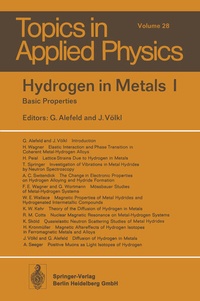
Hydrogen in Metals I
Basic Properties
Published on 17. April 2014
Book
Paperback/Softback
XVI, 428 pages
978-3-662-30846-2 (ISBN)
Description
Elastic interaction and phase transition in coherent metal-hydrogen alloys.- Lattice strains due to hydrogen in metals.- Investigation of vibrations in metal hydrides by neutron spectroscopy.- The change in electronic properties on hydrogen alloying and hydride formation.- Mössbauer studies of metal-hydrogen systems.- Magnetic properties of metal hydrides and hydrogenated intermetallic compounds.- Theory of the diffusion of hydrogen in metals.- Nuclear magnetic resonance on metal-hydrogen systems.- Quasielastic neutron scattering studies of metal hydrides.- Magnetic after effects of hydrogen isotopes in ferromagnetic metals and alloys.- Diffusion of hydrogen in metals.- Positive muons as light isotopes of hydrogen.
More details
Series
Edition
Softcover reprint of the original 1st ed. 1978
Language
English
Place of publication
Berlin
Germany
Publishing group
Springer Berlin
Target group
Professional and scholarly
Research
Illustrations
8 s/w Abbildungen
XVI, 428 p. 8 illus.
Dimensions
Height: 229 mm
Width: 152 mm
Thickness: 25 mm
Weight
644 gr
ISBN-13
978-3-662-30846-2 (9783662308462)
DOI
10.1007/3-540-08705-2
Schweitzer Classification
Other editions
Additional editions

Book
08/1978
Springer
€85.59
Article exhausted; check different version
Persons
Content
Elastic interaction and phase transition in coherent metal-hydrogen alloys.- Lattice strains due to hydrogen in metals.- Investigation of vibrations in metal hydrides by neutron spectroscopy.- The change in electronic properties on hydrogen alloying and hydride formation.- Mössbauer studies of metal-hydrogen systems.- Magnetic properties of metal hydrides and hydrogenated intermetallic compounds.- Theory of the diffusion of hydrogen in metals.- Nuclear magnetic resonance on metal-hydrogen systems.- Quasielastic neutron scattering studies of metal hydrides.- Magnetic after effects of hydrogen isotopes in ferromagnetic metals and alloys.- Diffusion of hydrogen in metals.- Positive muons as light isotopes of hydrogen.