

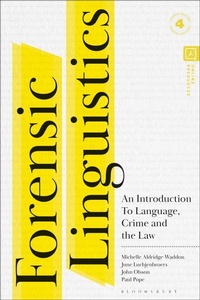
Forensic Linguistics
An Introduction to Language, Crime and the Law
4th Edition
Will be published approx. on 10. December 2026
Book
Hardback
336 pages
978-1-350-47141-2 (ISBN)
Description
Now in its fourth edition, this practical introduction to forensic linguistics combines critical theoretical discussion with workplace application. This updated version reflects digital developments in areas such a forensic phonetics, artificial intelligence, and cybercrime, and includes more recent case studies and texts. Student exercises also reflect topics of current, global interest.
This new edition is fully updated and revised throughout and includes:
- a new chapter on author profiling
- a new chapter on forensic phonetics written by Ricky Chan (Hong Kong University)
- the expertise of two new co-authors
- case studies, transcripts to analyse, communication aids to design, and a glossary
- appendices of forensic texts for student study, plus additional exercises and commentaries, and suggestions for further reading
- an updated companion website with a repository of statements, notes and examples referred to throughout the text.
Parts One and Two introduce, illustrate and critically evaluate methods while Part Three applies this introduction to workplace settings. The new revising authors offer an important blend of knowledge and research experience from law and linguistics in the UK and the USA ensuring that this well-established textbook remains relevant for the next generation of students.
This new edition is fully updated and revised throughout and includes:
- a new chapter on author profiling
- a new chapter on forensic phonetics written by Ricky Chan (Hong Kong University)
- the expertise of two new co-authors
- case studies, transcripts to analyse, communication aids to design, and a glossary
- appendices of forensic texts for student study, plus additional exercises and commentaries, and suggestions for further reading
- an updated companion website with a repository of statements, notes and examples referred to throughout the text.
Parts One and Two introduce, illustrate and critically evaluate methods while Part Three applies this introduction to workplace settings. The new revising authors offer an important blend of knowledge and research experience from law and linguistics in the UK and the USA ensuring that this well-established textbook remains relevant for the next generation of students.
Reviews / Votes
Whether one is a legal language researcher, academic, and/or practitioner, Forensic Linguistics (4th Edition), continues its ongoing relevance as one of the seminal publications in our field. Its demonstrably knowledgeable authors relate not just information regarding the history and science of forensic linguistics, but also the laws governing it, applicable empirical research findings, and ideal social justice objectives in its real world usage. Most important to me, however, is the referenced practical applications, i.e., the how-to of working a language analysis case from beginning to end. This includes dozens of actual forensic linguistic case examples designed to further the reader's comprehension of taking a language-related matter before the courts. If one is, in fact, analyzing these matters, of any sort, as a member of law enforcement, a prosecuting attorney, a defense attorney, or in any aspect in the criminal/civil justice system involving spoken or written language, this book is a must read. * James R. Fitzgerald, MS, Supervisory Special Agent, FBI (Ret.), Associate Professor of Forensic Linguistics Pennsylvania Western University (2019-2025), USA * A thorough and well-structured introduction to forensic linguistics, this fourth edition covers the field's core areas with notable range: from authorship analysis and forensic phonetics to cybercrime and courtroom discourse. The integration of real-world case materials, practical exercises and theoretical grounding makes it an accessible and reliable resource for students and practitioners alike. What sets this book apart is its international scope, drawing on cases across multiple jurisdictions, and its attention to social justice, including vulnerable witnesses, asylum seekers and non-native speakers. A valuable and timely contribution to the field. * Julia Kupper, Tactical Linguist, USA *More details
Edition
4th edition
Language
English
Place of publication
London
United Kingdom
Publishing group
Bloomsbury Publishing PLC
Target group
Professional and scholarly
Illustrations
9 b&w illustrations
Dimensions
Height: 234 mm
Width: 156 mm
ISBN-13
978-1-350-47141-2 (9781350471412)
Copyright in bibliographic data and cover images is held by Nielsen Book Services Limited or by the publishers or by their respective licensors: all rights reserved.
Schweitzer Classification
Persons
John Olsson was a lecturer in Forensic Linguistics in both the School of Linguistics and the School of Law at Bangor University, UK, and was head of the Forensic Linguistics Institute.
June Luchjenbroers was Senior Lecturer in Linguistics at Bangor University, UK.
Paul Pope is Associate Professor at Montana State University Billings in the Department of Social Sciences & Cultural Studies, USA.
Michelle Aldridge-Waddon is a Reader in the School of English, Communication and Philosophy at Cardiff University, UK.
June Luchjenbroers was Senior Lecturer in Linguistics at Bangor University, UK.
Paul Pope is Associate Professor at Montana State University Billings in the Department of Social Sciences & Cultural Studies, USA.
Michelle Aldridge-Waddon is a Reader in the School of English, Communication and Philosophy at Cardiff University, UK.
Content
List of figures
List of tables
Foreword
Acknowledgements
PART ONE: Language as forensic evidence
1. Introduction to Forensic Linguistics
2. The author constructed
3. Time, variation and genre
4. Range of variation
5. Textual variation
6. Forensic phonetics: An introduction by Harry Hollien
7. Cybercrime
PART TWO: Dealing with linguistic evidence
8. Forensic texts
9. Forensic transcription
10. Forensic authorship in practice
11. Investigating author variation in naturalistic data
12. Forensic linguistic evidence in court
The texts in the case
The features in the texts
Excerpts from prosecution reports
Conclusion
PART THREE: The legal process: Language and the law
13. Power in legal contexts: The courts
14. Power in legal contexts: The police
15. Vulnerable witnesses
PART FOUR: Language of the law
16. The law and us
17. The language of statutes
Appendix 1. Forensic texts
Appendix 2. Exercises and exercise commentaries
Appendix 3. Active researchers in the field of forensic linguistics
Bibliography
Author Index
Subject Index
List of tables
Foreword
Acknowledgements
PART ONE: Language as forensic evidence
1. Introduction to Forensic Linguistics
2. The author constructed
3. Time, variation and genre
4. Range of variation
5. Textual variation
6. Forensic phonetics: An introduction by Harry Hollien
7. Cybercrime
PART TWO: Dealing with linguistic evidence
8. Forensic texts
9. Forensic transcription
10. Forensic authorship in practice
11. Investigating author variation in naturalistic data
12. Forensic linguistic evidence in court
The texts in the case
The features in the texts
Excerpts from prosecution reports
Conclusion
PART THREE: The legal process: Language and the law
13. Power in legal contexts: The courts
14. Power in legal contexts: The police
15. Vulnerable witnesses
PART FOUR: Language of the law
16. The law and us
17. The language of statutes
Appendix 1. Forensic texts
Appendix 2. Exercises and exercise commentaries
Appendix 3. Active researchers in the field of forensic linguistics
Bibliography
Author Index
Subject Index