

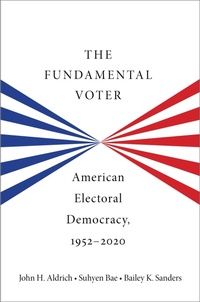
The Fundamental Voter
American Electoral Democracy, 1952-2020
Published on 24. July 2025
Book
Paperback/Softback
192 pages
978-0-19-774549-6 (ISBN)
Description
Why is American politics so intense and emotionally competitive today, and how did we get here? In The Fundamental Voter, John H. Aldrich, Suhyen Bae, and Bailey K. Sanders explain why the notion that we are divided into tribal loyalties is, at best, only partially correct, and discuss how the divisions rest on much more substantive politics than they once did.
In the 1950s and 1960s, the American public based voting primarily on partisan loyalties. Landslide presidential elections were once common, but over the last forty years, they have converged to very closely contested elections. Congressional elections were increasingly incumbent centered before 1984 and decreasingly so afterward. These changes reflect the changing nature of fundamental forces that shape the public's electoral opinions and voting behavior. From a single such fundamental, partisan identification, the electorate now rests on five fundamental forces: party, ideology, issues, race, and economics.
Since the 1980s, these fundamentals have grown increasingly important and increasingly aligned, such that voters are now sorted into two increasingly bitterly divided sides. Believing that the other side is on the wrong side of nearly everything of political relevance, voters, like officials, have come to deeply dislike the opposition, a state of affairs that threatens to undermine the stability of democratic institutions in the United States.
In the 1950s and 1960s, the American public based voting primarily on partisan loyalties. Landslide presidential elections were once common, but over the last forty years, they have converged to very closely contested elections. Congressional elections were increasingly incumbent centered before 1984 and decreasingly so afterward. These changes reflect the changing nature of fundamental forces that shape the public's electoral opinions and voting behavior. From a single such fundamental, partisan identification, the electorate now rests on five fundamental forces: party, ideology, issues, race, and economics.
Since the 1980s, these fundamentals have grown increasingly important and increasingly aligned, such that voters are now sorted into two increasingly bitterly divided sides. Believing that the other side is on the wrong side of nearly everything of political relevance, voters, like officials, have come to deeply dislike the opposition, a state of affairs that threatens to undermine the stability of democratic institutions in the United States.
Reviews / Votes
Recommended. Advanced undergraduates through faculty; professionals. * Choice *More details
Language
English
Place of publication
New York
United States
Product notice
Paperback (trade)
Unsewn / adhesive bound
Illustrations
45 b/w line drawings
Dimensions
Height: 226 mm
Width: 150 mm
Thickness: 13 mm
Weight
272 gr
ISBN-13
978-0-19-774549-6 (9780197745496)
Copyright in bibliographic data and cover images is held by Nielsen Book Services Limited or by the publishers or by their respective licensors: all rights reserved.
Schweitzer Classification
Other editions
Additional editions
John H. Aldrich | Suhyen Bae | Bailey K. Sanders
The Fundamental Voter
American Electoral Democracy, 1952-2020
Book
07/2025
Oxford University Press Inc
€73.16
Shipment within 15-20 days
John H. Aldrich | Suhyen Bae | Bailey K. Sanders
The Fundamental Voter
American Electoral Democracy, 1952-2020
E-Book
05/2024
OUP eBook
€21.99
Available for download
John H. Aldrich | Suhyen Bae | Bailey K. Sanders
The Fundamental Voter
American Electoral Democracy, 1952-2020
E-Book
05/2024
OUP eBook
€21.99
Available for download
Persons
John H. Aldrich is Pfizer-Pratt University Professor of Political Science at Duke University. He specializes in American and comparative politics and behavior, formal theory, and methodology. Aldrich is the author or coauthor of Why Parties, Why Parties Matter, Before the Convention, Interdisciplinarity, and Change and Continuity in the 2020 and 2022 Elections. He is past President of the Southern Political Science Association, the Midwest Political Science Association, and the American Political Science Association.
Suhyen Bae is a PhD candidate in the Department of Political Science, Duke University. Her research examines the political consequences of social connections, especially on loneliness and social isolation in American and comparative contexts. Bae has published in peer-reviewed journals and was the editor of and contributor to the book Khop Jai Laos and the academic web-magazine on Latin America, TransLatin, published in Korea.
Bailey K. Sanders, PhD, JD,is a visiting assistant professor at the Duke University School of Law.Her research focuses on women's representation in politics and the judiciary, as well as the ways in which market competition advances gender equality. Sanders has published in Legislative Studies Quarterly, Perspectives on Politics(with Danielle Thomsen), The Connecticut Public Interest Law Journal(with Jane Wettach), and theUCLA Journal of Gender and Law. Her work is forthcoming at theJournal of Law and Courtsand theColumbia Journal of Gender and Law.
Suhyen Bae is a PhD candidate in the Department of Political Science, Duke University. Her research examines the political consequences of social connections, especially on loneliness and social isolation in American and comparative contexts. Bae has published in peer-reviewed journals and was the editor of and contributor to the book Khop Jai Laos and the academic web-magazine on Latin America, TransLatin, published in Korea.
Bailey K. Sanders, PhD, JD,is a visiting assistant professor at the Duke University School of Law.Her research focuses on women's representation in politics and the judiciary, as well as the ways in which market competition advances gender equality. Sanders has published in Legislative Studies Quarterly, Perspectives on Politics(with Danielle Thomsen), The Connecticut Public Interest Law Journal(with Jane Wettach), and theUCLA Journal of Gender and Law. Her work is forthcoming at theJournal of Law and Courtsand theColumbia Journal of Gender and Law.
Content
List of Tables
List of Figures
Chapter 1: A Fundamental Change in National Elections, 1952-2020
Chapter 2: The Fundamentals: What They Are and How Many Are There?
Chapter 3: The Fundamentals and the Vote, 1952-2020
Chapter 4: The Fundamentals Sort and Polarize the Electorate
Chapter 5: How Fundamentals Shape Evaluations of Candidates and Campaigns
Chapter 6: The Fundamentals: From Polarization to a Single Reinforced Cleavage
Chapter 7: Conclusion
References
List of Figures
Chapter 1: A Fundamental Change in National Elections, 1952-2020
Chapter 2: The Fundamentals: What They Are and How Many Are There?
Chapter 3: The Fundamentals and the Vote, 1952-2020
Chapter 4: The Fundamentals Sort and Polarize the Electorate
Chapter 5: How Fundamentals Shape Evaluations of Candidates and Campaigns
Chapter 6: The Fundamentals: From Polarization to a Single Reinforced Cleavage
Chapter 7: Conclusion
References