

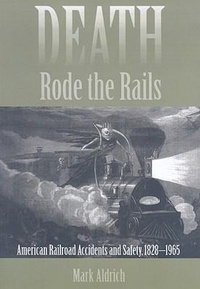
Death Rode the Rails
American Railroad Accidents and Safety, 1828-1965
Published on 4. January 2010
Book
Paperback/Softback
480 pages
978-0-8018-9402-2 (ISBN)
Description
For most of the 19th and much of the 20th centuries, railroads dominated American transportation. They transformed life and captured the imagination. Yet by 1907 railroads had also become the largest cause of violent death in the country, that year claiming the lives of nearly twelve thousand passengers, workers, and others. In Death Rode the Rails Mark Aldrich explores the evolution of railroad safety in the United States by examining a variety of incidents: spectacular train wrecks, smaller accidents in shops and yards that devastated the lives of workers and their families, and the deaths of thousands of women and children killed while walking on or crossing the street-grade tracks. The evolution of railroad safety, Aldrich argues, involved the interplay of market forces, science and technology, and legal and public pressures. He considers the railroad as a system in its entirety: operational realities, technical constraints, economic history, internal politics, and labor management. Aldrich shows that economics initially encouraged American carriers to build and operate cheap and dangerous lines.
Only over time did the trade-off between safety and output-shaped by labor markets and public policy-motivate carriers to develop technological improvements that enhanced both productivity and safety. A fascinating account of one of America's most important industries and its dangers, Death Rode the Rails will appeal to scholars of economics and the history of transportation, technology, labor, regulation, safety, and business, as well as to railroad enthusiasts.
Only over time did the trade-off between safety and output-shaped by labor markets and public policy-motivate carriers to develop technological improvements that enhanced both productivity and safety. A fascinating account of one of America's most important industries and its dangers, Death Rode the Rails will appeal to scholars of economics and the history of transportation, technology, labor, regulation, safety, and business, as well as to railroad enthusiasts.
Reviews / Votes
A fascinating account of one of America's most important industries and its dangers. Scale Rails A well-made book such as this one stands out as a rare exception. Scitech Book News Students of rail safety, and today's Class I railroad managers, need to read this volume. -- Ray Weart Trains Aldrich has created a masterpiece. His research is extensive, drawing on a rich variety of obscure yet relevant sources. -- H. Roger Grant Register of the Kentucky Historical Society Aldrich... has done an excellent and thorough job of explaining and analyzing the evolution of rail safety over nearly two hundred years. History: Reviews of New Books One of the first large-scale scholarly studies of railroad safety in America... I recommend this book without qualifications. Railroad History An excellent narrative of the evolution of public and industry focus on industrial safety. -- Russell D. Jones Enterprise and Society Important new book... A significant contribution to the study of both industrial safety and consumer safety as exemplified by one of the most important industries in our nation's history. Business History Review A thought-provoking and well-grounded contribution to the history of American economic development. Journal of American History Pioneering... A central message of Aldrich's book is that 'little accidents' played a crucial though until now largely hidden role in the gradual evolution of a risk society. -- Bill Luckin Technology and Culture A work of merit... Essential reading for historians of transport safety, business, and technology. -- Mike Esbester Journal of Transport History Impressive and thoroughly researched... Demonstrates how railroad safety evolved from the intersection of market pressures, technology, and public sentiment. -- James B. McSwain Journal of Southern History Aldrich has written the field-defining work on railroad safety... An important corrective to the simplistic notion that railroad companies wanted nothing to do with safety before the era of federal regulation. -- John Williams-Searle Annals of Iowa A masterful study of the complex evolution of railroad safety. -- James W. Ely, Jr. American Historical Review Highly informative... A worthwhile read. -- John L. Niehaus The VillagerMore details
Language
English
Place of publication
Baltimore, MD
United States
Target group
Professional and scholarly
Product notice
Paperback (trade)
Illustrations
40 s/w Photographien bzw. Rasterbilder, 29 s/w Zeichnungen
29 Line drawings, black and white; 40 Halftones, black and white
Dimensions
Height: 253 mm
Width: 174 mm
Thickness: 26 mm
Weight
866 gr
ISBN-13
978-0-8018-9402-2 (9780801894022)
DOI
10.1353/book.3249
Copyright in bibliographic data and cover images is held by Nielsen Book Services Limited or by the publishers or by their respective licensors: all rights reserved.
Schweitzer Classification
Other editions
Additional editions
E-Book
06/2006
Johns Hopkins University Press
€28.49
Available for download
Book
06/2006
Johns Hopkins University Press
€70.50
Article not available for order
Person
Mark Aldrich is the Marilyn Carlson Nelson Professor of Economics Emeritus at Smith College and the author of Safety First: Technology, Labor, and Business in the Building of American Work Safety, 1870-1939, also published by Johns Hopkins.
Content
List of Figures
List of Tables
Preface
Introduction
1. In the Beginning: American Railroad Dangers and Safety, 1828-1873
2. Off the Tracks: The Changing Pattern of Derailments, 1873-1900
3. Collisions and the Rise of Regulation, 1873-1900
4. The Major Risks from Minor Accidents, 1873-1900
5. Engineering Success and Disaster: Bridge Design and Failure, 1840-1900
6. Coping with the Casualties: Companies, Workers, and Injuries, 1850-1900
7. Safety Crisis and Safety First, 1900-1920
8. Lobbying for Regulation: Transporting Hazardous Substances, 1903-1930
9. Private Enterprise and Public Regulation: Safety between the Wars, 1922-1939
10. Safety in War and Decline, 1940-1965
Conclusion: The Political Economy of Railroad Safety, 1830-1965
Appendix 1: Nineteenth-Century Railroad Accident and Casualty Statistics
Appendix 2: Casualties and Accidents from Interstate Commerce Commission Statistics, 1888-1965
List of Abbreviations
Notes
Essay on Sources
Index
List of Tables
Preface
Introduction
1. In the Beginning: American Railroad Dangers and Safety, 1828-1873
2. Off the Tracks: The Changing Pattern of Derailments, 1873-1900
3. Collisions and the Rise of Regulation, 1873-1900
4. The Major Risks from Minor Accidents, 1873-1900
5. Engineering Success and Disaster: Bridge Design and Failure, 1840-1900
6. Coping with the Casualties: Companies, Workers, and Injuries, 1850-1900
7. Safety Crisis and Safety First, 1900-1920
8. Lobbying for Regulation: Transporting Hazardous Substances, 1903-1930
9. Private Enterprise and Public Regulation: Safety between the Wars, 1922-1939
10. Safety in War and Decline, 1940-1965
Conclusion: The Political Economy of Railroad Safety, 1830-1965
Appendix 1: Nineteenth-Century Railroad Accident and Casualty Statistics
Appendix 2: Casualties and Accidents from Interstate Commerce Commission Statistics, 1888-1965
List of Abbreviations
Notes
Essay on Sources
Index