

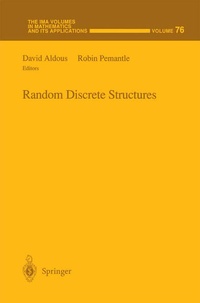
Random Discrete Structures
Published on 23. October 2012
Book
Paperback/Softback
XVIII, 225 pages
978-1-4612-6881-9 (ISBN)
Description
The articles in this volume present the state of the art in a variety of areas of discrete probability, including random walks on finite and infinite graphs, random trees, renewal sequences, Stein's method for normal approximation and Kohonen-type self-organizing maps. This volume also focuses on discrete probability and its connections with the theory of algorithms. Classical topics in discrete mathematics are represented as are expositions that condense and make readable some recent work on Markov chains, potential theory and the second moment method. This volume is suitable for mathematicians and students.
More details
Series
Edition
Softcover reprint of the original 1st ed. 1996
Language
English
Place of publication
New York
United States
Target group
Professional and scholarly
Research
Illustrations
XVIII, 225 p.
Dimensions
Height: 235 mm
Width: 155 mm
Thickness: 14 mm
Weight
382 gr
ISBN-13
978-1-4612-6881-9 (9781461268819)
DOI
10.1007/978-1-4612-0719-1
Schweitzer Classification
Other editions
Additional editions
David Aldous | Robin Pemantle
Random Discrete Structures
Book
12/1995
Springer
€160.49
Shipment within 5-7 days
Content
Probability distributions on cladograms.- Stability of self-organizing processes.- Some examples of normal approximations by Stein's method.- Large deviations for random distribution of mass.- Random minimax game tress.- Metrics on compositions and coincidences among renewal sequences.- The no long odd cycle theorem for completely positive matrices.- A note on triangle-free graphs.- Intersections and limits of regenerative sets.- Random processes of the form Xn+1 = anXn + bn (mod p) where bn takes on a single value.- The second moment method, conditioning and approximation.- How fast and where does a random walker move on a random tree?.- A note on recurrence, amenability, and the universal cover of graphs.- On which graphs are all random walks in random environments transient?.- Energy, and intersections of Markov chains.