


Language Test Construction and Evaluation
Published on 26. May 1995
Book
Hardback
324 pages
978-0-521-47255-5 (ISBN)
Description
Language Test Construction and Evaluation describes the process of language test construction clearly and comprehensively. Each chapter deals with one stage of the test construction process; from drafting initial test specifications, to reporting test scores, test validation and washback. In addition, current practice in the examining of English as a Foreign Language by different examining boards is reviewed in order to compare testing principles with present test practice. The focus is on the practical: it does not assume a statistical background but explains and demystifies the procedures and concepts that are relevant to the construction and evaluation of language tests. Language Test Construction and Evaluation will provide an invaluable reference for anyone who wishes to understand how language tests are, and should be, constructed.
More details
Series
Language
English
Place of publication
Cambridge
United Kingdom
Target group
ELT/ESL
Dimensions
Height: 235 mm
Width: 155 mm
Thickness: 25 mm
Weight
622 gr
ISBN-13
978-0-521-47255-5 (9780521472555)
Copyright in bibliographic data is held by Nielsen Book Services Limited or its licensors: all rights reserved.
Schweitzer Classification
Other editions
New editions
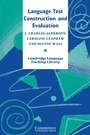
J. Charles Alderson | Caroline Clapham | Dianne Wall
Language Test Construction and Evaluation
Book
05/1995
Cambridge University Press
€67.80
Shipment within 15-20 days
Additional editions
J. Charles Alderson | Caroline Clapham | Dianne Wall
Language Test Construction and Evaluation
Book
05/1995
Cambridge University Press
€67.80
Shipment within 15-20 days
Persons
Content
1; Origins and overview; 2;Test specifications: the syllabus on which the test is based; 3; Item writing, test assembly and test analysis; 4; Trialling the draft test and test analysis; 5; The training of examiners and test administrators; 6; Monitoring examiner reliability; 7 Reporting scores and setting pass marks; 8; Post-test reports; 9; Test validation; 10; Developing and improving tests; 11; Standards in language testing: THE STATE OF THE ART