

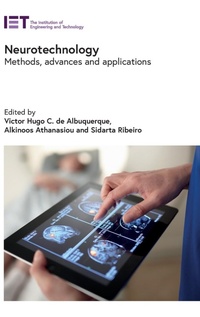
Neurotechnology
Methods, advances and applications
Published on 13. July 2020
Book
Hardback
312 pages
978-1-78561-813-0 (ISBN)
Description
This book focuses on recent advances and future trends in the methods and applications of technologies that are used in neuroscience for the evaluation, diagnosis and treatment of neurological diseases and conditions or for the improvement of quality of life. The editors have assembled contributions from a range of international experts, to bring together key topics in neurotechnology, neuroengineering, and neurorehabilitation. The book explores biomedical signal processing, neuroimaging acquisition and analysis, computational intelligence, virtual and augmented reality, biometrics, machine learning and neurorobotics, human machine interaction, mobile apps and discusses ways in which these neural technologies can be used as diagnostic tools, research methods, treatment modalities, as well as in devices and apps in everyday life.
This cross-disciplinary topic is of particular interest to researchers and professionals with a background in neuroscience-related disciplines and neurotechnology, but also touches on a wide range of other fields including biomedical engineering, AI, medicine, healthcare, security and industry, among others.
This cross-disciplinary topic is of particular interest to researchers and professionals with a background in neuroscience-related disciplines and neurotechnology, but also touches on a wide range of other fields including biomedical engineering, AI, medicine, healthcare, security and industry, among others.
More details
Series
Language
English
Place of publication
Stevenage
United Kingdom
Target group
College/higher education
Professional and scholarly
Product notice
sewn/stitched
Cloth over boards
Dimensions
Height: 239 mm
Width: 160 mm
Thickness: 20 mm
Weight
635 gr
ISBN-13
978-1-78561-813-0 (9781785618130)
Copyright in bibliographic data and cover images is held by Nielsen Book Services Limited or by the publishers or by their respective licensors: all rights reserved.
Schweitzer Classification
Persons
Victor Hugo C. de Albuquerque [M'17, SM'19] is a professor and senior researcher at the University of Fortaleza (UNIFOR), Brazil and director of Data Science at the Superintendency for Research and Public Safety Strategy of Ceara State (SUPESP/CE), Brazil. He has a Ph.D. in mechanical engineering from the Federal University of Paraiba, an M.Sc. in teleinformatics engineering from the Federal University of Cearaa, and he graduated in mechatronics engineering at the Federal Center of Technological Education of Ceara. He is currently a full professor of the Graduate Program in Applied Informatics of UNIFOR and leader of the Industrial Informatics, Electronics and Health Research Group (CNPq). He is an expert, mainly, in IoT, machine/deep learning, pattern recognition, and robotics.
Alkinoos Athanasiou is a board-certified neurosurgeon and a post-doc researcher at the Medical Physics Lab, School of Medicine, Aristotle University of Thessaloniki, Greece. He is employed as associated scientific staff at the Hellenic Open University, teaching Neuronal Restoration Engineering. He serves as elected Secretary and member of the administrative board of the Hellenic Society for Biomedical Technology. His research interests lie with neurorehabilitation and neurotechnology. He has been awarded more than 15 research grants and awards in total.
Sidarta Ribeiro is a professor of neuroscience and director of the Brain Institute at the Federal University of Rio Grande do Norte, Brazil. He has considerable experience in the areas of neuroethology, molecular neurobiology, and systems neurophysiology. He currently coordinates the Brazilian committee of the Pew Latin American Fellows Program in the Biomedical Sciences, and is a member of the steering committee of the Latin American School of Education, Cognitive and Neural Sciences.
Alkinoos Athanasiou is a board-certified neurosurgeon and a post-doc researcher at the Medical Physics Lab, School of Medicine, Aristotle University of Thessaloniki, Greece. He is employed as associated scientific staff at the Hellenic Open University, teaching Neuronal Restoration Engineering. He serves as elected Secretary and member of the administrative board of the Hellenic Society for Biomedical Technology. His research interests lie with neurorehabilitation and neurotechnology. He has been awarded more than 15 research grants and awards in total.
Sidarta Ribeiro is a professor of neuroscience and director of the Brain Institute at the Federal University of Rio Grande do Norte, Brazil. He has considerable experience in the areas of neuroethology, molecular neurobiology, and systems neurophysiology. He currently coordinates the Brazilian committee of the Pew Latin American Fellows Program in the Biomedical Sciences, and is a member of the steering committee of the Latin American School of Education, Cognitive and Neural Sciences.
Content
Chapter 1: A brief introduction to neurotechnology: old challenges and new battlegrounds
Chapter 2: Current trends of biomedical signal processing in neuroscience
Chapter 3: Neuroimage acquisition and analysis
Chapter 4: Virtual and augmented reality in neuroscience
Chapter 5: EEG-based biometric systems
Chapter 6: The evolution of passive brain-computer interfaces: enhancing the human-machine interaction
Chapter 7: Neurorobotics: review of underlying technologies, current developments, and future directions
Chapter 8: Mobile apps for neuroscience
Chapter 9: Ideas for a school of the future
Chapter 2: Current trends of biomedical signal processing in neuroscience
Chapter 3: Neuroimage acquisition and analysis
Chapter 4: Virtual and augmented reality in neuroscience
Chapter 5: EEG-based biometric systems
Chapter 6: The evolution of passive brain-computer interfaces: enhancing the human-machine interaction
Chapter 7: Neurorobotics: review of underlying technologies, current developments, and future directions
Chapter 8: Mobile apps for neuroscience
Chapter 9: Ideas for a school of the future