

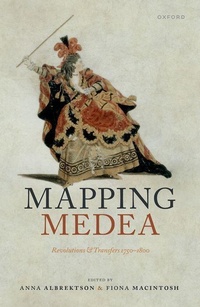
Mapping Medea
Revolutions and Transfers 1750-1800
Published on 25. September 2023
Book
Hardback
272 pages
978-0-19-288419-0 (ISBN)
Description
The late-eighteenth century witnessed multiple Medeas take to the stages of Europe, in the Americas, and across the Russian empire. Performances took place in Moscow and Sao Paulo, in London and Lisbon, in Gotha, Stuttgart, and Venice. This lively collection of essays examines the various reasons why Medea, the ancient mother who killed her own children, attracted the attention of authors, audiences, actors, and rulers in Europe and its dominions during the pivotal period 1750 to 1800, and to what effects.
As a migrant and iconoclast, Medea crosses a number of eighteenth-century borders: linguistic, cultural, national, temporal, spatial, aesthetic, ethical, and generic. Moreover, the fact that late-eighteenth-century playwrights, poets, composers, and choreographers all turned to one of the most problematic characters of Greco-Roman antiquity offers a unique opportunity to examine the remarkable flexibility of the reception process itself. Medea therefore functions as an intriguing case study, reflecting a wider context of cultural and political change within Europe and its colonies in the late-eighteenth century.
By drawing together eighteenth-century specialists working across multiple languages and disciplines with the reception perspective of classical scholars, this volume brings much rare material from a range of archives across continental Europe to critical attention for the first time. Mapping Medea shows how the eighteenth century made Medea modern, and Medea helped to shape modern performance.
As a migrant and iconoclast, Medea crosses a number of eighteenth-century borders: linguistic, cultural, national, temporal, spatial, aesthetic, ethical, and generic. Moreover, the fact that late-eighteenth-century playwrights, poets, composers, and choreographers all turned to one of the most problematic characters of Greco-Roman antiquity offers a unique opportunity to examine the remarkable flexibility of the reception process itself. Medea therefore functions as an intriguing case study, reflecting a wider context of cultural and political change within Europe and its colonies in the late-eighteenth century.
By drawing together eighteenth-century specialists working across multiple languages and disciplines with the reception perspective of classical scholars, this volume brings much rare material from a range of archives across continental Europe to critical attention for the first time. Mapping Medea shows how the eighteenth century made Medea modern, and Medea helped to shape modern performance.
Reviews / Votes
The importance of the volume lies in its detailed investigation of a period and its versions and aspects of the Medea story that are not well known. It thus sheds light on a part of modern reception history that has hitherto been rather overshadowed. The volume is amply illustrated in black and white. This is helpful, especially in Dotlacilova's 'Visual Narrative: The Role of Costumes in Noverre's ballet d'action, Medee et Jason'. There is an index and a useful list of manuscript sources. * Betine Vanzyl Smit, Classical Review *More details
Language
English
Place of publication
Oxford
United Kingdom
Target group
Professional and scholarly
Product notice
sewn/stitched
Cloth over boards
Illustrations
50 black and white illustrations
Dimensions
Height: 229 mm
Width: 163 mm
Thickness: 30 mm
Weight
590 gr
ISBN-13
978-0-19-288419-0 (9780192884190)
Copyright in bibliographic data and cover images is held by Nielsen Book Services Limited or by the publishers or by their respective licensors: all rights reserved.
Schweitzer Classification
Other editions
Additional editions
E-Book
09/2023
1st Edition
OUP eBook
€81.99
Available for download
E-Book
08/2023
1st Edition
OUP eBook
€81.99
Available for download
Persons
Anna Albrektson (FKA Cullhed) is Professor of Literature at Stockholm University. She has published on eighteenth- and nineteenth-century European poetics, and Swedish sentimental literature. Her current research concerns ecocriticism and Swedish literature, 1780-1840. Her project 'Moving Medea: The Transcultural stage in the Eighteenth Century' was funded by the Swedish Foundation for Humanities and Social Sciences. Albrektson is a former President of the Swedish Society for Eighteenth-Century Studies.
Fiona Macintosh is Professor of Classical Reception, Director of the Archive of Performances of Greek and Roman Drama (APGRD), and Fellow of St Hilda's College, University of Oxford. She is the author of Dying Acts (1994), Greek Tragedy and the British Theatre 1660-1914 (OUP, 2005--with Edith Hall), Sophocles' Oedipus Tyrannus (2009), and Performing Epic or Telling Tales (OUP, 2020--with Justine McConnell). She has edited nine APGRD volumes, most recently Epic Performances from the Middle Ages into the Twenty-First Century (OUP, 2018) and Seamus Heaney and the Classics (OUP, 2019).
Fiona Macintosh is Professor of Classical Reception, Director of the Archive of Performances of Greek and Roman Drama (APGRD), and Fellow of St Hilda's College, University of Oxford. She is the author of Dying Acts (1994), Greek Tragedy and the British Theatre 1660-1914 (OUP, 2005--with Edith Hall), Sophocles' Oedipus Tyrannus (2009), and Performing Epic or Telling Tales (OUP, 2020--with Justine McConnell). She has edited nine APGRD volumes, most recently Epic Performances from the Middle Ages into the Twenty-First Century (OUP, 2018) and Seamus Heaney and the Classics (OUP, 2019).
Content
1: Anna Albrektson and Fiona Macintosh: Mapping Medea: Revolutions and Transfers 1750-1800
I: Medea in an Expanding Eighteenth-Century World
2: Edith Hall: Pushing the Boundaries of Operatic Convention and European Identity: Generic and Historical Perspectives on Georg Benda's 1775 Medea
3: Larisa Nikiforova: Medea's Russian Images on Stage and in Literature: The Politics and Poetics of Female Characters
4: Anthony John Lappin: An Imperial Medea: Spain, Portugal, the Colonies
5: Anna Albrektson: Inverting the Barbarian: Estrangement and Excess in the Eighteenth-Century Medea
II: Local Interpretations and Global Issues: Ontology and Form
6: Fiona Macintosh: From Hearth to Hades: Breaking Boundaries with Medea and ballet d'action
7: Joerg Kraemer: Shaping Complexity: Medea in the German-Language Theatre of the Eighteenth Century
8: Petra Dotla%cilova: Visual Narrative: The Role of Costumes in Noverre's ballet d'action, Medee et Jason
9: Zoe Schweitzer: Medea as Infanticidal Mother in the Late Eighteenth-Century Theatre
10: Roland Lysell: Medea--Sorceress or Woman? c.1750 and Beyond
Bibliography
Index
I: Medea in an Expanding Eighteenth-Century World
2: Edith Hall: Pushing the Boundaries of Operatic Convention and European Identity: Generic and Historical Perspectives on Georg Benda's 1775 Medea
3: Larisa Nikiforova: Medea's Russian Images on Stage and in Literature: The Politics and Poetics of Female Characters
4: Anthony John Lappin: An Imperial Medea: Spain, Portugal, the Colonies
5: Anna Albrektson: Inverting the Barbarian: Estrangement and Excess in the Eighteenth-Century Medea
II: Local Interpretations and Global Issues: Ontology and Form
6: Fiona Macintosh: From Hearth to Hades: Breaking Boundaries with Medea and ballet d'action
7: Joerg Kraemer: Shaping Complexity: Medea in the German-Language Theatre of the Eighteenth Century
8: Petra Dotla%cilova: Visual Narrative: The Role of Costumes in Noverre's ballet d'action, Medee et Jason
9: Zoe Schweitzer: Medea as Infanticidal Mother in the Late Eighteenth-Century Theatre
10: Roland Lysell: Medea--Sorceress or Woman? c.1750 and Beyond
Bibliography
Index