

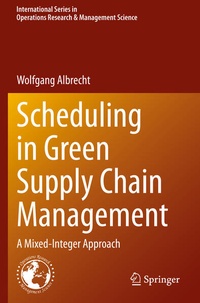
Scheduling in Green Supply Chain Management
A Mixed-Integer Approach
Published on 2. April 2022
Book
Paperback/Softback
XXV, 169 pages
978-3-030-67480-9 (ISBN)
Description
This book presents scheduling with a medium- and short-term focus, which makes it possible to capitalize on fleeting market opportunities while simultaneously working to reconcile economic and environmental priorities. It introduces a new mixed-integer approach to hierarchical discrete-time and continuous-time scheduling, combining aspects of production and recycling, forward and reverse logistics as well as emissions trading for multi-stage supply chain networks. Problem-specific variants of relax-and-fix heuristics and genetic algorithms are also proposed. Given its scope, the book provides a range of practical tools and new perspectives for researchers and professionals in the field of supply chain management.
More details
Series
Edition
2021 ed.
Language
English
Place of publication
Cham
Switzerland
Publishing group
Springer International Publishing
Target group
Professional and scholarly
Illustrations
4 farbige Abbildungen, 12 s/w Abbildungen
XXV, 169 p. 16 illus., 4 illus. in color.
Dimensions
Height: 235 mm
Width: 155 mm
Thickness: 11 mm
Weight
306 gr
ISBN-13
978-3-030-67480-9 (9783030674809)
DOI
10.1007/978-3-030-67478-6
Schweitzer Classification
Other editions
Additional editions
Book
04/2021
Springer
€149.79
Shipment within 7-9 days
Person
Dr. Wolfgang Albrecht researches and lectures in business administration. He received his doctorate in 2014 and completed his postdoctoral degree (habilitation) in 2020 at the Faculty of Law and Economics, University of Greifswald (Germany). His research interests include production, logistics and supply chain management.
Content
1. Introduction.- 2. Scheduling in Supply Chain Management.- 3. Green Supply Chain Management.- 4. Literature Review.- 5. Discrete-Time Scheduling in Green Supply Chain Management.- 6. Continuous-Time Scheduling in Green Supply Chain Management.- 7. Summary and Conclusions.