

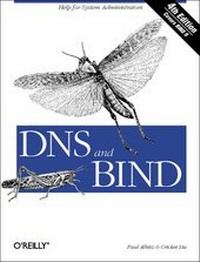
DNS and BIND
4th Edition
Published on 22. May 2001
Book
620 pages
978-0-596-00158-2 (ISBN)
Description
"DNS and BIND" is about one of the Internet's fundamental building blocks: the distributed host information database that's responsible for translating names into addresses, routing mail to its proper destination, and many other services. As the authors say in the preface, if you're using the Internet, you're already using DNS - even if you don't know it. This edition covers the 9.1.0 and 8.2.3 versions of BIND along with the older 4.9 version. There's also more extensive coverage of NOTIFY, IPv6 forward and reverse mapping, transaction signatures, and the new DNS Security Extensions; and a new section on accommodating Windows 2000 clients, servers and Domain Controllers. Whether you're an administrator involved daily with DNS or a user who wants to be more informed about the Internet and how it works, the book should be of interest.
Topics include: what DNS does, how it works, and when you need to use it; how to find your own place in the Internet's name space; setting up name servers; using MX records to route mail; configuring hosts to use DNS name servers; subdividing domains (parenting); securing your name server: restricting who can query your server, preventing unauthorized zone transfers, avoiding bogus name servers, and so on; mapping one name to several servers for load sharing; troubleshooting: using nslookup, reading debugging output, common problems; and DNS programming, using the resolver library and Perl's Net::DNS module.
Topics include: what DNS does, how it works, and when you need to use it; how to find your own place in the Internet's name space; setting up name servers; using MX records to route mail; configuring hosts to use DNS name servers; subdividing domains (parenting); securing your name server: restricting who can query your server, preventing unauthorized zone transfers, avoiding bogus name servers, and so on; mapping one name to several servers for load sharing; troubleshooting: using nslookup, reading debugging output, common problems; and DNS programming, using the resolver library and Perl's Net::DNS module.
Reviews / Votes
'Now into its fourth edition, updated to cover BIND 9, the O'Reilly textbook has already attained classic status. DNS and BIND can be found on the shelf, or more likely open on the desk, of most clued-up system administrators... Don't expect a fun read ... the subject matter is a little dry for that ... but if you like your Unix and want to truly understand how DNS works in general and in practice within your enterprise, this is the book to buy.' - Davey Winder, PC PRO, September 'This book has been the bible for DNS administration since 1992. .. I can't fault this new edition of the book. The first edition serve me well when I was setting up my first DNS server. The book still achieves what it sets out to do, and explains DNS and BIND. This has got more complicated (sorry, feature rich!) over the years, but this book still explains it in clear terms. O'Reilly rightly made their name through publishing titles like this.' - Joel Smith, new@UK, December 2001 'This book is as useful now as it was back in the mid 90's. Buy it if you have to do any more than be a simple user of DNS. As a measure of how times change, the appendices no longer show you how to compile and install BIND on a Sun operating system, it is now shown with Linux.' - Raza Rizvi, new@UK, December 2001More details
Edition
4., Aufl.
Language
English
Place of publication
Sebastopol
United States
Target group
College/higher education
Professional and scholarly
Edition type
Revised edition
Illustrations
index
Dimensions
Height: 233 mm
Width: 178 mm
Weight
885 gr
ISBN-13
978-0-596-00158-2 (9780596001582)
Schweitzer Classification
Other editions
New editions
Book
07/2006
1st Edition
O'Reilly
€60.00
Shipment within 10-20 days
Previous edition
Paul Albitz | Liu Cricket
DNS and BIND
Book
12/1998
3rd Edition
O'Reilly
€32.00
Article exhausted; check for reprint
Persons
Paul Albitz is a software engineer at HewlettPackard. Paul earned a bachelor of science degree from the University of Wisconsin, LaCrosse, and a master of science degree from Purdue University. Paul worked on BIND for the HPUX 7.0 and 8.0 releases. During this time he developed the tools used to run the hp.com domain. Since then Paul has worked on networking HP's DesignJet plotter and on the fax subsystem of HP's OfficeJet multifunction peripheral. Before joining HP, Paul was a system administrator in the CS Department of Purdue University. As system administrator, Paul ran versions of BIND before BIND's initial release with 4.3 BSD. Paul and his wife Katherine live in San Diego, CA. Cricket Liu matriculated at the University of California's Berkeley campus, that great bastion of free speech, unencumbered Unix and cheap pizza. He went to work for HewlettPackard after graduation and stayed at HP for nine years. Cricket began managing the hp.com zone after the Loma Prieta earthquake forcibly moved the zone's management from HP Labs to HP's Corporate Offices. He was hostmaster@hp.com for over three years, and then joined HP's Professional Services Organization to found HP's Internet consulting program. Cricket, his wife, Paige, and their son, Walt, live in Colorado with two Siberian Huskies, Annie and Dakota. On warm weekends, you'll probably find them on the flying trapeze.
Content
Preface 1. Background A (Very) Brief History of the Internet On the Internet and internets The Domain Name System in a Nutshell The History of BIND Must I Use DNS? 2. How Does DNS Work? The Domain Name Space The Internet Domain Name Space Delegation Name Servers and Zones Resolvers Resolution Caching 3. Where Do I Start? Getting BIND Choosing a Domain Name 4. Setting Up BIND Our Zone Setting Up Zone Data Setting Up a BIND Configuration File Abbreviations Host Name Checking (BIND 4.9.4 and Later Versions) Tools Running a Primary Master Name Server Running a Slave Name Server Adding More Zones What Next? 5. DNS and Electronic Mail MX Records What's a Mail Exchanger, Again? The MX Algorithm 6. Configuring Hosts The Resolver Sample Resolver Configurations Minimizing Pain and Suffering Vendor Specific Options 7. Maintaining BIND Controlling the Name Server Updating Zone Data Files Organizing Your Files Changing System File Locations in BIND 8 and 9 Logging in BIND 8 and 9 Keeping Everything Running Smoothly 8. Growing Your Domain How Many Name Servers? Adding More Name Servers Registering Name Servers Changing TTLs Planning for Disasters Coping with Disaster 9. Parenting When to Become a Parent How Many Children? What to Name Your Children How to Become a Parent: Creating Subdomains Subdomains of inaddr.arpa Domains Good Parenting Managing the Transition to Subdomains The Life of a Parent 10. Advanced Features Address Match Lists and ACLs DNS Dynamic Update DNS NOTIFY (Zone Change Notification) Incremental Zone Transfer (IXFR) Forwarding Views Round Robin Load Distribution Name Server Address Sorting Preferring Name Servers on Certain Networks A Nonrecursive Name Server Avoiding a Bogus Name Server System Tuning Compatibility The ABCs of IPv6 Addressing Addresses and Ports IPv6 Forward and Reverse Mapping 11. Security TSIG Securing Your Name Server DNS and Internet Firewalls The DNS Security Extensions 12. nslookup and dig Is nslookup a Good Tool? Interactive Versus Noninteractive Option Settings Avoiding the Search List Common Tasks Less Common Tasks Troubleshooting nslookup Problems Best of the Net Using dig 13. Reading BIND Debugging Output Debugging Levels Turning On Debugging Reading Debugging Output The Resolver Search Algorithm and Negative Caching (BIND 8) The Resolver Search Algorithm and Negative Caching (BIND 9) Tools 14. Troubleshooting DNS and BIND Is NIS Really Your Problem? Troubleshooting Tools and Techniques Potential Problem List Transition Problems Interoperability and Version Problems TSIG Errors Problem Symptoms 15. Programming with the Resolver and Name Server Library Routines Shell Script Programming with nslookup C Programming with the Resolver Library Routines Perl Programming with Net::DNS 16. Miscellaneous Using CNAME Records Wildcards A Limitation of MX Records Dialup Connections Network Names and Numbers Additional Resource Records DNS and WINS DNS and Windows 2000 A. DNS Message Format and Resource Records B. BIND Compatibility Matrix C. Compiling and Installing BIND on Linux D. TopLevel Domains E. BIND Name Server and Resolver Configuration Index