

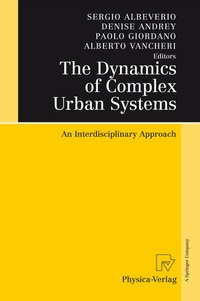
The Dynamics of Complex Urban Systems
An Interdisciplinary Approach
Published on 11. October 2007
Book
Hardback
XX, 484 pages
978-3-7908-1936-6 (ISBN)
Description
In recent years it has become increasingly clear that the dynamics of cities can be best captured by looking at them as complex systems governed by many degrees of freedom, interacting on different space and time scales in a non-linear fashion. The evolution of cities is shaped by internal factors, e. g. decisions taken by ins- tutions and individuals, external causes (international economic context) and by social development. The underlying processes can be slow or fast, acting locally or globally. At a different level, both European cities and megacities are magnets for immigrants (e. g. countries, which have major economical and political pr- lems), leading often to phenomena like marginalization or even ghettization and segregation. They are also hotbeds of economic, political and cultural activity, giving rise, among other things, to relocation and conversion of industries, - valuation of land, and development of new services. These phenomena as quali- tive changes, are opposed to purely quantitative growth processes. They are far from being fully understood, nor they are captured in validated and complete - ban models. For most of urban theory hitherto has been based on the assumption of slowly varying spatial and social structures. Only recently, these assumptions have been questioned, giving rise to models employing dissipative dynamics, s- chastic cellular automata and multi-agent models, fractal geometry, and evoluti- ary change models, and to further mathematically oriented approaches.
Reviews / Votes
From the reviews: "'The Dynamics of Complex Urban Systems' is about . new kind of science, and how we might use it to improve our understanding of urban growth and change. . the collection is an excellent combination of model-oriented discussions, relevant data issues and various case studies involving interactions with urban planners. . it provides a collection of starting points for researchers who are seriously interested in applying some of the toolkit of complex systems science to study the possible evolution of urban form." (David F. Batten, Papers in Regional Science, Vol. 87 (4), November, 2008)More details
Edition
2008 ed.
Language
English
Place of publication
Heidelberg
Germany
Target group
Professional and scholarly
Research
Illustrations
190 s/w Abbildungen
XX, 484 p. 190 illus.
Dimensions
Height: 241 mm
Width: 160 mm
Thickness: 32 mm
Weight
922 gr
ISBN-13
978-3-7908-1936-6 (9783790819366)
DOI
10.1007/978-3-7908-1937-3
Schweitzer Classification
Other editions
Additional editions
Sergio Albeverio | Denise Andrey | Paolo Giordano
The Dynamics of Complex Urban Systems
An Interdisciplinary Approach
Book
10/2010
Physica
€106.99
Shipment within 10-15 days
Sergio Albeverio | Denise Andrey | Paolo Giordano
The Dynamics of Complex Urban Systems
An Interdisciplinary Approach
E-Book
10/2007
1st Edition
Physica
€96.29
Available for download
Content
Fifty Years of Urban Modeling: Macro-Statics to Micro-Dynamics.- Complexity: the Integrating Framework for Models of Urban and Regional Systems.- Ontogeny and Ontology in Complex Systems Modeling.- A Model for Asystematic Mobility in Urban Space.- Preliminary Results of a Multi-Agent Traffic Simulation for Berlin.- Hybrid Geographical Models of Urban Spatial Structure and Behaviour.- Two Complexities and a Few Models.- Cities as Evolutionary Systems in Random Media.- Grilling the Grid: a Non-Ultimate (Nor Objective) Report on the Configurational Approach to Urban Phenomena.- Validating and Calibrating Integrated Cellular Automata Based Models of Land Use Change.- Fractal Geometry for Measuring and Modelling Urban Patterns.- The Dynamics of Complex Urban Systems: Theory and Application of the STASA-Model within the Scatter Project.- Study of Urban Developers' Behavior in a Game Environment.- Self-Organization and Optimization of Pedestrian and Vehicle Traffic in Urban Environments.- Multidimensional Events in Multilevel Systems.- The Simulation of Spatial Change: What Relation Between Knowledge and Modeling? A Proposal and Its Application.- A Structural-Cognitive Approach to Urban Simulation Models.- The Socio-Spatial Dynamics of Systems of Cities and Innovation Processes: a Multi-Level Model.- The Great Return of Large Scale Urban Models: Revival or "Renaissance"?.- The Multi-Agent Simulation of the Economic and Spatial Dynamics of a Poli-Nucleated Urban Area.- Modelling the Micro-Dynamics of Urban Systems with Continuum Valued Cellular Automata.- Multiplicative Processes and City Sizes.