

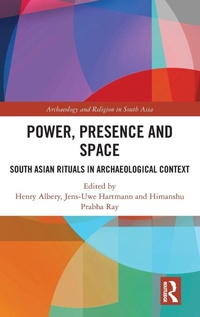
Power, Presence and Space
South Asian Rituals in Archaeological Context
1st Edition
Published on 27. July 2020
Book
Hardback
312 pages
978-0-367-13396-2 (ISBN)
Description
Patterns of ritual power, presence, and space are fundamentally connected to, and mirror, the societal and political power structures in which they are enacted.
This book explores these connections in South Asia from the early Common Era until the present day. The essays in the volume examine a wide range of themes, including a genealogy of ideas concerning Vedic rituals in European thought; Buddhist donative rituals of Gandhara and Andhra Pradesh in the early Common Era; land endowments, festivals, and temple establishments in medieval Tamil Nadu and Karnataka; Mughal court rituals of the Mughal Empire; and contemporary ritual complexes on the Nilgiri Plateau. This volume argues for the need to redress a historical neglect in identifying and theorising ritual and religion in material contexts within archaeology. Further, it challenges existing theoretical and methodological forms of documentation to propose new ways of understanding rituals in history.
This volume will be of great interest to scholars and researchers of South Asian history, religion, archaeology, and historical geography.
This book explores these connections in South Asia from the early Common Era until the present day. The essays in the volume examine a wide range of themes, including a genealogy of ideas concerning Vedic rituals in European thought; Buddhist donative rituals of Gandhara and Andhra Pradesh in the early Common Era; land endowments, festivals, and temple establishments in medieval Tamil Nadu and Karnataka; Mughal court rituals of the Mughal Empire; and contemporary ritual complexes on the Nilgiri Plateau. This volume argues for the need to redress a historical neglect in identifying and theorising ritual and religion in material contexts within archaeology. Further, it challenges existing theoretical and methodological forms of documentation to propose new ways of understanding rituals in history.
This volume will be of great interest to scholars and researchers of South Asian history, religion, archaeology, and historical geography.
More details
Series
Language
English
Place of publication
London
United Kingdom
Publishing group
Taylor & Francis Ltd
Target group
College/higher education
Illustrations
51 s/w Abbildungen, 37 s/w Photographien bzw. Rasterbilder, 14 s/w Zeichnungen, 3 s/w Tabellen
3 Tables, black and white; 14 Line drawings, black and white; 37 Halftones, black and white; 51 Illustrations, black and white
Dimensions
Height: 240 mm
Width: 161 mm
Thickness: 21 mm
Weight
637 gr
ISBN-13
978-0-367-13396-2 (9780367133962)
Copyright in bibliographic data and cover images is held by Nielsen Book Services Limited or by the publishers or by their respective licensors: all rights reserved.
Schweitzer Classification
Other editions
Additional editions
Henry Albery | Jens-Uwe Hartmann | Himanshu Prabha Ray
Power, Presence and Space
South Asian Rituals in Archaeological Context
Book
09/2023
1st Edition
Routledge India
€68.60
Shipment within 15-20 days
Henry Albery | Jens-Uwe Hartmann | Himanshu Prabha Ray
Power, Presence and Space
South Asian Rituals in Archaeological Context
E-Book
07/2020
1st Edition
Routledge India
€61.99
Available for download
Henry Albery | Jens-Uwe Hartmann | Himanshu Prabha Ray
Power, Presence and Space
South Asian Rituals in Archaeological Context
E-Book
07/2020
1st Edition
Routledge India
€61.99
Available for download
Persons
Henry Albery has been a Postdoctoral Fellow at the Distant Worlds Graduate School, Muenchner Zentrum fuer Antike Welten, at Ludwig-Maximilians-Universitaet, Muenchen, Germnay, since 2018, where a year prior he completed his doctoral thesis in Indologie und Religionswissenschaft. His research is primarily concerned with a social and political history of Buddhism in the north and nortwesterly regions of South Asia in the early Common Era, focusing foremost on donative inscriptions in Brahmi and Kharo??hi and on Buddhist legal and narrative literature in Chinese, Gandhari, Pali and Sanskrit. He is also a member of the collaborative project, 'An English Translation of a Sanskrit Buddhist Yoga Manual' from Kuca, funded by The Robert H. N. Ho Family Foundation Grants for Critical Editions and Scholarly Translations, 2018.
Jens-Uwe Hartmann is former Professor of Indology at the University of Munich, Germany. After studying in Munich and Goettingen he held the post of Professor of Tibetology at Humboldt University in Berlin before returning to Munich in 1999. In 2001, he became a full member of the Bavarian Academy of Sciences, and a corresponding member of the Austrian Academy of Sciences in 2007. He has held visiting appointments at the College de France in Paris (2001 and 2004), the Centre for Advanced Study of the Norwegian Academy of Sciences in Oslo (2001-2002), the International College for Advanced Buddhist Studies in Tokyo (2002), the Soka University in Tokyo (2003), the UC Berkeley (2010) and the University of Stanford (2017).
His research centres on the recovery and reconstruction of Indian Buddhist literature on the basis of Indic manuscripts as well as translations into Chinese and Tibetan with a focus on canonical texts and works of poetry. His various authored and coedited works include an edition of the Var?arhavar?astotra of Mat?ce?a (1987), a study of the Dirghagama of the Sarvastivadins (1992), the series Buddhist Manuscripts devoted to the publication of ancient Indic manuscripts from Afghanistan (2000, 2002, 2006, 2016), and From Birch Bark to Digital Data: Recent Advances in Buddhist Manuscript Research (2014).
Himanshu Prabha Ray is Research Fellow, Oxford Centre for Hindu Studies, Oxford, UK. She was the first Chairperson of the National Monuments Authority, Ministry of Culture in New Delhi, India from 2012 to 2015, and former Professor in the Centre for Historical Studies, Jawaharlal Nehru University in New Delhi, India. Her research interests include Maritime History and Archaeology of the Indian Ocean, the History of Archaeology in South and Southeast Asia and the Archaeology of Religion in Asia. Her recent books include Archaeology and Buddhism in South Asia (2018), Buddhism and Gandhara: An Archaeology of Museum Collections (ed. 2018), The Archaeology of Sacred Spaces: The Temple in Western India,2nd Century BCE to 8th Century CE (with Susan Verma Mishra, 2017), The Return of the Buddha: Ancient Symbols for a New Nation (2014) and The Archaeology of Seafaring in Ancient South Asia, (2003).
Jens-Uwe Hartmann is former Professor of Indology at the University of Munich, Germany. After studying in Munich and Goettingen he held the post of Professor of Tibetology at Humboldt University in Berlin before returning to Munich in 1999. In 2001, he became a full member of the Bavarian Academy of Sciences, and a corresponding member of the Austrian Academy of Sciences in 2007. He has held visiting appointments at the College de France in Paris (2001 and 2004), the Centre for Advanced Study of the Norwegian Academy of Sciences in Oslo (2001-2002), the International College for Advanced Buddhist Studies in Tokyo (2002), the Soka University in Tokyo (2003), the UC Berkeley (2010) and the University of Stanford (2017).
His research centres on the recovery and reconstruction of Indian Buddhist literature on the basis of Indic manuscripts as well as translations into Chinese and Tibetan with a focus on canonical texts and works of poetry. His various authored and coedited works include an edition of the Var?arhavar?astotra of Mat?ce?a (1987), a study of the Dirghagama of the Sarvastivadins (1992), the series Buddhist Manuscripts devoted to the publication of ancient Indic manuscripts from Afghanistan (2000, 2002, 2006, 2016), and From Birch Bark to Digital Data: Recent Advances in Buddhist Manuscript Research (2014).
Himanshu Prabha Ray is Research Fellow, Oxford Centre for Hindu Studies, Oxford, UK. She was the first Chairperson of the National Monuments Authority, Ministry of Culture in New Delhi, India from 2012 to 2015, and former Professor in the Centre for Historical Studies, Jawaharlal Nehru University in New Delhi, India. Her research interests include Maritime History and Archaeology of the Indian Ocean, the History of Archaeology in South and Southeast Asia and the Archaeology of Religion in Asia. Her recent books include Archaeology and Buddhism in South Asia (2018), Buddhism and Gandhara: An Archaeology of Museum Collections (ed. 2018), The Archaeology of Sacred Spaces: The Temple in Western India,2nd Century BCE to 8th Century CE (with Susan Verma Mishra, 2017), The Return of the Buddha: Ancient Symbols for a New Nation (2014) and The Archaeology of Seafaring in Ancient South Asia, (2003).
Content
Introduction: The Archaeology of Ritual in South Asian Contexts Part I: Power 1. Imagining Sacrifice in Ancient India: A Genealogy of Heesterman's 'Broken World' 2. Rituals of Power: Coinage, Court Culture and Kingship under the Great Mughals 3. Ritual as Performed Constitutions-Badagas in the Nilgiris District Part II: Presence 4. Codified Relic Theft and Buddhist Propaganda: (Re)-Dedicating the Buddha's Relics in the Indic Northwest 5. Naming Rituals and Sharing Power in the Time and Space of the Tamil Temple 6. Power, Processions and the Festival Architecture of the Tamil temple Part III: Space 7. Money for Rituals: Ak?ayanivi and Related Inscriptions from Andhradesa 8 Neither Cave nor Temple: Expressions of Power and Divinity in the Rock-Reliefs at Badami 9. Ritualising Land and Cultivating Distinctions: Medieval Period Donative Practices, and a Political Ecology of the Raichur Doab 10. Sacred Frames: Knowledge, Culture and Ritual Agency in Ancient Talukas of Karnataka (Late 10th-12th centuries)