

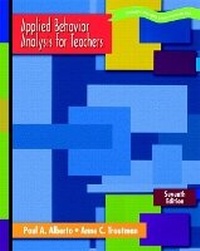
Applied Behavior Analysis for Teachers
7th Edition
Published on 21. July 2005
Book
Paperback/Softback
496 pages
978-0-13-117994-3 (ISBN)
Description
For courses in Applied Behavior Analysis, Behavior Management and Behavior Modification.
Scholarly and empirically based, this market-leading text gives students what they need to understand using the principles and practices of applied behavioral management in the classroom. The content is presented clearly, in a friendly, accessible-even fun-manner. This edition has been shortened and streamlined and chapters flow step-by-step through an actual behavior analysis, using classroom-based examples and practices firmly grounded in research. Content is presented in the order of decision-making by: 1) a teacher who has a student exhibiting challenging behavior in class; or, 2) a student who needs to execute a behavior-change project. The text covers: identifying target behavior, collecting and graphing data, functional assessment, experimental design, arranging antecedents and consequences, generalizing behavior change and discusses the importance of ethical considerations in using applied behavior analysis in the classroom.
The seventh edition is improved with the addition of more multicultural considerations, a stronger emphasis on technology, a discussion on the Board Certified Behavior Analysis (BCBA), more enhanced pedagogy, and a robust Companion Website.
Scholarly and empirically based, this market-leading text gives students what they need to understand using the principles and practices of applied behavioral management in the classroom. The content is presented clearly, in a friendly, accessible-even fun-manner. This edition has been shortened and streamlined and chapters flow step-by-step through an actual behavior analysis, using classroom-based examples and practices firmly grounded in research. Content is presented in the order of decision-making by: 1) a teacher who has a student exhibiting challenging behavior in class; or, 2) a student who needs to execute a behavior-change project. The text covers: identifying target behavior, collecting and graphing data, functional assessment, experimental design, arranging antecedents and consequences, generalizing behavior change and discusses the importance of ethical considerations in using applied behavior analysis in the classroom.
The seventh edition is improved with the addition of more multicultural considerations, a stronger emphasis on technology, a discussion on the Board Certified Behavior Analysis (BCBA), more enhanced pedagogy, and a robust Companion Website.
More details
Edition
7th edition
Language
English
Place of publication
United States
Publishing group
Pearson Education (US)
Target group
Professional and scholarly
Dimensions
Height: 253 mm
Width: 201 mm
Thickness: 18 mm
Weight
871 gr
ISBN-13
978-0-13-117994-3 (9780131179943)
Copyright in bibliographic data and cover images is held by Nielsen Book Services Limited or by the publishers or by their respective licensors: all rights reserved.
Schweitzer Classification
Other editions
New editions
Book
09/2008
8th Edition
Pearson
€94.08
Article exhausted; check for reprint
Previous edition
Paul A. Alberto | Anne C. Troutman
Applied Behavior Analysis for Teachers
Book
07/2002
6th Edition
Pearson
€53.22
Article exhausted; check for reprint
Content
1. ROOTS OF APPLIED BEHAVIOR ANALYSIS
2. PREPARING BEHAVIORAL OBJECTIVES
3. PROCEDURES FOR COLLECTING DATA
4. GRAPHING DATA
5. SINGLE-SUBJECT DESIGNS
6. DEVELOPING A HYPOTHESIS FOR BEHAVIOR CHANGE: FUNCTIONAL ASSESSMENT AND FUNCTIONAL ANALYSIS
7. ARRANGING CONSEQUENCES THAT INCREASE BEHAVIOR
8. ARRANGING CONSEQUENCES THAT DECREASE BEHAVIOR
9. DIFFERENTIAL REINFORCEMENT: STIMULUS CONTROL AND SHAPING
10. PROVIDING FOR GENERALIZATION OF BEHAVIOR CHANGE
11. TEACHING STUDENTS TO MANAGE THEIR OWN BEHAVIOR
12. RESPONSIBLE USE OF APPLIED BEHAVIOR ANALYSIS PROCEDURES
13. PUTTING IT ALL TOGETHER
APPENDIX
GLOSSARY
AUTHOR INDEX
SUBJECT INDEX
2. PREPARING BEHAVIORAL OBJECTIVES
3. PROCEDURES FOR COLLECTING DATA
4. GRAPHING DATA
5. SINGLE-SUBJECT DESIGNS
6. DEVELOPING A HYPOTHESIS FOR BEHAVIOR CHANGE: FUNCTIONAL ASSESSMENT AND FUNCTIONAL ANALYSIS
7. ARRANGING CONSEQUENCES THAT INCREASE BEHAVIOR
8. ARRANGING CONSEQUENCES THAT DECREASE BEHAVIOR
9. DIFFERENTIAL REINFORCEMENT: STIMULUS CONTROL AND SHAPING
10. PROVIDING FOR GENERALIZATION OF BEHAVIOR CHANGE
11. TEACHING STUDENTS TO MANAGE THEIR OWN BEHAVIOR
12. RESPONSIBLE USE OF APPLIED BEHAVIOR ANALYSIS PROCEDURES
13. PUTTING IT ALL TOGETHER
APPENDIX
GLOSSARY
AUTHOR INDEX
SUBJECT INDEX