

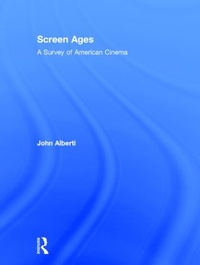
Screen Ages
A Survey of American Cinema
1st Edition
Published on 9. February 2015
Book
Hardback
318 pages
978-0-415-53551-9 (ISBN)
Description
Screen Ages is a valuable guide for students exploring the complex and vibrant history of US cinema and showing how this film culture has grown, changed and developed.
Covering key periods from across American cinema history, John Alberti explores the social, technological and political forces that have shaped cinematic output and the varied impacts cinema of on US society.
Each chapter has a series of illuminating key features, including:
'Now Playing', focusing on films as cinematic events, from The Birth of a Nation to Gone with the Wind to Titanic, to place the reader in the social context of those viewing the films for the first time
'In Development', exploring changing genres, from the melodrama to the contemporary super hero movies,
'The Names Above and Below the Title', portraying the impact and legacy of central figures, including Florence Lawrence, Orson Welles and Wes Anderson
Case studies, analyzing key elements of films in more depth
Glossary terms featured throughout the text, to aid non-specialist students and expand the readers understanding of changing screen cultures.
Screen Ages illustrates how the history of US cinema has always been and continues to be one of multiple screens, audiences, venues, and markets. It is an essential text for all those wanting to understand of power of American cinema throughout history and the challenges for its future.
The book is also supported by a companion website, featuring additional case studies, an interactive blog, a quiz bank for each chapter and an online chapter, 'Screen Ages Today' that will be updated to discuss the latest developments in American cinema.
Covering key periods from across American cinema history, John Alberti explores the social, technological and political forces that have shaped cinematic output and the varied impacts cinema of on US society.
Each chapter has a series of illuminating key features, including:
'Now Playing', focusing on films as cinematic events, from The Birth of a Nation to Gone with the Wind to Titanic, to place the reader in the social context of those viewing the films for the first time
'In Development', exploring changing genres, from the melodrama to the contemporary super hero movies,
'The Names Above and Below the Title', portraying the impact and legacy of central figures, including Florence Lawrence, Orson Welles and Wes Anderson
Case studies, analyzing key elements of films in more depth
Glossary terms featured throughout the text, to aid non-specialist students and expand the readers understanding of changing screen cultures.
Screen Ages illustrates how the history of US cinema has always been and continues to be one of multiple screens, audiences, venues, and markets. It is an essential text for all those wanting to understand of power of American cinema throughout history and the challenges for its future.
The book is also supported by a companion website, featuring additional case studies, an interactive blog, a quiz bank for each chapter and an online chapter, 'Screen Ages Today' that will be updated to discuss the latest developments in American cinema.
Reviews / Votes
'An interesting, comprehensive, and up-to-date history of the US cinema industry. Screen Ages betrays our dependence on glossy overviews and simple narratives. The history of American cinema is far more varied, interesting, and complex than commonly recognized, and the careful work of John Alberti successfully reveals the richness of our shared Hollywood heritage. From the silver screen to our smartphones, movies continue to be a significant aspect of the modern American experience. Screen Ages traces the intriguing and often unrecognized history of the evolution of US cinema and show how this profoundly important medium matters amidst larger structures of social change.' Gerardo Marti, L Richardson King Associate Professor of Sociology at Davidson College and author of Hollywood Faith: Holiness, Prosperity, and Ambition in a Los Angeles Church'Screen Ages acknowledges that the reason we study film is because, first and foremost, we love to watch movies. John Alberti has contextualized the history of cinema within that frame, which is always simultaneously about the craft of making movies and the pleasure of watching them. This text is exceptionally well suited to student learning because Alberti makes it relevant for them, connecting the past to the present in creative ways-for example, linking the Kinetoscope to YouTube. An especially valuable and unique feature of this text is its exploration of gender genres across time, which shows how the changing nature of gender roles have been at times challenged and at others reinforced by movies and moviegoing in American culture. Furthermore, Alberti's inclusion of women in film from Alice Guy-Blache to Lena Dunham offers a more diverse analysis of filmmaking than other textbooks. Screen Ages is comprehensive in its coverage of the history of cinema, accessible in its clear design and approachable style, and a genuine contribution the field.' Laura Mattoon D'Amore, Assistant Professor of American Studies, Roger Williams University and editor of Smart Chicks on Screen: Representing Women's Intellect in Film and Television.
'John Alberti's Screen Ages: A Survey of American Cinema should work well with traditional College age students as well as adults in introductory courses in American cinema. The text is interesting, easy to read, not overly detailed, and it regularly draws connections between past and present developments, practices, characters, storylines and images. Each historical period is given roughly equal treatment as appropriate for a survey text. Clear and telling examples are used to illustrate changes in popular genres that reflect changes in society. Economic and technical topics are explained well. There is much throughout the text to spark productive questions and discussion.' Walter Skiba, Associate Professor of Media and Fine Arts Calumet College of St. Joseph Whating, Indiana
'An interesting and innovative handbook of genuine value to a wide range of readers and students.' Oliver Harris, Professor of American Literature, Keele University, UK
More details
Language
English
Place of publication
London
United Kingdom
Publishing group
Taylor & Francis Ltd
Target group
College/higher education
Illustrations
224 Farbfotos bzw. farbige Rasterbilder
224 Halftones, color
Dimensions
Height: 254 mm
Width: 191 mm
Weight
907 gr
ISBN-13
978-0-415-53551-9 (9780415535519)
Copyright in bibliographic data and cover images is held by Nielsen Book Services Limited or by the publishers or by their respective licensors: all rights reserved.
Schweitzer Classification
Other editions
Additional editions
Book
02/2015
1st Edition
Routledge
€111.74
Shipment within 15-20 days
E-Book
11/2014
1st Edition
Routledge
€103.99
Available for download
E-Book
11/2014
1st Edition
Routledge
€103.99
Available for download
Person
John Alberti is Director of Graduate Studies and Director of Cinema Studies in the Department of English at Northern Kentucky University, USA. His previous books included The Working Life: Readings on Work, Labor, and Career, Leaving Springfield: The Simpsons and the Possibilities of Oppositional Culture, and The Canon in the Classroom: Pedagogical Implications of Canon Revision in American Literature.
Content
Introduction: Hollywood in the Screen Ages 1. Beginnings: Multiple Cinemas, Multiple Audiences, 1895-1907 2. Becoming "The Movies": The Nickelodeon Age, 1908-1915 3. Movie Palaces, Corner Theaters, and Tent Shows: The Silent Era and the First Hollywood, 1915-1928 4. The Studios Era: Dominance and Diversity in the Golden Age of Hollywood, 1929-1948 5. Theatres, Drive-Ins, and Living Rooms: Changing Screens, Changing Movies, 1949-1966 6. Movies Big and Small: Art Movies, Blockbusters, and the New Hollywood, 1967-1980 7. Shopping Malls, Video Stores, and Cable TV: Movies in the Franchise Era, 1981-1997 8. The Digital Era: Back to the Future, 1994-Present