

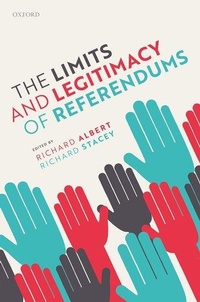
The Limits and Legitimacy of Referendums
Published on 10. May 2022
Book
Hardback
320 pages
978-0-19-886764-7 (ISBN)
Description
The possibility of democracy-enhancing uses and anti-democratic abuses of referendums reveals a paradox: mechanisms of democracy can be exploited to do violence to the basic principles of democracy. The Limits and Legitimacy of Referendums seeks to identify standards we might use to assess the democratic legitimacy of a referendum when we cannot rely on the norms of traditional liberal democracy.
This innovative book explores how referendums manage the tension between liberalism and democracy, and whether this device holds promise for reconciling these two commitments. A range of scholars from around the world expose how referendums may be abused on one hand to achieve short-term political or even personal gains, and how, on the other, they may aspire to reflect the best traditions of deliberative, innovative, democracy-enhancing popular decision-making.
Structured around three big questions, this book seeks to identify what makes a referendum legitimate. First, why have referendums on issues of fundamental political importance become so frequent around the world? Second, who are - or who should be - the people that make decisions about a political community's future? And third, are referendums an effective and reliable mechanism of popular sovereignty or democratic choice?
These essays - written for scholars, public lawyers, political actors and citizens - bring together diverse perspectives on referendums, constitutionalism, liberalism and democracy in ways that challenge the conventional wisdom, prompt new answers to enduring questions, and urge reconsideration of how we evaluate the legitimacy of referendums.
This innovative book explores how referendums manage the tension between liberalism and democracy, and whether this device holds promise for reconciling these two commitments. A range of scholars from around the world expose how referendums may be abused on one hand to achieve short-term political or even personal gains, and how, on the other, they may aspire to reflect the best traditions of deliberative, innovative, democracy-enhancing popular decision-making.
Structured around three big questions, this book seeks to identify what makes a referendum legitimate. First, why have referendums on issues of fundamental political importance become so frequent around the world? Second, who are - or who should be - the people that make decisions about a political community's future? And third, are referendums an effective and reliable mechanism of popular sovereignty or democratic choice?
These essays - written for scholars, public lawyers, political actors and citizens - bring together diverse perspectives on referendums, constitutionalism, liberalism and democracy in ways that challenge the conventional wisdom, prompt new answers to enduring questions, and urge reconsideration of how we evaluate the legitimacy of referendums.
Reviews / Votes
We need to try to better understand referendums, to think more deeply about them, and to design and deploy them more appropriately. And Albert and Stacey's volume makes a huge contribution to those ends. * Tom Hickey and Sean Rainford, School of Law and Government, Dublin City Univeristy15., 68 Irish Jurist * A first-rate, thoughtfully curated collection of essays concerning one of the most critical questions in contemporary constitutional theory: the fraught relations between popular sovereignty and the legitimacy of constitutional (and political) change. An invaluable source of fresh insights, made all the more pertinent in the current age of democratic backsliding and constitutional retrogression. * Ran Hirschl, Professor of Government & Earl E. Sheffield Regents Chair in Law, The University of Texas at Austin * Democracy in recent years has taken a participatory turn: in a range of settings, we now see democracy as involving direct popular participation, not just elite deliberation. Hence the rise of plebiscites and referenda as part of the process of formal constitutional change. In this important new volume, Richard Albert and Richard Stacey take stock of this development, and situate it in the context of broader shifts in our approach to liberalism, democracy and popular sovereignty. They also bring together an all-star cast of comparative scholars to study "referendum's moment" in a range of contexts - including Catalonia, Colombia, Ireland, the UK and the post-Soviet world, and broader federal and post-colonial contexts. It is worthy of close attention by all those interested in democracy and constitutionalism in the modern age. * Rosalind Dixon, Professor of Law, University of New South Wales * Richard Albert and Richard Stacey tackle an exceptionally difficult question in their excellent edited volume, The Limits and Legitimacy of Referendums: How can we understand referendums to mediate-or exacerbate-the tensions between liberalism and democracy? Through theory, typology, individual case studies, and quantitative analysis, this volume brings multiple methodologies to bear in crafting its answers. A wide-ranging and important work, this collection addresses the challenges of the who, what, and when of referendums, and further outlines a research agenda for those contemplating design. Constitutional scholars and both constitutional and legislative drafters will benefit from close attention to the book's significant insights. * Erin F. Delaney, Professor of Law, Northwestern University * In an era when the context within which self-governing democratic societies function is itself being reworked by transnational players and intrusive technologies, twelve scholars share the heavy-lifting to demonstrate how ballot questions remain uniquely relevant instruments in a democrat's toolbox. Rigorous, comprehensive, and realistic, The Limits and Legitimacy of Referendums is foundational for vital democracy in the decades ahead. * J. Patrick Boyer, Q.C.; Author of Lawmaking by the People (1982) and Forcing Choice: The Risky Rewards of Referendums (2017) * Referendums can be the most democratic of institutions; a mechanism of public deliberation. But the very same institution can descend into polarized toxic populism. The Limits and Legitimacy of Referendums provides a thorough, clear, and comprehensive overview of this democratic device; the good, the bad, and even the ugly. A very important collection by internationally recognized experts at the top of their game. * Matt Qvortrup, Professor of Political Science and International Relations, Coventry University; Author of Referendums and Ethnic Conflict (2014) * This timely book breaks new ground in the theoretical analysis of referendums. Foregrounding a wide range of diverse and comparatively under-studied cases, it will be essential reading for anyone interested in constitutional amendment or popular participation in public decision-making more broadly. * Oran Doyle, Research Professor, Institutum Iurisprudentiae Academia Sinica; Professor of Law, Trinity College Dublin *More details
Language
English
Place of publication
Oxford
United Kingdom
Target group
Professional and scholarly
Product notice
sewn/stitched
Cloth over boards
Dimensions
Height: 242 mm
Width: 163 mm
Thickness: 22 mm
Weight
630 gr
ISBN-13
978-0-19-886764-7 (9780198867647)
Copyright in bibliographic data and cover images is held by Nielsen Book Services Limited or by the publishers or by their respective licensors: all rights reserved.
Schweitzer Classification
Other editions
Additional editions
Richard Albert | Richard Stacey
The Limits and Legitimacy of Referendums
E-Book
06/2022
1st Edition
OUP eBook
€67.49
Available for download
Richard Albert | Richard Stacey
The Limits and Legitimacy of Referendums
E-Book
04/2022
1st Edition
OUP eBook
€67.49
Available for download
Persons
Richard Albert is the William Stamps Farish Professor in Law, Professor of Government, and Director of Constitutional Studies at the University of Texas at Austin. A scholar of constitutional law and democratic reform, he has published over 20 books, including Constitutional Amendments: Making, Breaking, and Changing Constitutions (Oxford University Press 2019). He is Co-President of the International Society of Public Law, a former law clerk to the Chief Justice of Canada, and he holds law and political science degrees from Yale, Oxford, and Harvard.
Richard Stacey is an Associate Professor at the University of Toronto Faculty of Law. A legal theorist trained in comparative and social science methods, his work explores how public law frames the relationship between people and their governments. He is a graduate of the University of the Witwatersand in South Africa and New York University in the United States, and served as law clerk to Justices Catherine O'Regan and Bess Nkabinde at the South African Constitutional Court.
Richard Stacey is an Associate Professor at the University of Toronto Faculty of Law. A legal theorist trained in comparative and social science methods, his work explores how public law frames the relationship between people and their governments. He is a graduate of the University of the Witwatersand in South Africa and New York University in the United States, and served as law clerk to Justices Catherine O'Regan and Bess Nkabinde at the South African Constitutional Court.
Content
- Part I: Why Referendums?
- 1: Zachary Elkins and Alexander Hudson: The Strange Case of the Package Deal: Amendments and Replacements in Constitutional Reform
- 2: Richard Albert: Discretionary Referendums in Constitutional Amendment
- 3: Richard Stacey: The Unnecessary Referendum: Popular Sovereignty in the Constitutional Interregnum
- Part II: Who Are the People?
- 4: Stephen Tierney: Referendums in Federal States: Territorial Pluralism and the Challenge of Direct Democracy
- 5: Antoni Abat i Ninet: Referendum and Self-Determination in Catalonia
- 6: Anna Fruhstorfer: Referendums and Autocratization: Explaining Referendum in the Post-Soviet Space
- Part III: Are the People Sovereign?
- 7: Leah Trueblood: Brexit and Two Roles for Referendums in the United Kingdom
- 8: Janna Promislow: Deciding on the Future: First Nations Ratification Processes, Crown Policies, and the Making of Modern Treaties
- 9: Carlos Bernal: Plebiscites and Peace: Comparative Lessons from the 2016 Colombian Plebiscite for Peace
- 10: Aileen Kavanagh and David Kenny: Are the People the Masters? Constitutional Referendums in Ireland