

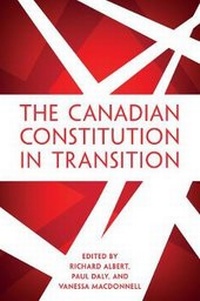
The Canadian Constitution in Transition
Published on 19. February 2019
Book
Hardback
416 pages
978-1-4875-0394-9 (ISBN)
Description
The year 2017 marked the 150th anniversary of Confederation and the 1867 Constitution Act. Anniversaries like these are often seized upon as opportunities for retrospection. This volume, by contrast, takes a distinctively forward-looking approach. Featuring essays from both emerging and established scholars, The Canadian Constitution in Transition reflects on the ideas that will shape the development of Canadian constitutional law in the decades to come. Moving beyond the frameworks that previous generations used to organize constitutional thinking, the scholars in this volume highlight new and innovative approaches to perennial problems, and seek new insights on where constitutional law is heading.
Featuring fresh scholarship from contributors who will lead the constitutional conversation in the years ahead - and who represent the gender, ethnic, linguistic, and demographic make-up of contemporary Canada - The Canadian Constitution in Transition enriches our understanding of the Constitution of Canada, and uses various methodological approaches to chart the course toward the bicentennial.
Featuring fresh scholarship from contributors who will lead the constitutional conversation in the years ahead - and who represent the gender, ethnic, linguistic, and demographic make-up of contemporary Canada - The Canadian Constitution in Transition enriches our understanding of the Constitution of Canada, and uses various methodological approaches to chart the course toward the bicentennial.
More details
Language
English
Place of publication
Toronto
Canada
Target group
College/higher education
Professional and scholarly
Dimensions
Height: 234 mm
Width: 160 mm
Thickness: 38 mm
Weight
760 gr
ISBN-13
978-1-4875-0394-9 (9781487503949)
Copyright in bibliographic data and cover images is held by Nielsen Book Services Limited or by the publishers or by their respective licensors: all rights reserved.
Schweitzer Classification
Persons
Richard Albert is Professor of Law at The University of Texas at Austin and, in 2017-18, Distinguished Visiting Professor at the Faculty of Law at the University of Toronto.
Paul Daly is a University Senior Lecturer in Public Law at University of Cambridge and the Derek Bowett Fellow in Law at Queen's College, Cambridge.
Vanessa A. MacDonnell is Associate Professor in the Faculty of Law at the University of Ottawa.
Paul Daly is a University Senior Lecturer in Public Law at University of Cambridge and the Derek Bowett Fellow in Law at Queen's College, Cambridge.
Vanessa A. MacDonnell is Associate Professor in the Faculty of Law at the University of Ottawa.
Content
Introduction: The Constitution of Canada in a New Key
Richard Albert, Paul Daly, and Vanessa MacDonnell
1. The Most Opaque Branch? The (Un)accountable Growth of Executive Power in Modern Canadian Government
Mary Liston
2. The Future of Constitutional Change in Canada: Examining Our Legal, Political, and Jurisprudential Straitjacket
Emmett Macfarlane
3. Section 96: Striking a Balance between Legal Centralism and Legal Pluralism
Paul Daly
4. Canada's "Constitution outside the Courts": Provincial Non-enforcement of Constitutionally Suspect Federal Criminal Laws as Case Study
Wade K. Wright
5. Cooperative Federalism in Canada and Quebec's Changing Attitudes
Noura Karazivan
6. Religious and Political Communities in the Canadian Judicial Imagination: Two Tensions, Two Questions
Howard Kislowicz
7. Collective Diversity and Jurisdictional Accommodations in Constitutional Perspective
Asha Kaushal
8. Difference and Inclusion: Reframing Reasonable Accommodation
Vrinda Narain
9. Freeing Inherent Aboriginal Rights from the Past
David Milward
10. False Western Universalism in Constitutionalism? The 1867 Canadian Constitution and the Legacy of the Residential Schools
Sujith Xavier
11. The Unstable Scope of Constitutionalized Property Rights in Canada: Public, Indigenous, and Private
Dwight Newman
12. A Role for Human Dignity under the Canadian Charter of Rights and Freedoms
Emily Kidd White
13. Is the Permanent Campaign the End of the Egalitarian Model for Elections?
Michael Pal
14. Immutability, Immigration Status, and the Limits of Equality Protection
Efrat Arbel and Eileen Myrdahl
Contributors
Index
Richard Albert, Paul Daly, and Vanessa MacDonnell
1. The Most Opaque Branch? The (Un)accountable Growth of Executive Power in Modern Canadian Government
Mary Liston
2. The Future of Constitutional Change in Canada: Examining Our Legal, Political, and Jurisprudential Straitjacket
Emmett Macfarlane
3. Section 96: Striking a Balance between Legal Centralism and Legal Pluralism
Paul Daly
4. Canada's "Constitution outside the Courts": Provincial Non-enforcement of Constitutionally Suspect Federal Criminal Laws as Case Study
Wade K. Wright
5. Cooperative Federalism in Canada and Quebec's Changing Attitudes
Noura Karazivan
6. Religious and Political Communities in the Canadian Judicial Imagination: Two Tensions, Two Questions
Howard Kislowicz
7. Collective Diversity and Jurisdictional Accommodations in Constitutional Perspective
Asha Kaushal
8. Difference and Inclusion: Reframing Reasonable Accommodation
Vrinda Narain
9. Freeing Inherent Aboriginal Rights from the Past
David Milward
10. False Western Universalism in Constitutionalism? The 1867 Canadian Constitution and the Legacy of the Residential Schools
Sujith Xavier
11. The Unstable Scope of Constitutionalized Property Rights in Canada: Public, Indigenous, and Private
Dwight Newman
12. A Role for Human Dignity under the Canadian Charter of Rights and Freedoms
Emily Kidd White
13. Is the Permanent Campaign the End of the Egalitarian Model for Elections?
Michael Pal
14. Immutability, Immigration Status, and the Limits of Equality Protection
Efrat Arbel and Eileen Myrdahl
Contributors
Index