

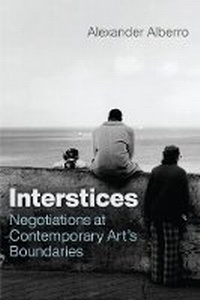
Interstices
Negotiations at Contemporary Art's Boundaries
Published on 20. June 2025
Book
Hardback
224 pages
978-0-226-83955-4 (ISBN)
Description
An exploration of innovative practices flourishing at the margins of Western art.
With this book, Alexander Alberro engages decolonial theory to explore the dynamic exchanges that occur where the ideals and values of different artistic frameworks meet. Resisting notions of a singular art world and global contemporary art, Alberro explores what lies outside of Western art's hegemonic presence, recognizing the rich multitude of art formations at its periphery, each with its own artistic narratives and conventions. Alberro brings into focus the complex negotiations that are cultivating innovation and transformation at the margins of Western art, showing how this seemingly monolithic framework is both crucial to and insufficient for a comprehensive understanding of contemporary art.
His examples include artists and collectives from around the world, including Iosu Aramburu, Subhankar Banerjee, Yto Barrada, Mabe Bethonico, El Colectivo, Maria Galindo and Mujeres Creando, Bouchra Khalili, Multiplicity, Lucy Orta, Raqs Media Collective, Tracey Rose, Doris Salcedo, Yinka Shonibare, World of Matter, and Yin Xiuzhen. As notions of transculturation and decoloniality continue to drive conversations about contemporary art, Interstices offers a critical explanation of what is at stake, showing how the tensions at the edges of the Western art framework are pushing it toward its discursive limits.
With this book, Alexander Alberro engages decolonial theory to explore the dynamic exchanges that occur where the ideals and values of different artistic frameworks meet. Resisting notions of a singular art world and global contemporary art, Alberro explores what lies outside of Western art's hegemonic presence, recognizing the rich multitude of art formations at its periphery, each with its own artistic narratives and conventions. Alberro brings into focus the complex negotiations that are cultivating innovation and transformation at the margins of Western art, showing how this seemingly monolithic framework is both crucial to and insufficient for a comprehensive understanding of contemporary art.
His examples include artists and collectives from around the world, including Iosu Aramburu, Subhankar Banerjee, Yto Barrada, Mabe Bethonico, El Colectivo, Maria Galindo and Mujeres Creando, Bouchra Khalili, Multiplicity, Lucy Orta, Raqs Media Collective, Tracey Rose, Doris Salcedo, Yinka Shonibare, World of Matter, and Yin Xiuzhen. As notions of transculturation and decoloniality continue to drive conversations about contemporary art, Interstices offers a critical explanation of what is at stake, showing how the tensions at the edges of the Western art framework are pushing it toward its discursive limits.
Reviews / Votes
"The book reconsiders the art of marginalised, subjugated and colonised people within the context of neoliberal globalisation. It is an 'interstitial perspective,' attentive to displacement, diaspora, stereotyping, migrancy and appropriation across various borderlands: post-apartheid South Africa, the Mediterranean, the Strait of Gibraltar, the Viceroyalty of Peru and Potosi in Bolivia. The works that Alberro discusses resist Western cultural hegemony by being contingent, unruly, difficult, defaced, disastrous and otherwise disruptive. . . . Above all, it is a book about the politics of attention: how and where we look, how we are seen, what is withheld, what we hide to ourselves and who, ultimately, controls the means of expression. . . . Like Alberro, we must cast our attention beyond the frame, the boundary, and the border - or risk finding ourselves, too, adrift." * Burlington Contemporary * "Alberro shows that 'global contemporary art' is a North Atlantic fiction, pervasive and insidious, that acts as a massive provincializing machine. Offering acute accounts of wide range of examples, Alberro traces how artists-especially art collectives-in many parts of the world are negotiating new modes of transcultural exchange at the margins, while at the same time enriching the independence of local cultures. This mix anticipates the worlds, and the art, to come." -- Terry Smith, author of "Art to Come: Histories of Contemporary Art" "With his compelling account of art at the margins, Alberro contributes powerfully to the growing voices of those who see clearly that, as colonial racial capitalism is threatening life on a global scale, to decolonize nature, end the violence of extraction, and enact creative worldbuilding otherwise is today more than ever urgent." -- T. J. Demos, author of "Radical Futurisms: Ecologies of Collapse, Chronopolitics, and Justice to Come" "A most timely investigation of the freedoms and prohibitions on artists to cross borders. What does it mean, if it can or should still mean anything, for "the West" to stand or not to stand at the gates of entry to the artworld? How are the visible and invisible lines drawn, and in how many directions do they flow, in a world that claims globalization? Alberro's new book is a great contribution to thinking about these and many more questions." -- Lydia Goehr, Fred and Fannie Mack Professor of Humanities, Department of Philosophy, Columbia UniversityMore details
Language
English
Place of publication
Chicago
United States
Publishing group
The University of Chicago Press
Target group
Professional and scholarly
Illustrations
45 halftones
Dimensions
Height: 229 mm
Width: 152 mm
Thickness: 15 mm
Weight
481 gr
ISBN-13
978-0-226-83955-4 (9780226839554)
Copyright in bibliographic data and cover images is held by Nielsen Book Services Limited or by the publishers or by their respective licensors: all rights reserved.
Schweitzer Classification
Person
Alexander Alberro is the Virginia Bloedel Wright '51 Professor of Modern and Contemporary Art History at Barnard College and Columbia University. He is the author or editor of numerous books, including Abstraction in Reverse, Institutional Critique, Conceptual Art and the Politics of Publicity, and Conceptual Art. Alberro has been the recipient of fellowships from the National Endowment for the Humanities, the Howard Foundation, the Whitney Museum of American Art, and others.
Content
Introduction: Deprovincializing Contemporary Art
1. Circulation
2. Translating Difference
3. Ch'ixi Epistemology
4. Decolonizing Nature
Conclusion: Beyond Hierarchy
Acknowledgments
Notes
Bibliography
Illustration Credits
Index
1. Circulation
2. Translating Difference
3. Ch'ixi Epistemology
4. Decolonizing Nature
Conclusion: Beyond Hierarchy
Acknowledgments
Notes
Bibliography
Illustration Credits
Index