

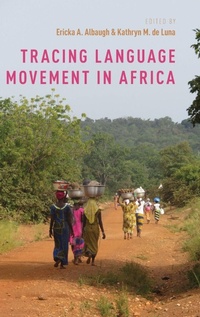
Tracing Language Movement in Africa
Published on 22. March 2018
Book
Hardback
444 pages
978-0-19-065754-3 (ISBN)
Description
The great diversity of ethnicities and languages in Africa encourages a vision of Africa as a fragmented continent, with language maps only perpetuating this vision by drawing discrete language groups. In reality, however, most people can communicate with most others within and across linguistic boundaries, even if not in languages taught or learned in schools.
Many disciplines have looked carefully at language movement and change on the continent, but their lack of interaction has prevented the emergence of a cohesive picture of African languages. Tracing Language Movement in Africa gathers eighteen scholars together to offer a truly multidisciplinary representation of language in Africa, combining insights from history, archaeology, religion, linguistics, political science, and philosophy. The resulting volume illuminates commonalities and distinctions in these disciplines' understanding of language change and movement in Africa. The volume is empirical -- aiming to represent language more accurately on the continent -- as well as theoretical. It identifies the theories that each discipline uses to make sense of language movement in Africa in plain terms and highlights the themes that cut across all disciplines: how scholars use data, understand boundaries, represent change, and conceptualize power. The volume is organized to reflect differing conceptions of language that arise from its discipline-specific contributions: that is, tendencies to study changes that consolidate language or those that splinter it, viewing languages as whole or in part.
Each contribution includes a short explanation of a discipline's theoretical and methodological approaches to language movement and change to ensure that the chapters are accessible to non-specialists, followed by an illustrative empirical case study. This volume will inspire multidisciplinary conversations around the study of language change in Africa, opening new interdisciplinary dialogue and spurring scholars to adapt the questions, data, and method of other disciplines to the problems that animate their own fields.
Many disciplines have looked carefully at language movement and change on the continent, but their lack of interaction has prevented the emergence of a cohesive picture of African languages. Tracing Language Movement in Africa gathers eighteen scholars together to offer a truly multidisciplinary representation of language in Africa, combining insights from history, archaeology, religion, linguistics, political science, and philosophy. The resulting volume illuminates commonalities and distinctions in these disciplines' understanding of language change and movement in Africa. The volume is empirical -- aiming to represent language more accurately on the continent -- as well as theoretical. It identifies the theories that each discipline uses to make sense of language movement in Africa in plain terms and highlights the themes that cut across all disciplines: how scholars use data, understand boundaries, represent change, and conceptualize power. The volume is organized to reflect differing conceptions of language that arise from its discipline-specific contributions: that is, tendencies to study changes that consolidate language or those that splinter it, viewing languages as whole or in part.
Each contribution includes a short explanation of a discipline's theoretical and methodological approaches to language movement and change to ensure that the chapters are accessible to non-specialists, followed by an illustrative empirical case study. This volume will inspire multidisciplinary conversations around the study of language change in Africa, opening new interdisciplinary dialogue and spurring scholars to adapt the questions, data, and method of other disciplines to the problems that animate their own fields.
Reviews / Votes
In a nutshell, the authors have successfully achieved their goals by providing the readers with a synthesis and analysis of Aftrican languages and their movements. Postgraduates and academics who have an interest in language change and variation should find fresh perspectives and information in this collection. * Yingzhu Chen and Ming Yue, Zhejiang University, Journal of Language and Politics * Tracing Language Movement in Africa exposes some of the pitfalls and possibilities of language-based research, sparking important debates for which future work must be held accountable. * Raevin Jimenez, Journal of Interdisciplinary History *More details
Language
English
Place of publication
New York
United States
Target group
Professional and scholarly
Dimensions
Height: 240 mm
Width: 161 mm
Thickness: 28 mm
Weight
828 gr
ISBN-13
978-0-19-065754-3 (9780190657543)
Copyright in bibliographic data and cover images is held by Nielsen Book Services Limited or by the publishers or by their respective licensors: all rights reserved.
Schweitzer Classification
Other editions
Additional editions
Ericka A. Albaugh | Kathryn M. De Luna
Tracing Language Movement in Africa
E-Book
01/2018
1st Edition
OUP eBook
€79.49
Available for download
Ericka A. Albaugh | Kathryn M. De Luna
Tracing Language Movement in Africa
E-Book
01/2018
1st Edition
OUP eBook
€79.49
Available for download
Persons
Ericka A. Albaugh teaches and researches on the politics of language, ethnic conflict, and political development in Africa. She has conducted field research in Cameroon, Senegal, Ghana, Cote d'Ivoire, and Burkina Faso, and has written articles on language politics, education, and elections on the continent. Her recent book is entitled State-Building and Multilingual Education in Africa (Cambridge University Press, 2014), and she is currently researching the spread of lingua francas within and across state boundaries.
Kathryn M. de Luna is an historian of Central Africa and publishes in the fields of history, linguistics, and archaeology. Her first book, Collecting Food, Cultivating People: Subsistence and Society in Central Africa (Yale University Press, 2016) won the Wallace Award. She is currently researching the politics of early central African pyrotechnologies and bodily senses and is beginning a project on human mobility and future and past climates in central Zambia.
Kathryn M. de Luna is an historian of Central Africa and publishes in the fields of history, linguistics, and archaeology. Her first book, Collecting Food, Cultivating People: Subsistence and Society in Central Africa (Yale University Press, 2016) won the Wallace Award. She is currently researching the politics of early central African pyrotechnologies and bodily senses and is beginning a project on human mobility and future and past climates in central Zambia.
Content
1. Toward an Interdisciplinary Perspective on Language Movement and Change
Ericka A. Albaugh and Kathryn M. de Luna
Part I: Describing and Classifying Language Movement and Change
2. Language Change and Movement as Seen by Historical Linguistics
Derek Nurse
3. The Ethnologue and L2 Mapping
Kenneth S. Olson and M. Paul Lewis
4. Understanding Distributions of Chadic Languages: Archaeological Perspectives
Scott MacEachern
5. 800 Languages and Counting: Lessons from Survey Research across a Linguistically Diverse Continent
Carolyn Logan
Part II: Forces of Fixity and Consolidation
6. Conquest and Contact in North African Languages
Moha Ennaji
7. Ajami Literacies of West Africa
Fallou Ngom
8. Vernacular Language and Political Imagination
Derek R. Peterson
9. Language Movement and Civil War in West Africa
Ericka A. Albaugh
10. How a Lingua Franca Spreads
Fiona Mc Laughlin
Part III: Influences on Fragmentation, Transformation, and Recombination
11. Scales and Units: Language Movement and Change in Central Africa
Kathryn M. de Luna
12. Localizing the Global: The Wanderwoerter of Nineteenth-Century South Central Africa
David M. Gordon
13. The Invisible Niche of AUYL
Phillip W. Rudd
14. Language Movement and Pragmatic Change in a Conflict Area: The Border Triangle of Uganda, Rwanda, and DR Congo
Nico Nassenstein
Part IV: Traveling Remnants: African Languages and the Diaspora
15. The African Diaspora and Language: Movement, Borrowing, and Return
Maureen Warner-Lewis
16. Metaphors to Live By in the Diaspora: Conceptual Tropes and Ontological Wordplay among Central Africans in the Middle Passage and Beyond
Robert W. Slenes
17. Caribbean French-African Creole and African Metaphysics
Hanetha Vete-Congolo
18. Population Movements, Language Contact, Linguistic Diversity, Etc.: A Postscript
Salikoko S. Mufwene
Ericka A. Albaugh and Kathryn M. de Luna
Part I: Describing and Classifying Language Movement and Change
2. Language Change and Movement as Seen by Historical Linguistics
Derek Nurse
3. The Ethnologue and L2 Mapping
Kenneth S. Olson and M. Paul Lewis
4. Understanding Distributions of Chadic Languages: Archaeological Perspectives
Scott MacEachern
5. 800 Languages and Counting: Lessons from Survey Research across a Linguistically Diverse Continent
Carolyn Logan
Part II: Forces of Fixity and Consolidation
6. Conquest and Contact in North African Languages
Moha Ennaji
7. Ajami Literacies of West Africa
Fallou Ngom
8. Vernacular Language and Political Imagination
Derek R. Peterson
9. Language Movement and Civil War in West Africa
Ericka A. Albaugh
10. How a Lingua Franca Spreads
Fiona Mc Laughlin
Part III: Influences on Fragmentation, Transformation, and Recombination
11. Scales and Units: Language Movement and Change in Central Africa
Kathryn M. de Luna
12. Localizing the Global: The Wanderwoerter of Nineteenth-Century South Central Africa
David M. Gordon
13. The Invisible Niche of AUYL
Phillip W. Rudd
14. Language Movement and Pragmatic Change in a Conflict Area: The Border Triangle of Uganda, Rwanda, and DR Congo
Nico Nassenstein
Part IV: Traveling Remnants: African Languages and the Diaspora
15. The African Diaspora and Language: Movement, Borrowing, and Return
Maureen Warner-Lewis
16. Metaphors to Live By in the Diaspora: Conceptual Tropes and Ontological Wordplay among Central Africans in the Middle Passage and Beyond
Robert W. Slenes
17. Caribbean French-African Creole and African Metaphysics
Hanetha Vete-Congolo
18. Population Movements, Language Contact, Linguistic Diversity, Etc.: A Postscript
Salikoko S. Mufwene