

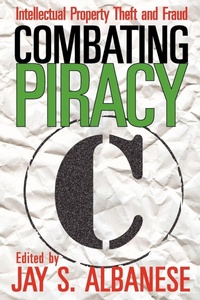
Combating Piracy
Intellectual Property Theft and Fraud
1st Edition
Published on 15. August 2009
Book
Paperback/Softback
192 pages
978-1-4128-1146-0 (ISBN)
Description
Fraud and piracy of products and ideas have become common in the early twenty-first century, as opportunities to commit them expand, and technology makes fraud and piracy easy to carry out. In Combating Piracy: Intellectual Property Theft and Fraud, Jay S. Albanese and his contributors provide new analyses of intellectual property theft and how perpetrators innovate and adapt in response to shifting opportunities.
The cases described here illustrate the wide-ranging nature of the activity and the spectrum of persons involved in piracy of intellectual property. Intellectual property theft includes stolen copyrights, trademarks, trade secrets, and patents, which represent the creative work of individuals for which others cannot claim credit. The distributors of books, movies, music, and other forms of intellectual property pay for this right, and those who distribute this work without compensation to its creator effectively hijack or "pirate" that property without the owner's or distributor's permission. The problem has grown to the point where most software in many parts of the world is pirated. The World Health Organization estimates that 10 percent of all pharmaceuticals available worldwide are counterfeit.
Such widespread fraud illustrates the global reach of the problem and the need for international remedies that include changed attitudes, public education, increasing the likelihood of apprehension, and reducing available opportunities. The contributors show that piracy is a form of fraud, a form of organized crime, a white-collar crime, a criminal activity with causes we can isolate and prevent, and a global problem. This book examines each of these perspectives to determine how they contribute to our understanding of the issues involved.
The cases described here illustrate the wide-ranging nature of the activity and the spectrum of persons involved in piracy of intellectual property. Intellectual property theft includes stolen copyrights, trademarks, trade secrets, and patents, which represent the creative work of individuals for which others cannot claim credit. The distributors of books, movies, music, and other forms of intellectual property pay for this right, and those who distribute this work without compensation to its creator effectively hijack or "pirate" that property without the owner's or distributor's permission. The problem has grown to the point where most software in many parts of the world is pirated. The World Health Organization estimates that 10 percent of all pharmaceuticals available worldwide are counterfeit.
Such widespread fraud illustrates the global reach of the problem and the need for international remedies that include changed attitudes, public education, increasing the likelihood of apprehension, and reducing available opportunities. The contributors show that piracy is a form of fraud, a form of organized crime, a white-collar crime, a criminal activity with causes we can isolate and prevent, and a global problem. This book examines each of these perspectives to determine how they contribute to our understanding of the issues involved.
More details
Language
English
Place of publication
New York
United States
Publishing group
Taylor & Francis Inc
Target group
College/higher education
Professional and scholarly
Dimensions
Height: 229 mm
Width: 152 mm
Thickness: 11 mm
Weight
290 gr
ISBN-13
978-1-4128-1146-0 (9781412811460)
Copyright in bibliographic data and cover images is held by Nielsen Book Services Limited or by the publishers or by their respective licensors: all rights reserved.
Schweitzer Classification
Other editions
Additional editions
Book
10/2017
1st Edition
Routledge
€207.30
Shipment within 10-20 days
E-Book
07/2017
Routledge
€64.49
Available for download
E-Book
07/2017
Routledge
€64.49
Available for download
Person
Graham Dawson
Content
Introduction -Jay S. Albanese 1. Fraud: The Characteristic Crime of the Twenty-first Century -Jay S. Albanese 2. Intellectual Property Theft and Organized Crime: The Case of Film Piracy -Jeffrey Scott McIllwain 3. Causes and Prevention of Intellectual Property Crime -Nicole Leeper Piquero 4. Intellectual Property and White-collar Crime: Report of Issues, Trends, and Problems for Future Research -Annette Beresford, Christian Desilets, Sandy Haantz, John Kane, and April Wall 5. Addressing the Global Scope of Intellectual Property Crimes and Policy Initiatives -Hedieh Nasheri 6. Report of the Task Force on Intellectual Property -U.S. Department of Justice About the Contributors Index