

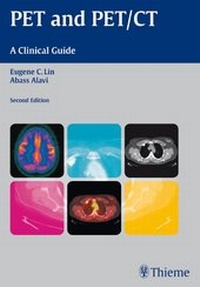
PET and PET/CT
A Clinical Guide
2nd Edition
Published on 16. April 2009
Book
Paperback/Softback
312 pages
978-1-60406-153-6 (ISBN)
Description
Returning in a second edition, this practical book presents oncological and nononcological applications for PET and PET/CT for the full range of scenarios frequently encountered in the professional setting. Placing special emphasis on PET/CT correlation and FDG oncological imaging, it opens with a thorough introduction to fundamental science and clinical basics. Each chapter in the Oncological Applications section of the book describes the role of PET and PET/CT in the management of specific diseases, providing succinct descriptions of indications and comparisons with other imaging modalities.
Highlights:
-New chapters covering PET/CT for pediatric patients; the use of FDG PET in the evaluation of infection and inflammation; the role of PET and PET/CT in radiation therapy planning; and FDG biology
-More than 500 high-quality images, including state-of-the-art color PET/CT images
-Pearls and pitfalls that emphasize critical concepts
-Discussion of normal variations and benign findings
-Thorough review of the current literature on PET/CT
This compact book provides readers with the tools to sharpen their assessment and decision-making skills. Organized efficiently to enable rapid reference to key concepts, this concise text is ideal for residents and practitioners in radiology, nuclear medicine, oncology, radiation oncology, and nuclear medicine technology.
Reviews / Votes
Praise for this book: "Sure to be a hit -- just like the first edition...All the chapters are well written and the accuracy of information is impressive...[we] cannot recommend the book strongly enough."--RAD MagazineA valuable reference source...This small and affordable book should be useful to both trainees and practicioners...Highly recommend[ed]. -- The Journal of Nuclear Medicine
"In conclusion, in the considered opinion of this reviewer, this textbook is the best reference source for both the trainees and practitioners who are actively involved in utilizing FDGPET/CT modality in their clinical practice."--Clinical Imaging
"[A] compact, softcover handbook that should be of immense help...useful...excellent points of discussion...supplemented with excellent figures and references...well written...this book summarizes the scientific literature on PET and PET/CT."--Academic Radiology
"Easy-to-read and well-organized package." -- American Journal of Roentgenology
"An excellent handbook.. A good study companion for trainees. The authors have fulfilled their objective and produced an excellent textbook that will be valuable to residents and other trainees who want an accesible source of authoritative information."--Radiology
"An affordable, portable, complete, and concise resource or review text concerning a very timely clinical subject. [The second section of the book] is an outstanding contribution to this text and could be used by any radiologist at any level of training who wants to review positron emission tomography (PET). The illustrations in this book are outstanding. They are appropriate for the discussion and expand the reader's understanding. None of the topics are covered too extensively, and this, combined with the partial outline format, makes this book more of a review and reference manual than a textbook. This book also could be used as a primary initial text for learning PET and PET/CT; I believe that many would find this very readable, even for the beginner. It bears repeating that this text covers both PET and PET/CT and thus serves an even larger purpose in a ready reference section or library. This is particularly impressive given how easily it could be placed in your pocket or bag and carried from site to site or office to reading room."--Academic Radiology
"This small but very informative book is to be read by senior radiologists and especially junior residents who are just encountering the applications of PET and PET/CT. The various chapters are well illustrated by demonstrative images, many with directing arrows, and in several are "pearls," which the readers will find very useful. This handbook is full of information regarding the applications of PET and PET/CT, and it is recommended especially to the junior radiologists.."--Clinical Imaging
"Retaining the goal of providing practitioners and trainees in medical imaging disciplines with the essential information about PET and PET/CT while simultaneously reflecting the breadth of the scientific literature, [the authors] have updated the material to reflect recent advances and have included a significant number of new images. New chapters have also been added on FDG biology, pediatric PET/CT, and PET/CT in radiation therapy and in inflammatory and infectious disorders."--SciTech Book News
More details
Language
English
Place of publication
New York
United States
Target group
College/higher education
Professional and scholarly
Ärzte
Edition type
New edition
Product notice
Paperback (trade)
Illustrations
505 Abbildungen
Dimensions
Height: 17.8 cm
Width: 25.4 cm
Weight
742 gr
ISBN-13
978-1-60406-153-6 (9781604061536)
Schweitzer Classification
Other editions
New editions
Book
04/2019
3rd Edition
Thieme Publishers
€100.00
Available immediately
Previous edition
Book
01/2006
1st Edition
Thieme
€59.95
Article exhausted; check for reprint
Person
Professor, Department of Radiology, University of Pennsylvania, Philadelphia, PA, USA
Content
I Basic Science
Chapter 1: The Physics of PET/CT Scanners
Chapter 2: Basics of Fluorodeoxyglucose Radiochemistry and Biology
Chapter 3: The Role of Glucose and FDG Metabolism in the Interpretation of PET Studies
II Clinical Basics
Chapter 4: Patient Preparation
Chapter 5: Standardized Uptake Value
Chapter 6: Normal Variants and Benign Findings
Chapter 7: The Interpretation of FDG PET Studies
Chapter 8: The Value of PET/CT
Chapter 9: Levels of Evidence for Clinical Indications of FDG PET
III Oncologic Applications
Chapter 10: Oncologic PET by Anatomical Region
Chapter 11: Therapy Response
Chapter 12: Brain Neoplasms
Chapter 13: Head and Neck Cancer
Chapter 14: Thyroid Cancer
Chapter 15: Thoracic Neoplasms
Chapter 16: Breast Cancer
Chapter 17: Gastric, Esophageal, and Gastrointestinal Stromal Tumors
Chapter 18: Lymphoma
Chapter 19: Melanoma
Chapter 20: Hepatobiliary Tumors
Chapter 21: Pancreatic Cancer
Chapter 22: Gynecologic Tumors
Chapter 23: Urologic Tumors
Chapter 24: Colorectal Cancer
Chapter 25: Musculoskeletal Tumors
IV Nononcologic Applications
Chapter 26: Pediatric PET/CT
Chapter 27: PET and PET/CT in Radiation Therapy Planning
Chapter 28: FDG PET in the Evaluation of Infection and Inflammation
Chapter 29: Neurologic Applications
Chapter 30: Cardiac PET and PET/CT
Chapter 1: The Physics of PET/CT Scanners
Chapter 2: Basics of Fluorodeoxyglucose Radiochemistry and Biology
Chapter 3: The Role of Glucose and FDG Metabolism in the Interpretation of PET Studies
II Clinical Basics
Chapter 4: Patient Preparation
Chapter 5: Standardized Uptake Value
Chapter 6: Normal Variants and Benign Findings
Chapter 7: The Interpretation of FDG PET Studies
Chapter 8: The Value of PET/CT
Chapter 9: Levels of Evidence for Clinical Indications of FDG PET
III Oncologic Applications
Chapter 10: Oncologic PET by Anatomical Region
Chapter 11: Therapy Response
Chapter 12: Brain Neoplasms
Chapter 13: Head and Neck Cancer
Chapter 14: Thyroid Cancer
Chapter 15: Thoracic Neoplasms
Chapter 16: Breast Cancer
Chapter 17: Gastric, Esophageal, and Gastrointestinal Stromal Tumors
Chapter 18: Lymphoma
Chapter 19: Melanoma
Chapter 20: Hepatobiliary Tumors
Chapter 21: Pancreatic Cancer
Chapter 22: Gynecologic Tumors
Chapter 23: Urologic Tumors
Chapter 24: Colorectal Cancer
Chapter 25: Musculoskeletal Tumors
IV Nononcologic Applications
Chapter 26: Pediatric PET/CT
Chapter 27: PET and PET/CT in Radiation Therapy Planning
Chapter 28: FDG PET in the Evaluation of Infection and Inflammation
Chapter 29: Neurologic Applications
Chapter 30: Cardiac PET and PET/CT