

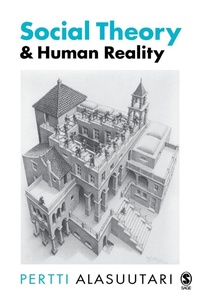
Social Theory and Human Reality
1st Edition
Published on 1. September 2004
Book
Paperback/Softback
192 pages
978-0-7619-5165-0 (ISBN)
Description
'This is a smart and compelling book. Difficult ideas are presented in an accessible manner, with plenty of supporting illustrations...Students will enjoy the research material and other supporting material. A definite winner!'-
Professor Jay Gubrium, University of Missouri
This book gets to the heart of what the social sciences really know about the elusive and contradictory object of research: human reality.
Drawing on a wide range of international examples and scenarios, Social Theory and Human Reality examines key sociological concepts that we use to understand human behaviour such as: norms, rules and meanings; language and discourse; ritual; and personality and identity construction.
Alasuutari clearly and convincingly demonstrates:
- The constant interplay between routines and reflexivity that grounds social order
- how the body and our bodily experiences mediate our social reality
- that language plays a multi-faceted role as it describes, reflects and constructs human reality
Building on the work started by Berger and Luckmann in The Social Construction of Reality, this book is a lucid and contemporary analysis of the premises shared across the social sciences, and of the kaleidoscope of 'human reality'.
This important book will be welcomed by students and scholars alike in the fields of Cultural Studies, Sociology and Anthropology.
Professor Jay Gubrium, University of Missouri
This book gets to the heart of what the social sciences really know about the elusive and contradictory object of research: human reality.
Drawing on a wide range of international examples and scenarios, Social Theory and Human Reality examines key sociological concepts that we use to understand human behaviour such as: norms, rules and meanings; language and discourse; ritual; and personality and identity construction.
Alasuutari clearly and convincingly demonstrates:
- The constant interplay between routines and reflexivity that grounds social order
- how the body and our bodily experiences mediate our social reality
- that language plays a multi-faceted role as it describes, reflects and constructs human reality
Building on the work started by Berger and Luckmann in The Social Construction of Reality, this book is a lucid and contemporary analysis of the premises shared across the social sciences, and of the kaleidoscope of 'human reality'.
This important book will be welcomed by students and scholars alike in the fields of Cultural Studies, Sociology and Anthropology.
More details
Edition
First Edition
Language
English
Place of publication
Thousand Oaks
United States
Target group
College/higher education
Professional and scholarly
Dimensions
Height: 234 mm
Width: 156 mm
Thickness: 10 mm
Weight
295 gr
ISBN-13
978-0-7619-5165-0 (9780761951650)
Copyright in bibliographic data and cover images is held by Nielsen Book Services Limited or by the publishers or by their respective licensors: all rights reserved.
Schweitzer Classification
Other editions
Additional editions
Pertti Alasuutari
Social Theory and Human Reality
Book
09/2004
1st Edition
SAGE Publications Inc
€201.90
Shipment within 15-20 days
Pertti Alasuutari
Social Theory and Human Reality
E-Book
09/2004
1st Edition
SAGE Publications Ltd
from
€44.69
Available for download
Person
Pertti Alasuutari is a sociologist, cultural studies scholar, paterfamilias and a highly significant figure in the development of both Finnish and international qualitative research. His career has gone from strength to strength as regards advancement in Finnish academia, as witnessed by some twenty books, and numerous articles in both Finnish and foreign journals.
Yet Professor Alasuutari insists that he did not consciously choose the career of a sociologist.
Professor Alasuutari completed his school education in Rovaniemi, Lapland in 1975 and went to study technology at the University of Oulu. But not for long. In 1977 he dropped out and began to dream of becoming a journalist, in the meantime doing supply teaching.
"In summer I studied journalism at summer university in Lapland and began my military service"
His days in the army driving a desk led him to another state agency. In autumn 1978 the train from the north arrived in Tampere with the 22-year-old on board. He had gained admission to study sociology.
"For the first year I only studied journalism, and didn't even set foot in the Department of Sociology," grins Professor Alasuutari.
Career development
In 1983 the Westermarck Society awarded a prize for a master's thesis to the youthful Alasuutari. The thesis was entitled "The Realm of Male Freedom". The ethnographic approach was to describe the alcohol culture of a group of men patronizing a suburban pub.
Yet Professor Alasuutari insists that he did not consciously choose the career of a sociologist.
Professor Alasuutari completed his school education in Rovaniemi, Lapland in 1975 and went to study technology at the University of Oulu. But not for long. In 1977 he dropped out and began to dream of becoming a journalist, in the meantime doing supply teaching.
"In summer I studied journalism at summer university in Lapland and began my military service"
His days in the army driving a desk led him to another state agency. In autumn 1978 the train from the north arrived in Tampere with the 22-year-old on board. He had gained admission to study sociology.
"For the first year I only studied journalism, and didn't even set foot in the Department of Sociology," grins Professor Alasuutari.
Career development
In 1983 the Westermarck Society awarded a prize for a master's thesis to the youthful Alasuutari. The thesis was entitled "The Realm of Male Freedom". The ethnographic approach was to describe the alcohol culture of a group of men patronizing a suburban pub.
Content
Introduction
Introduction
Norms and Rules
Language
Conversations
Rituals
Personality
The Case of Modernity
Identity
The Modernization Story as a Reflexive Frame
The Enigma of Human Reality
Introduction
Norms and Rules
Language
Conversations
Rituals
Personality
The Case of Modernity
Identity
The Modernization Story as a Reflexive Frame
The Enigma of Human Reality