

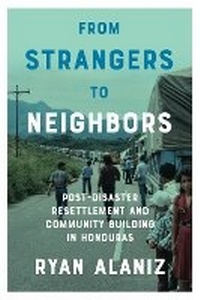
From Strangers to Neighbors
Post-Disaster Resettlement and Community Building in Honduras
Published on 15. December 2017
Book
Paperback/Softback
216 pages
978-1-4773-1409-8 (ISBN)
Description
Natural disasters, the effects of climate change, and political upheavals and war have driven tens of millions of people from their homes and spurred intense debates about how governments and nongovernmental organizations (NGOs) should respond with long-term resettlement strategies. Many resettlement efforts have focused primarily on providing infrastructure and have done little to help displaced people and communities rebuild social structure, which has led to resettlement failures throughout the world. So what does it take to transform a resettlement into a successful community?
This book offers the first long-term comparative study of social outcomes through a case study of two Honduran resettlements built for survivors of Hurricane Mitch (1998) by two different NGOs. Although residents of each arrived from the same affected neighborhoods and have similar demographics, twelve years later one resettlement wrestles with high crime, low participation, and low social capital, while the other maintains low crime, a high degree of social cohesion, participation, and general social health. Using a multi-method approach of household surveys, interviews, ethnography, and analysis of NGO and community documents, Ryan Alaniz demonstrates that these divergent resettlement trajectories can be traced back to the type and quality of support provided by external organizations and the creation of a healthy, cohesive community culture. His findings offer important lessons and strategies that can be utilized in other places and in future resettlement policy to achieve the most effective and positive results.
This book offers the first long-term comparative study of social outcomes through a case study of two Honduran resettlements built for survivors of Hurricane Mitch (1998) by two different NGOs. Although residents of each arrived from the same affected neighborhoods and have similar demographics, twelve years later one resettlement wrestles with high crime, low participation, and low social capital, while the other maintains low crime, a high degree of social cohesion, participation, and general social health. Using a multi-method approach of household surveys, interviews, ethnography, and analysis of NGO and community documents, Ryan Alaniz demonstrates that these divergent resettlement trajectories can be traced back to the type and quality of support provided by external organizations and the creation of a healthy, cohesive community culture. His findings offer important lessons and strategies that can be utilized in other places and in future resettlement policy to achieve the most effective and positive results.
Reviews / Votes
"From [resettlement theorists and practitioners'] vantage point, I believe this brief book will be a very welcome contribution to their debates and concerns." (The Americas) "The findings and recommendations from this detailed and singular study (in its focus on social outcomes) are important for scholars, NGOs, government officials, and others involved in post-disaster resettlement and community development at a crucial time of climate change and increasing numbers of 'climate refugees.' While the circumstances of the study are particular to a fragile Central American nation, the lessons learned should have ample applicability to other countries throughout Latin America and in other vulnerable parts of the world impacted by environmental and other types of disasters." (The Latin Americanist) "A rigorously researched and scholarly engaged examination of community relocation projects in Honduras during the two decades that followed Hurricane Mitch... This is a book every practitioner involved in disaster recovery and community relocation should have on their shelf. Overall, the book is written in clear and effective prose that should make it accessible to a broad audience including advanced undergraduate students, graduate students, and professionals in a variety of fields beyond the social sciences." (Journal of Latin American and Caribbean Anthropology) "[Alaniz's] detailed local explorations are the highlight of the book: the communities are fascinating, and Alaniz's lucid and evocative writing engagingly conveys the essence of these places." (Journal of Latin American Geography)More details
Language
English
Place of publication
Austin, TX
United States
Target group
Professional and scholarly
Dimensions
Height: 229 mm
Width: 152 mm
Thickness: 28 mm
Weight
313 gr
ISBN-13
978-1-4773-1409-8 (9781477314098)
Copyright in bibliographic data and cover images is held by Nielsen Book Services Limited or by the publishers or by their respective licensors: all rights reserved.
Schweitzer Classification
Person
RYAN ALANIZ is an associate professor of sociology at California Polytechnic State University, San Luis Obispo. He is also affiliated with the United Nations University and the Resilient Communities Research Institute.
Content
Preface
Acknowledgments
Chapter 1. The Perilous Path: From Resettlement to Community
Chapter 2. The Consequences of Hurricane Mitch
Chapter 3. Community Development in the Context of Disaster Resettlement
Chapter 4. Measuring Successful Resettlement
Chapter 5. Suyapa
Chapter 6. Pino Alto
Chapter 7. From Strangers to Neighbors: The Development of Community
Appendix
Notes
References
Index
Acknowledgments
Chapter 1. The Perilous Path: From Resettlement to Community
Chapter 2. The Consequences of Hurricane Mitch
Chapter 3. Community Development in the Context of Disaster Resettlement
Chapter 4. Measuring Successful Resettlement
Chapter 5. Suyapa
Chapter 6. Pino Alto
Chapter 7. From Strangers to Neighbors: The Development of Community
Appendix
Notes
References
Index