

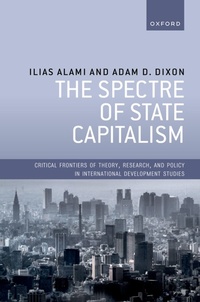
The Spectre of State Capitalism
Published on 25. July 2024
Book
Hardback
312 pages
978-0-19-892519-4 (ISBN)
Description
The state is back, and it means business. Since the turn of the 21st century, state-owned enterprises, sovereign funds, and policy banks have vastly expanded their control over assets and markets. Concurrently, governments have experimented with increasingly assertive modalities of statism, from techno-industrial policies and spatial development strategies to economic nationalism and trade and investment restrictions.
This book argues that we are currently witnessing a historic arc in the trajectories of state intervention, characterized by a drastic reconfiguration of the state's role as promoter, supervisor, shareholder-investor, and direct owner of capital across the world economy. It offers a comprehensive analysis of this "new state capitalism", as commentators increasingly refer to it, and maps out its key empirical manifestations across a range of geographies, cases, and issue areas. Alami and Dixon show that the new state capitalism is rooted in deep geopolitical economic and financial processes pertaining to the secular development of global capitalism, as much as it is the product of the geoeconomic agency of states and the global corporate strategies of leading firms. The book demonstrates that the proliferation of muscular modalities of statist interventionism and the increasing concentration of capital in the hands of states indicate foundational shifts in global capitalism. This includes a growing fusion of private and state capital, and the development of flexible and liquid forms of property that collapse the distinction between state and private ownership, control, and management. This has fundamental implications for the nature and operations of global capitalism and world politics.
This is an open access title available under the terms of a CC BY-NC-ND 4.0 International licence. It is free to read on the Oxford Academic platform and offered as a free PDF download from OUP and selected open access locations.
This book argues that we are currently witnessing a historic arc in the trajectories of state intervention, characterized by a drastic reconfiguration of the state's role as promoter, supervisor, shareholder-investor, and direct owner of capital across the world economy. It offers a comprehensive analysis of this "new state capitalism", as commentators increasingly refer to it, and maps out its key empirical manifestations across a range of geographies, cases, and issue areas. Alami and Dixon show that the new state capitalism is rooted in deep geopolitical economic and financial processes pertaining to the secular development of global capitalism, as much as it is the product of the geoeconomic agency of states and the global corporate strategies of leading firms. The book demonstrates that the proliferation of muscular modalities of statist interventionism and the increasing concentration of capital in the hands of states indicate foundational shifts in global capitalism. This includes a growing fusion of private and state capital, and the development of flexible and liquid forms of property that collapse the distinction between state and private ownership, control, and management. This has fundamental implications for the nature and operations of global capitalism and world politics.
This is an open access title available under the terms of a CC BY-NC-ND 4.0 International licence. It is free to read on the Oxford Academic platform and offered as a free PDF download from OUP and selected open access locations.
Reviews / Votes
In this transformative intervention, Ilias Alami and Adam D. Dixon take debates around "the new" state capitalism to a new place. Rigorous, grounded, and theoretically incisive, The Specter of State Capitalism deserves to be recognized as a signal contribution to geographical political economy. * Jamie Peck, Professor of Geography at the University of British Columbia * In this essential book, Alami and Dixon adopt a truly global perspective to illuminate the rationale and contradictions of state-led capital accumulation in the world economy. Mobilizing a rigorously crafted analytical framework, they drive us throughout the rapidly changing forms of the separation/articulation between the economic sphere of private market activity and the political sphere, pointing out the implications of those mutations in terms of crisis-tendencies, international rivalries, and social balance of forces. In the process, they recall us that the institutionalization of the power to allocate social wealth is fragile and contingent on open-ended historical development, and that the rapid contemporary changes in that regard should stimulate our political imagination to look beyond neoliberalism and think beyond capitalism. * Cedric Durand, Associate Professor of Political Economy, University of Geneva * Bringing together the insights of two authors central to new state capitalist studies, Alami and Dixon's The Specter of State Capitalism weaves theory and empirics to adeptly specify the global expansion of 'state-capital hybrids' and 'muscular statism' - novel arrangements that suggest the looming possibility (or specter) of fundamental transformation in global capitalism. For everything you need to know about the state of new state capitalism, read this book. * Heather Whiteside, Associate Professor of Political Science, University of Waterloo * Epochal shifts are under way in the global political economy, often captured under the rubric of 'new state capitalism'. Alami and Dixon cut through the jargon and confusion surrounding much of the current debate, providing invaluable insights into the origins, drivers and contours of contemporary transformations in state and capitalism globally. This is an essential text, not only for academic specialists, but for anyone keen to understand the core challenges of our time and how to respond to them. * Shahar Hameiri, Professor of Political Science, University of Queensland * Alami and Dixon provide a groundbreaking account of the new era of statism and hybrid control over an ever-greater swathe of global assets, production and banking. Lucidly written, theoretically sophisticated and wide ranging, the Specter of State Capitalism ties together the various threads of the polycrisis to show us that the new state capitalism is epoch-shaping, not only in recasting the edifices of the world economy, but also in unveiling the inseparability of the political and the economic and the opportunities that this provides for progressive change. * Liam Campling, Professor of International Business and Development, Queen Mary University of London * Moving beyond a facile binary of "good" versus "bad" state capitalism central to Western liberal discourse, Alami and Dixon instead ask - and answer - why state capitalism takes the spatial and institutional forms that it does, why now, and why it matters. Written in engaging prose, The Specter of State Capitalism offers a compelling and original theoretical approach to this fast-moving field. Readers will gain unique insights into the tectonic geopolitical shifts of our rapidly changing world. * Marion Werner, Associate Professor, Department of Geography, University at Buffalo, SUNY * "This compelling book is a powerful and highly original contribution to the burgeoning literature on state capitalism. Unlike so much writing on the topic, it is anchored in a sophisticated analytical framework and showcases an impressive command of diverse theoretical traditions, literatures, and geographies. An invaluable resource that does much to illuminate the new dynamics of global capitalism and its multiple crises today." * Adam Hanieh, Professor of Political Economy and Global Development, University of Exeter * The book covers an enormous amount of ground already, and there is no space to defend this analysis in any depth. The Spectre of State Capitalism offers readers an alternative to the shallow discourse around state capitalism, while also showing how that discourse operates, and why it is successful. The authors bring together a theory of the state, an analysis of the global economy's recent history and close attention to the actions of individual actors-states, firms and multilaterals - within that economy. The book provides a materialist explanation for the expanding role of the state in the economy. It is an excellent piece of scholarly work. * J D Evans, The Marx and Philosophy Review of Books *More details
Series
Language
English
Place of publication
Oxford
United Kingdom
Target group
Professional and scholarly
Product notice
sewn/stitched
Cloth over boards
Dimensions
Height: 240 mm
Width: 159 mm
Thickness: 27 mm
Weight
628 gr
ISBN-13
978-0-19-892519-4 (9780198925194)
Copyright in bibliographic data and cover images is held by Nielsen Book Services Limited or by the publishers or by their respective licensors: all rights reserved.
Schweitzer Classification
Other editions
Additional editions
Ilias Alami | Adam D. Dixon
The Spectre of State Capitalism
E-Book
09/2024
OUP eBook
€98.99
Available for download
Ilias Alami | Adam D. Dixon
The Spectre of State Capitalism
E-Book
07/2024
1st Edition
OUP eBook
€98.99
Available for download
Persons
Dr Ilias Alami is an Assistant Professor in the Political Economy of Development in the Centre of Development Studies and the Department of Politics and International Studies at Cambridge University. Prior to joining Cambridge, he held research and teaching positions at Uppsala University, Maastricht University, and Manchester University. He also held visiting positions at the Getulio Vargas Foundation in Sao Paulo, the University of Johannesburg, and Sciences Po Paris. He holds a PhD in Politics from the University of Manchester.
Professor Adam D. Dixon holds the Adam Smith Chair in Sustainable Capitalism at Adam Smith's Panmure House, the last and final home of moral philosopher and father of economics Adam Smith. Previously, he worked at the University of Bristol and Maastricht University in the Netherlands, where he led a large European Research Council project on sovereign wealth funds. He holds a D.Phil. in economic geography from the University of Oxford, a Diplome (Master) de l'Institut d'Etudes Politiques de Paris, and a BA in international affairs and Spanish literature from The George Washington University in Washington, DC.
Professor Adam D. Dixon holds the Adam Smith Chair in Sustainable Capitalism at Adam Smith's Panmure House, the last and final home of moral philosopher and father of economics Adam Smith. Previously, he worked at the University of Bristol and Maastricht University in the Netherlands, where he led a large European Research Council project on sovereign wealth funds. He holds a D.Phil. in economic geography from the University of Oxford, a Diplome (Master) de l'Institut d'Etudes Politiques de Paris, and a BA in international affairs and Spanish literature from The George Washington University in Washington, DC.
Content
1: State Capitalism(s) Redux?
2: Theories, Tensions, Controversies
3: The Problematique of State Capitalism
4: Rooting State Capitalism in the Churn of Uneven Development
5: State Capitalism Begets State Capitalism: On Combination and Political Multiplicity
6: Expropriation of Capitalist by State Capitalist: Centralizing Capital as State Property
7: The Rhetorical Weaponization of the New State Capitalism
8: Liberal Anxieties and Ideological Adjustment in Global Development
9: A Specter Haunting Capitalism?
2: Theories, Tensions, Controversies
3: The Problematique of State Capitalism
4: Rooting State Capitalism in the Churn of Uneven Development
5: State Capitalism Begets State Capitalism: On Combination and Political Multiplicity
6: Expropriation of Capitalist by State Capitalist: Centralizing Capital as State Property
7: The Rhetorical Weaponization of the New State Capitalism
8: Liberal Anxieties and Ideological Adjustment in Global Development
9: A Specter Haunting Capitalism?