

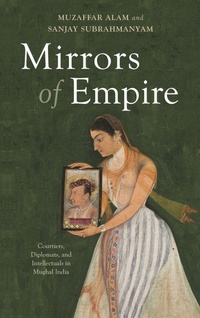
Mirrors of Empire
Courtiers, Diplomats, and Intellectuals in Mughal India
Will be published approx. on 1. February 2026
Book
Hardback
480 pages
979-8-8558-0560-4 (ISBN)
Description
Approaches the history of the Mughal Empire at the level of human experience, through a diverse group of autobiographical narratives.
Starting from 1526, the Mughals ruled over much of India for three centuries, perhaps the most important Islamic empire in the early modern world. This period saw the production of a fascinating variety of memoirs and autobiographies in which residents of the empire reflected on their own lives, on Islam in a Hindu context, and on the relationship of individual subjects to their new rulers. Those written by Mughal royalty-especially Babur and Jahangir-are well known. This book considers the less well known writings of diverse others, from the poet laureate Faizi to those who were not part of elite society but a few notches below it, such as the lowly envoy Asad Beg and characters like Mirza Nathan and Abdul Latif, who lived dangerously on the Bengal frontier. Also considered are prolific Hindu writers, such as Bhimsen Saksena and the witty Anand Ram Mukhlis, who lived in Delhi through the turbulent 1730s and 1740s. Together, they offer an original and differently critical perspective on the empire-its religious, social, and political tensions, as well as its strategies for overcoming them.
Covering over two centuries of such materials, Mirrors of Empire is a work of cultural history that is also firmly rooted in social history. It incorporates extensive translations from Persian, including materials that are little-known even to historians and specialists, and shows the transformation of the empire from its difficult emergence, to its expansive height, to its phase of disintegration in the middle of the eighteenth century. Gracefully written, the book approaches the Mughal Empire at the level of human experience, rendering it accessible and not a mere abstraction.
Starting from 1526, the Mughals ruled over much of India for three centuries, perhaps the most important Islamic empire in the early modern world. This period saw the production of a fascinating variety of memoirs and autobiographies in which residents of the empire reflected on their own lives, on Islam in a Hindu context, and on the relationship of individual subjects to their new rulers. Those written by Mughal royalty-especially Babur and Jahangir-are well known. This book considers the less well known writings of diverse others, from the poet laureate Faizi to those who were not part of elite society but a few notches below it, such as the lowly envoy Asad Beg and characters like Mirza Nathan and Abdul Latif, who lived dangerously on the Bengal frontier. Also considered are prolific Hindu writers, such as Bhimsen Saksena and the witty Anand Ram Mukhlis, who lived in Delhi through the turbulent 1730s and 1740s. Together, they offer an original and differently critical perspective on the empire-its religious, social, and political tensions, as well as its strategies for overcoming them.
Covering over two centuries of such materials, Mirrors of Empire is a work of cultural history that is also firmly rooted in social history. It incorporates extensive translations from Persian, including materials that are little-known even to historians and specialists, and shows the transformation of the empire from its difficult emergence, to its expansive height, to its phase of disintegration in the middle of the eighteenth century. Gracefully written, the book approaches the Mughal Empire at the level of human experience, rendering it accessible and not a mere abstraction.
Reviews / Votes
"Muzaffar Alam and Sanjay Subrahmanyam are two of the world's leading scholars of the Mughal Empire. Since 1994 they have achieved the unusual feat of joint authorship ... Alam brings to the partnership expertise in the Islamic textual tradition in Urdu, Persian, and Arabic. Subrahmanyam brings to the partnership skills in the social sciences, in South Indian languages as well as Dutch, French, and Portuguese, interests in early modern history ranging from Iberia to Southeast Asia, and an instinct to question old ways of seeing things and to discover new ones" - Francis Robinson, Journal of the Royal Asiatic SocietyMore details
Language
English
Place of publication
Albany, NY
United States
Target group
Professional and scholarly
US School Grade: College Graduate Student and over
Illustrations
2 Tables, black and white; 12 Illustrations, black and white; 5 Maps
Dimensions
Height: 235 mm
Width: 157 mm
Thickness: 30 mm
Weight
831 gr
ISBN-13
979-8-8558-0560-4 (9798855805604)
Copyright in bibliographic data and cover images is held by Nielsen Book Services Limited or by the publishers or by their respective licensors: all rights reserved.
Schweitzer Classification
Other editions
Additional editions
Muzaffar Alam | Sanjay Subrahmanyam
Mirrors of Empire
Courtiers, Diplomats, and Intellectuals in Mughal India
E-Book
02/2026
State University of New York Press
€40.49
Available for download
Persons
Muzaffar Alam is Professor Emeritus in the Department of South Asian Languages and Civilizations at the University of Chicago. He is the author of many books on the Mughal Empire, including The Mughals and the Sufis: Islam and Political Imagination in India, 1500-1750, also published by SUNY Press. Sanjay Subrahmanyam is Distinguished Professor of History and Irving & Jean Stone Chair in Social Sciences at UCLA. His previous books include Empires Between Islam and Christianity, 1500-1800, also published by SUNY Press, and Across the Green Sea: Histories from the Western Indian Ocean, 1440-1640.