

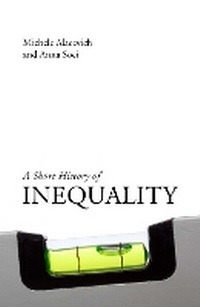
A Short History of Inequality
Published on 31. October 2017
Book
Hardback
232 pages
978-1-78821-048-5 (ISBN)
Description
Inequality is part and parcel of our lives. What degree of inequality we find acceptable or unacceptable informs the foundational values of our societies, and shapes our political and economic structures. Yet until recently the study of economic inequality (unlike poverty) was considered by economists as a problem not worth examining. That has changed. With the dramatic increase in the concentration of wealth in the hands of a few, inequality has become recognised by all shades of political opinion as a potential threat to economic growth and the functioning of society and democracy.
In A Short History of Inequality, Michele Alacevich and Anna Soci chart the emergence of the inequality question and in so doing provide a masterly overview of the work of recent scholars and the main concepts and debates that have arisen within inequality studies. Their analysis highlights how the historical diffidence to examining inequality, the relationship of inequality to the processes of globalization, and the adverse effects of inequality on democracy are all strongly intertwined.
The book is an ideal introduction for students and the general reader looking to understand what's at stake when the rewards of capitalism are distributed unjustly.
In A Short History of Inequality, Michele Alacevich and Anna Soci chart the emergence of the inequality question and in so doing provide a masterly overview of the work of recent scholars and the main concepts and debates that have arisen within inequality studies. Their analysis highlights how the historical diffidence to examining inequality, the relationship of inequality to the processes of globalization, and the adverse effects of inequality on democracy are all strongly intertwined.
The book is an ideal introduction for students and the general reader looking to understand what's at stake when the rewards of capitalism are distributed unjustly.
Reviews / Votes
I would like to emphasize that it is exciting and appealing to read and study this small book. It is a smart and readable introduction to the issues of inequality from an economic and historic perspective and a good starting point for further in-depth analyses of the consequences of inequality as well as its policy implications. -- Wilfried Altzinger, Journal of EconomicsMore details
Language
English
Place of publication
Newcastle upon Tyne
United Kingdom
Target group
College/higher education
Professional and scholarly
Dimensions
Height: 198 mm
Width: 129 mm
ISBN-13
978-1-78821-048-5 (9781788210485)
Copyright in bibliographic data and cover images is held by Nielsen Book Services Limited or by the publishers or by their respective licensors: all rights reserved.
Schweitzer Classification
Persons
Michele Alacevich is Associate Professor of Economic History at the University of Bologna. He is a former director of global studies at Loyola University Maryland and a research fellow at Harvard University, Columbia University, the Institute for New Economic Thinking (INET), and the World Bank.
Anna Soci is Professor of Economics at the University of Bologna. She is a life-member of Clare Hall, Cambridge, and was recently a research fellow at the Italian Academy for Advanced Studies, Columbia University, and a Jemolo Fellow at Nuffield College, Oxford.
Anna Soci is Professor of Economics at the University of Bologna. She is a life-member of Clare Hall, Cambridge, and was recently a research fellow at the Italian Academy for Advanced Studies, Columbia University, and a Jemolo Fellow at Nuffield College, Oxford.
Content
Introduction
1. Why inequality is the real issue
2. The long neglect of inequality
3. The statistical drift of inequality studies
4. Inequality and globalization
5. Inequality and democracy: an open issue
6. The future of inequality
Appendix: measures of inequality
1. Why inequality is the real issue
2. The long neglect of inequality
3. The statistical drift of inequality studies
4. Inequality and globalization
5. Inequality and democracy: an open issue
6. The future of inequality
Appendix: measures of inequality