

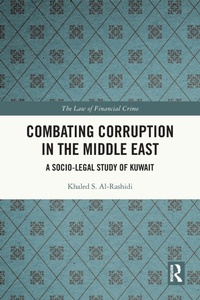
Combating Corruption in the Middle East
A Socio-Legal Study of Kuwait
1st Edition
Published on 26. September 2022
Book
Paperback/Softback
288 pages
978-0-367-72179-4 (ISBN)
Description
This book examines the phenomenon of 'grand corruption' in Kuwait and the pattern in the wider region.
Taking an interdisciplinary approach, the work places corruption in its sociological, political and economic context to explore the relationship between the characteristics of Kuwait as a state with an endemic corruption problem. It then focuses on laws and regulations as key problem-solving mechanisms. In doing so, it identifies, explores, and assesses the existing counter-corruption laws and regulations in Kuwait in a broad socio-political-economic context. The work goes beyond doctrinal legal research, employing empirical methodology based on semi-structured interviews with elite politicians and professional experts from criminal justice and non-governmental organisations (NGOs). These valuable and original insights are reflected upon throughout the study.
The grand corruption that permeates the tier of high-profile officials in Kuwait is replicated in many developing countries where accountability mechanisms regularly suffer from lack of enforcement. The appeal of this book is its application to numerous jurisdictions, and the Gulf Cooperation Council (GCC) countries and Middle East in particular. It will be a valuable resource for academics, researchers, and policymakers working in the areas of financial crime and corruption.
Taking an interdisciplinary approach, the work places corruption in its sociological, political and economic context to explore the relationship between the characteristics of Kuwait as a state with an endemic corruption problem. It then focuses on laws and regulations as key problem-solving mechanisms. In doing so, it identifies, explores, and assesses the existing counter-corruption laws and regulations in Kuwait in a broad socio-political-economic context. The work goes beyond doctrinal legal research, employing empirical methodology based on semi-structured interviews with elite politicians and professional experts from criminal justice and non-governmental organisations (NGOs). These valuable and original insights are reflected upon throughout the study.
The grand corruption that permeates the tier of high-profile officials in Kuwait is replicated in many developing countries where accountability mechanisms regularly suffer from lack of enforcement. The appeal of this book is its application to numerous jurisdictions, and the Gulf Cooperation Council (GCC) countries and Middle East in particular. It will be a valuable resource for academics, researchers, and policymakers working in the areas of financial crime and corruption.
More details
Series
Language
English
Place of publication
London
United Kingdom
Publishing group
Taylor & Francis Ltd
Target group
College/higher education
Postgraduate
Illustrations
2 s/w Abbildungen, 2 s/w Zeichnungen, 19 s/w Tabellen
19 Tables, black and white; 2 Line drawings, black and white; 2 Illustrations, black and white
Dimensions
Height: 234 mm
Width: 156 mm
Thickness: 17 mm
Weight
471 gr
ISBN-13
978-0-367-72179-4 (9780367721794)
Copyright in bibliographic data and cover images is held by Nielsen Book Services Limited or by the publishers or by their respective licensors: all rights reserved.
Schweitzer Classification
Other editions
Additional editions
Book
03/2021
1st Edition
Routledge
€206.80
Shipment within 15-20 days
E-Book
03/2021
1st Edition
Routledge
€58.99
Available for download
E-Book
03/2021
1st Edition
Routledge
€58.99
Available for download
Person
Khaled Al-Rashidi is an assistant professor in the Criminal Law Department at School of Law, Kuwait University.
Content
1 Introduction
2 The phenomenon of corruption
3 Counter-corruption: Values and strategies
4 Kuwaiti criminal counter-corruption measures
5 Kuwaiti non-criminal counter-corruption measures
6 Conclusion
2 The phenomenon of corruption
3 Counter-corruption: Values and strategies
4 Kuwaiti criminal counter-corruption measures
5 Kuwaiti non-criminal counter-corruption measures
6 Conclusion