

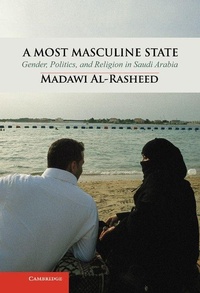
A Most Masculine State
Gender, Politics and Religion in Saudi Arabia
Published on 15. March 2013
Book
Hardback
348 pages
978-0-521-76104-8 (ISBN)
Description
Women in Saudi Arabia are often described as either victims of patriarchal religion and society or successful survivors of discrimination imposed on them by others. Madawi Al-Rasheed's new book goes beyond these conventional tropes to probe the historical, political and religious forces that have, across the years, delayed and thwarted their emancipation. The book demonstrates how, under the patronage of the state and its religious nationalism, women have become hostage to contradictory political projects that on the one hand demand female piety, and on the other hand encourage modernity. Drawing on state documents, media sources and interviews with women from across Saudi society, the book examines the intersection between gender, religion and politics to explain these contradictions and to show that, despite these restraints, vibrant debates on the question of women are opening up as the struggle for recognition and equality finally gets under way.
Reviews / Votes
'This book deserves praise - and more importantly - to be read by those with an interest in Saudi Arabia or a desire to learn more about the factors and mechanisms that contribute to women's continued marginalisation worldwide.' The Times Higher Education Supplement 'Al-Rasheed demonstrates the centrality of women in a state that draws its legitimacy from its fidelity to the sectarian ideology that presided over its birth in the 19th century. The author depicts the relationship between state and Wahabism (deemed a form of 'religious nationalism') as close, albeit fraught with tensions ... the book is timely, lucid, and filled with insights into the lives of these still little-known women. Summing up: recommended. All academic levels/libraries.' M. Lazreg, Choice 'What makes the book so rewarding and useful is, first, the thoughtful, richly detailed historical context it provides for understanding women's education, the regulations of women's bodies and sexuality, and the place of women in business relations in Saudi Arabia over the span of several decades. But Al-Rasheed is also very attentive to both the state-centered mythologizing and religious discourse-making that goes into the maintenance of gender relations, as well as the contestation over the boundaries of control ... For now, her readers will be grateful for such a sympathetically critical guide to the way so many Saudi women live today.' Laleh Khalili, Women's Studies QuarterlyMore details
Series
Language
English
Place of publication
Cambridge
United Kingdom
Target group
Professional and scholarly
Illustrations
- Printed music items
Dimensions
Height: 235 mm
Width: 157 mm
Thickness: 23 mm
Weight
655 gr
ISBN-13
978-0-521-76104-8 (9780521761048)
Copyright in bibliographic data and cover images is held by Nielsen Book Services Limited or by the publishers or by their respective licensors: all rights reserved.
Schweitzer Classification
Other editions
Additional editions
E-Book
04/2013
1st Edition
Cambridge University Press
€26.49
Available for download
Book
04/2013
Cambridge University Press
€40.10
Shipment within 15-20 days
E-Book
03/2013
Cambridge University Press
€21.99
Available for download
Person
Madawi Al-Rasheed is Professor of Anthropology of Religion at King's College London. She specialises in Saudi history, politics and society. Her publications include Contesting the Saudi State (2007), Kingdom without Borders (2009) and A History of Saudi Arabia (2010).
Content
Introduction: the 'woman question' in Saudi Arabia; 1. From religious revival to religious nationalism; 2. Schooling women: the state as benevolent educator; 3. Symbols of piety: fatwa on women in the 1980s; 4. The quest for cosmopolitan modernity; 5. Women in search of themselves; 6. Celebrity women novelists and the cosmopolitan fantasy; 7. Guarding self and nation: women preachers and activists; Conclusion: light at the end of the tunnel.