

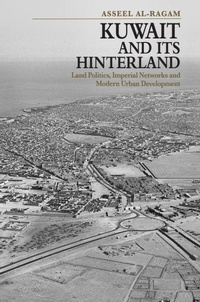
Kuwait and its Hinterland
Land Politics, Imperial Networks and Modern Urban Development
Will be published approx. on 30. June 2026
Book
Hardback
288 pages
978-1-3995-5497-8 (ISBN)
Description
This book rethinks Gulf urbanism by placing the infrastructure, planning and spatial politics of Kuwait at the centre of analysis. Offering an alternative to oil-centred narratives, it examines the impact of British indirect rule on the built environment after the signing of the 1899 Anglo-Kuwaiti Agreement. It explores how British indirect rule, regional realignments and land politics reconfigured Kuwait's urban landscape and disrupted longstanding ties to its hinterland.
Drawing on extensive research in colonial and local archives, the book focuses on the period from 1904 to 1971, from the arrival of the first Political Agent to the British withdrawal from the Gulf. It shows how indirect rule operated through networks of intermediaries who transferred and adapted a range of administrative and planning models from across the British Empire, playing a central role in shaping urban growth while also negotiating - and sometimes containing - competing spatial futures. By situating Kuwait within imperial networks, trade routes and regional infrastructures, the book offers a new framework for understanding Gulf cities beyond oil.
Drawing on extensive research in colonial and local archives, the book focuses on the period from 1904 to 1971, from the arrival of the first Political Agent to the British withdrawal from the Gulf. It shows how indirect rule operated through networks of intermediaries who transferred and adapted a range of administrative and planning models from across the British Empire, playing a central role in shaping urban growth while also negotiating - and sometimes containing - competing spatial futures. By situating Kuwait within imperial networks, trade routes and regional infrastructures, the book offers a new framework for understanding Gulf cities beyond oil.
Reviews / Votes
By treating history as an unfinished field of possibilities rather than a linear march to modernity, Al-Ragam disrupts standard oil-centred accounts of Kuwait. She reveals how urbanization actually stemmed from the interplay of British imperialism, territorial politics, local interests, and the negotiation between the city and its hinterland. -- Nasser Rabbat, Massachusetts Institute of Technology A superb book that masterfully uses urban history to unravel the uneven legacies of imperial rule, its complex connections with local intermediaries and how these relationalities reshaped modern political geographies of Kuwait and its hinterland-legitimising dominant power even as they reworked it through contestations that still resonate in urban development today and in possibilities for more just regional futures. -- Mona Harb, American University of BeirutMore details
Language
English
Place of publication
Edinburgh
United Kingdom
Target group
Professional and scholarly
Dimensions
Height: 234 mm
Width: 156 mm
ISBN-13
978-1-3995-5497-8 (9781399554978)
Copyright in bibliographic data and cover images is held by Nielsen Book Services Limited or by the publishers or by their respective licensors: all rights reserved.
Schweitzer Classification
Person
Asseel Al-Ragam is an Associate Professor of Architecture at Kuwait University, where she also serves as Vice Dean for Planning, Consultation and Training, and Director of the Design Development and Research Lab. Her research focuses on the urban history and planning of Kuwait, with particular interest in knowledge circulation, sustainable urban development, public space, and socio-political dynamics in the built environment. She has held research fellowships at Sciences Po, Paris (2022-2024) and ENSA Malaquais (2011-2012), and her work has been supported by the Kuwait Foundation for the Advancement of Sciences (KFAS) and the LSE Middle East Centre. She sits on the international advisory board of Manazir Journal and is co-author of Kuwaitscapes (2022), a public engagement card game published under a Creative Commons licence. Her publications include contributions to the International Journal of Urban and Regional Research and the International Journal of Heritage Studies.
Content
1. Beyond Oil: Empire, Urbanisation, and the Making of Modern Kuwait
2. The Making of an Imperial Outpost: Kuwait's Integration into British Networks
3. 'Brer Rabbit' Diplomacy and the Politics of Land Use Development
4. Negotiating Influence: Social Capital and Architectural Expression of British Agency Buildings in Kuwait
5. Reordering Space: The Changing Role of Kuwait's Hinterland in Trade and Governance
6. From Improvement Trusts to Development Boards: Model Towns and the Politics of Urban Modernity
7. 'Kuwait is a Welfare State': Spatialising Exclusion in the Welfare State
8. Revisiting Gulf Urbanism: Toward Alternative Histories and Futures
References
2. The Making of an Imperial Outpost: Kuwait's Integration into British Networks
3. 'Brer Rabbit' Diplomacy and the Politics of Land Use Development
4. Negotiating Influence: Social Capital and Architectural Expression of British Agency Buildings in Kuwait
5. Reordering Space: The Changing Role of Kuwait's Hinterland in Trade and Governance
6. From Improvement Trusts to Development Boards: Model Towns and the Politics of Urban Modernity
7. 'Kuwait is a Welfare State': Spatialising Exclusion in the Welfare State
8. Revisiting Gulf Urbanism: Toward Alternative Histories and Futures
References