

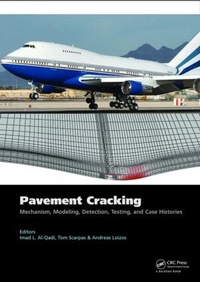
Pavement Cracking
Mechanisms, Modeling, Detection, Testing and Case Histories
1st Edition
Published on 30. July 2008
Book
Hardback
930 pages
978-0-415-47575-4 (ISBN)
Description
Internationally, much attention is given to causes, prevention, and rehabilitation of cracking in concrete, flexible, and composite pavements. The Sixth RILEM
International Conference on Cracking in Pavements (Chicago, June 16-18, 2008) provided a forum for discussion of recent developments and research results.
This book is a collection of papers from the Conference, and includes contributions on a variety of topics:
- Modeling of the initiation and propagation of pavement cracking
- Top-down and bottom-up fatigue cracking mechanisms
- Laboratory testing techniques and evaluation effectiveness
- Construction approaches and their relation to crack development
- Crack surveys and nondestructive evaluation
- In-situ experimental studies: field construction and rehabilitation techniques to inhibit pavement cracking
- Performance of crack preventative techniques and pavement service life prediction
- Interlay system effectiveness
- Pavement cracking evaluation using accelerated pavement testing
- Hot-mix asphalt overlay characterization
- Pavement interface modeling and testing
- Laboratory and field model validation
- Low-temperature cracking mechanisms and field studies
- Cracking in semi-rigid and stabilized pavement layers
- Analytical and experimental investigations of concrete joints
- White topping performance
Pavement Cracking: Mechanisms, Modeling, Detection, Testing, and Case Histories is particularly of interest to academics, researchers, and
practitioners involved in pavement mechanics and performance.
International Conference on Cracking in Pavements (Chicago, June 16-18, 2008) provided a forum for discussion of recent developments and research results.
This book is a collection of papers from the Conference, and includes contributions on a variety of topics:
- Modeling of the initiation and propagation of pavement cracking
- Top-down and bottom-up fatigue cracking mechanisms
- Laboratory testing techniques and evaluation effectiveness
- Construction approaches and their relation to crack development
- Crack surveys and nondestructive evaluation
- In-situ experimental studies: field construction and rehabilitation techniques to inhibit pavement cracking
- Performance of crack preventative techniques and pavement service life prediction
- Interlay system effectiveness
- Pavement cracking evaluation using accelerated pavement testing
- Hot-mix asphalt overlay characterization
- Pavement interface modeling and testing
- Laboratory and field model validation
- Low-temperature cracking mechanisms and field studies
- Cracking in semi-rigid and stabilized pavement layers
- Analytical and experimental investigations of concrete joints
- White topping performance
Pavement Cracking: Mechanisms, Modeling, Detection, Testing, and Case Histories is particularly of interest to academics, researchers, and
practitioners involved in pavement mechanics and performance.
More details
Language
English
Place of publication
London
United Kingdom
Publishing group
Taylor & Francis Ltd
Target group
College/higher education
Dimensions
Height: 246 mm
Width: 174 mm
Weight
1752 gr
ISBN-13
978-0-415-47575-4 (9780415475754)
Copyright in bibliographic data and cover images is held by Nielsen Book Services Limited or by the publishers or by their respective licensors: all rights reserved.
Schweitzer Classification
Other editions
Additional editions
Imad L. Al-Qadi | Tom Scarpas | Andreas Loizos
Pavement Cracking
Mechanisms, Modeling, Detection, Testing and Case Histories
E-Book
07/2008
1st Edition
CRC Press
€555.99
Available for download
Imad L. Al-Qadi | Tom Scarpas | Andreas Loizos
Pavement Cracking
Mechanisms, Modeling, Detection, Testing and Case Histories
E-Book
07/2008
CRC Press
€555.99
Available for download
Persons
Imad L. Al-Qadi, Tom Scarpas, Andreas Loizos
Content
@contents: Selected Contents: 1. Accelarated pavement testing to access pavement structure, interface bonding and reflective cracking; 2. Analytical and experimental investigations of concrete joints; 3. Performance of concrete pavements and white toppings; 4. Cracking in semi-rigid and stabilized-base pavements; 5. Fatigue cracking and damage characterization of HMA; 6. Top-down cracking in flexible pavements; 7. Low temperature cracking in HMA; 8. Binder and HMA laboratory characterization for cracking potential; 9. Pavement modeling response, crack analysis and damage predicion; 10. Pavement interface testing and modeling; 11. Interlayer system effectiveness in reducing reflective cracking in pavements; 12. Field investigation of pavement cracking; 13. Pavement cracking detection; 14. Cracking control in concrete and bridge decks. 15 Author Index