

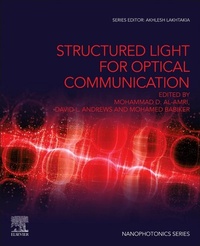
Structured Light for Optical Communication
Published on 23. June 2021
Book
Paperback/Softback
312 pages
978-0-12-821510-4 (ISBN)
Description
Structured Light for Optical Communication highlights principles and applications in the rapidly evolving field of structured light in wide-ranging contexts, from classical forms of communication to new frontiers of quantum communication. Besides the basic principles and applications, the book covers the background of structured light in its most common forms, as well as state-of-the-art developments. Structured light has been hailed as affording outstanding prospects for the realization of high bandwidth communication, enhanced tools for more highly secure cryptography, and exciting opportunities for providing a reliable platform for quantum computing.This book is a valuable resource for graduate students and other active researchers, as well as others who may be interested in learning about this cutting-edge research field.
More details
Series
Language
English
Place of publication
United States
Target group
Professional and scholarly
Dimensions
Height: 235 mm
Width: 191 mm
Weight
630 gr
ISBN-13
978-0-12-821510-4 (9780128215104)
Copyright in bibliographic data and cover images is held by Nielsen Book Services Limited or by the publishers or by their respective licensors: all rights reserved.
Schweitzer Classification
Other editions
Additional editions
Mohammad D. Al-Amri | Mohamed Babiker | David Andrews
Structured Light for Optical Communication
E-Book
06/2021
Elsevier
€195.00
Available for download
Persons
Mohammad Al-Amri is Professor of Physics at the Center for Quantum Optics and Quantum Informatics, KACST, Riyadh, Saudi Arabia. His research focuses in the areas of quantum optics and quantum informatics. Mohamed Babiker is Emeritus Professor of Physics at the University of York, UK. His research focuses on quantum optics theory, optical and matter vortices, and quantum field theory. David L. Andrews is Emeritus Professor of Chemical Physics at the University of East Anglia, UK. His research, covering a wide range of topics in spectroscopy, optics, photonics, and quantum science, has produced over four hundred scientific papers, nearly all of them applying the tools of molecular quantum electrodynamics. As an author and editor, he has already published more than twenty books, including Lasers in Chemistry, Resonance Energy Transfer, Structured Light and its Applications, Optical Nanomanipulation, and an Introduction to Photon Science and Technology. David has organized more than a hundred international conferences, both in Europe and North America, including several now well-established series: Complex Light and Optical Forces at Photonics West, Nanophotonics at Photonics Europe, and several iterations of the International Conference on Optical Angular Momentum. He is an awardee of the RSC Horizon Prize in 2022 and the IOP Thomas Young Award in 2023. David is a Fellow of SPIE - the international society for optics and photonics; also Optica; the Institute of Physics; and the Royal Society of Chemistry. He served as elected President of SPIE in 2021.
Content
1. Basics of quantum communications
2. Structured Light
3.Quantum features of structured light
4. Poincare beams for optical communications
5. Operators in paraxial quantum optics
6. Quantum cryptography with structured photons
7. Spin and Angular Momentum Coupling
8. Quantum communication with structured light
9. Optical angular momentum interaction with turbulent and scattering media
10. Causes and mitigation of modal crosstalk in OAM multiplexed optical communication links
2. Structured Light
3.Quantum features of structured light
4. Poincare beams for optical communications
5. Operators in paraxial quantum optics
6. Quantum cryptography with structured photons
7. Spin and Angular Momentum Coupling
8. Quantum communication with structured light
9. Optical angular momentum interaction with turbulent and scattering media
10. Causes and mitigation of modal crosstalk in OAM multiplexed optical communication links