

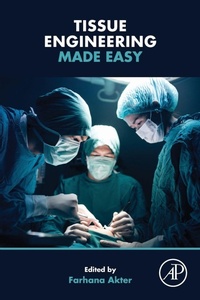
Tissue Engineering Made Easy
Published on 2. June 2016
Book
Paperback/Softback
116 pages
978-0-12-805361-4 (ISBN)
Description
Tissue Engineering Made Easy provides concise, easy to understand, up-to-date information about the most important topics in tissue engineering. These include background and basic principles, clinical applications for a variety of organs (skin, nerves, eye, heart, lungs and bones), and the future of the field. The descriptions and explanations of each topic are such that those who have not had any exposure to the principles and practice of tissue engineering will be able to understand them, and the volume will serve as a source for self-teaching to get readers to a point where they can effectively engage with active researchers.
More details
Language
English
Place of publication
San Diego
United States
Publishing group
Elsevier Science Publishing Co Inc
Target group
Professional and scholarly
Product notice
Paperback (trade)
Dimensions
Height: 229 mm
Width: 152 mm
Thickness: 7 mm
Weight
185 gr
ISBN-13
978-0-12-805361-4 (9780128053614)
Copyright in bibliographic data and cover images is held by Nielsen Book Services Limited or by the publishers or by their respective licensors: all rights reserved.
Schweitzer Classification
Other editions
Additional editions
Person
His status as an early-career researcher (with a limited publication record; h-index 5) is precisely what makes this author the ideal voice for a truly entry-level volume. Other successful Life Science titles - MATLAB for Neuroscientists and Guide to Research Techniques for Neuroscientists - serve as examples of how young authors can effectively address the questions most pertinent to others in their same career phase. Author, OSCE Passcards for Medical Students (Radcliffe Publishing, 2014, 9781910227251) - publication designed to test Objective Structured Clinical Examination candidates on procedure for a wide variety of topics. Presents topics in an easy-to-read format, detailing best practices, pertinent questions, tests to perform, and possible responses and suspected diagnoses. Prizes & distinctions: Great Britain & Ireland Intercalated award, 2009; Young Physiologists Prize, 2009; Royal College of Obstetrics & Gynaecology research prize, 2010; Merit prize for Teaching, 2013. Additional clinical and research experience: Critical care, MGH, Harvard Medical School; Neurosurgery, Hospital Kuala Lumpur; Postpartum Haemorrhage, BDG, Hospital, Tanzania; Febrile convulsions, ICMH, Dhaka, Bangladesh.
Content
1. What is tissue engineering?2. Principles of tissue engineering3. Factors governing tissue engineering4. Skin regeneration5. Nerve regeneration6. Opthalmic regeneration7. Cardiovascular regeneration8. Respiratory regeneration 9. Bone regeneration