

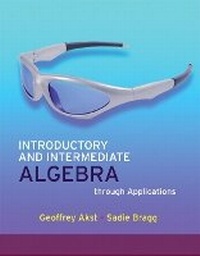
Introductory and Intermediate Algebra through Applications
2nd Edition
Published on 19. February 2008
Book
Paperback/Softback
1104 pages
978-0-321-53578-8 (ISBN)
Description
Presented in a clear and concise style, the Akst/Bragg series teaches by example while expanding understanding with applications that are fully integrated throughout the text and exercise sets. Akst/Bragg's user-friendly design offers a distinctive side-by-side format that pairs each example and its solution with a corresponding practice exercise. The concise writing style keeps students' interest and attention by presenting the mathematics with minimal distractions, and the motivating real-world applications demonstrate how integral mathematical understanding is to a variety of disciplines, careers, and everyday situations.
More details
Edition
2nd edition
Language
English
Place of publication
United States
Publishing group
Pearson Education (US)
Target group
College/higher education
Dimensions
Height: 276 mm
Width: 216 mm
Weight
1996 gr
ISBN-13
978-0-321-53578-8 (9780321535788)
Copyright in bibliographic data and cover images is held by Nielsen Book Services Limited or by the publishers or by their respective licensors: all rights reserved.
Schweitzer Classification
Other editions
New editions
Geoffrey Akst | Sadie Bragg
Introductory and Intermediate Algebra through Applications
Book
03/2013
3rd Edition
Pearson
€216.64
Article is exhausted; no reprint
Geoffrey Akst | Sadie Bragg
Introductory and Intermediate Algebra Through Applications Plus NEW MyMathLab with Pearson eText -- Access Card Package
Book
02/2013
3rd Edition
Pearson
Unfortunately, price unknown
Article is exhausted; no reprint
Persons
Geoffrey Akst and Sadie Bragg have worked together for many years as professors of mathematics at Borough of Manhattan Community College/City University of New York. They met as graduate students at Teachers College, Columbia University, where they were both working on degrees in the teaching of college mathematics. The emphasis on applications in their texts reflects a concern they share for helping students understand why the topics to be studied are useful. Dr. Akst for years has begun his classes with the payoff question:- why is this material worth learning? A native New Yorker, he enjoys surfing the Web, listening to good music, and traveling to exciting places. Dr. Bragg, who began her career in math education as a high school geometry teacher, credits her teachers with inspiring her love for mathematics and an appreciation of its utility. A transplanted Virginian, she spends her time with her family and her beautiful granddaughter, Maya.
Content
R. Prealgebra Review
R.1 Exponents and Order of Operations
R.2 Factors, Primes, and Least Common Multiples
R.3 Fractions
R.4 Decimals
R.5 Percents
1. Real Numbers and Algebraic Expressions
1.1 Real Numbers and the Real-Number Line
1.2 Addition of Real Numbers
1.3 Subtraction of Real Numbers
1.4 Multiplication and Division of Real Numbers
1.5 Properties of Real Numbers
1.6 Algebraic Expressions, Translations, and Exponents
1.7 Simplifying Algebraic Expressions
1.8 Translating and Evaluating Algebraic Expressions
2. Solving Linear Equations and Inequalities
2.1 Solving Linear Equations: The Addition Property
2.2 Solving Linear Equations: The Multiplication Property
2.3 Solving Linear Equations by Combining Properties
2.4 Solving Literal Equations and Formulas
2.5 Solving Equations Involving Percent
2.6 Solving Linear Inequalities
3. Graphing Linear Equations and Inequalities; Functions
3.1 Introduction to Graphing
3.2 Slope of a Line
3.3 Graphing Linear Equations
3.4 More on Linear Equations and Their Graphs
3.5 Graphing Linear Inequalities
3.6 Introduction to Functions
4. Systems of Equations and Inequalities
4.1 Solving Systems of Linear Equations by Graphing
4.2 Solving Systems of Linear Equations by Substitution
4.3 Solving Systems of Linear Equations by Elimination
4.4 Solving Systems of Linear Inequalities
5. Exponents and Polynomials
5.1 Laws of Exponents
5.2 More Laws of Exponents and Scientific Notation
5.3 Basic Concepts of Polynomials
5.4 Addition and Subtraction of Polynomials
5.5 Multiplication of Polynomials
5.6 Special Products
5.7 Division of Polynomials
6. Factoring Polynomials
6.1 Common Factoring and Factoring by Grouping
6.2 Factoring Trinomials Whose Leading Coefficient Is 1
6.3 Factoring Trinomials Whose Leading Coefficient Is Not 1
6.4 Special Factoring
6.5 More Factoring Strategies
6.6 Solving Quadratic Equations by Factoring
7. Rational Expressions and Equations
7.1 Rational Expressions and Functions
7.2 Multiplication and Division of Rational Expressions
7.3 Addition and Subtraction of Rational Expressions
7.4 Complex Rational Expressions
7.5 Solving Rational Equations
7.6 Ratio and Proportion; Variation
8. Radical Expressions and Equations
8.1 Radical Expressions and Functions
8.2 Rational Exponents
8.3 Simplifying Radical Expressions
8.4 Addition and Subtraction of Radical Expressions
8.5 Multiplication and Division of Radical Expressions
8.6 Solving Radical Equations
8.7 Complex Numbers
9. Quadratic Equations, Functions, and Inequalities
9.1 Solving Quadratic Equations: Square Root Property and Completing the Square
9.2 Solving Quadratic Equations: The Quadratic Formula
9.3 More on Quadratic Equations
9.4 Graphing Quadratic Functions
9.5 Solving Quadratic and Rational Inequalities
10. Exponential and Logarithmic Functions
10.1 The Algebra of Functions and Inverse Functions
10.2 Exponential Functions
10.3 Logarithmic Functions
10.4 Properties of Logarithms
10.5 Common Logarithms, Natural Logarithms, and Change of Base
10.6 Exponential and Logarithmic Equations
11. Conic Sections and Nonlinear Systems
11.1 Introduction to Conics; The Parabola
11.2 The Circle
11.3 The Ellipse and the Hyperbola
11.4 Solving Nonlinear Systems of Equations
11.5 Solving Nonlinear Inequalities and Nonlinear Systems of Inequalities
Appendix A. Transition to Intermediate Algebra
A.1 Review of Introductory Algebra
A.2 Solving Compound Inequalities
A.3 Absolute Value Equations and Inequalities
A.4 Systems of Linear Equations in Three Variables
A.5 Solving Systems of Linear Equations by Using Matrices
Appendix B. Additional Topics
B.1 Determinants and Cramer's Rule
B.2 Synthetic Division
Appendix C. Symbols and Graphing Calculators
C.1 Table of Symbols
C.2 Introduction to Graphing Calculators
R.1 Exponents and Order of Operations
R.2 Factors, Primes, and Least Common Multiples
R.3 Fractions
R.4 Decimals
R.5 Percents
1. Real Numbers and Algebraic Expressions
1.1 Real Numbers and the Real-Number Line
1.2 Addition of Real Numbers
1.3 Subtraction of Real Numbers
1.4 Multiplication and Division of Real Numbers
1.5 Properties of Real Numbers
1.6 Algebraic Expressions, Translations, and Exponents
1.7 Simplifying Algebraic Expressions
1.8 Translating and Evaluating Algebraic Expressions
2. Solving Linear Equations and Inequalities
2.1 Solving Linear Equations: The Addition Property
2.2 Solving Linear Equations: The Multiplication Property
2.3 Solving Linear Equations by Combining Properties
2.4 Solving Literal Equations and Formulas
2.5 Solving Equations Involving Percent
2.6 Solving Linear Inequalities
3. Graphing Linear Equations and Inequalities; Functions
3.1 Introduction to Graphing
3.2 Slope of a Line
3.3 Graphing Linear Equations
3.4 More on Linear Equations and Their Graphs
3.5 Graphing Linear Inequalities
3.6 Introduction to Functions
4. Systems of Equations and Inequalities
4.1 Solving Systems of Linear Equations by Graphing
4.2 Solving Systems of Linear Equations by Substitution
4.3 Solving Systems of Linear Equations by Elimination
4.4 Solving Systems of Linear Inequalities
5. Exponents and Polynomials
5.1 Laws of Exponents
5.2 More Laws of Exponents and Scientific Notation
5.3 Basic Concepts of Polynomials
5.4 Addition and Subtraction of Polynomials
5.5 Multiplication of Polynomials
5.6 Special Products
5.7 Division of Polynomials
6. Factoring Polynomials
6.1 Common Factoring and Factoring by Grouping
6.2 Factoring Trinomials Whose Leading Coefficient Is 1
6.3 Factoring Trinomials Whose Leading Coefficient Is Not 1
6.4 Special Factoring
6.5 More Factoring Strategies
6.6 Solving Quadratic Equations by Factoring
7. Rational Expressions and Equations
7.1 Rational Expressions and Functions
7.2 Multiplication and Division of Rational Expressions
7.3 Addition and Subtraction of Rational Expressions
7.4 Complex Rational Expressions
7.5 Solving Rational Equations
7.6 Ratio and Proportion; Variation
8. Radical Expressions and Equations
8.1 Radical Expressions and Functions
8.2 Rational Exponents
8.3 Simplifying Radical Expressions
8.4 Addition and Subtraction of Radical Expressions
8.5 Multiplication and Division of Radical Expressions
8.6 Solving Radical Equations
8.7 Complex Numbers
9. Quadratic Equations, Functions, and Inequalities
9.1 Solving Quadratic Equations: Square Root Property and Completing the Square
9.2 Solving Quadratic Equations: The Quadratic Formula
9.3 More on Quadratic Equations
9.4 Graphing Quadratic Functions
9.5 Solving Quadratic and Rational Inequalities
10. Exponential and Logarithmic Functions
10.1 The Algebra of Functions and Inverse Functions
10.2 Exponential Functions
10.3 Logarithmic Functions
10.4 Properties of Logarithms
10.5 Common Logarithms, Natural Logarithms, and Change of Base
10.6 Exponential and Logarithmic Equations
11. Conic Sections and Nonlinear Systems
11.1 Introduction to Conics; The Parabola
11.2 The Circle
11.3 The Ellipse and the Hyperbola
11.4 Solving Nonlinear Systems of Equations
11.5 Solving Nonlinear Inequalities and Nonlinear Systems of Inequalities
Appendix A. Transition to Intermediate Algebra
A.1 Review of Introductory Algebra
A.2 Solving Compound Inequalities
A.3 Absolute Value Equations and Inequalities
A.4 Systems of Linear Equations in Three Variables
A.5 Solving Systems of Linear Equations by Using Matrices
Appendix B. Additional Topics
B.1 Determinants and Cramer's Rule
B.2 Synthetic Division
Appendix C. Symbols and Graphing Calculators
C.1 Table of Symbols
C.2 Introduction to Graphing Calculators