

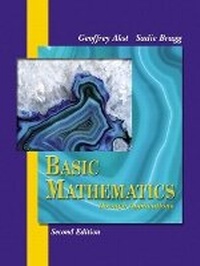
Basic Mathematics through Applications
2nd Edition
Published on 11. March 2003
Book
Paperback/Softback
624 pages
978-0-201-79532-5 (ISBN)
Description
The second edition of Akst/Bragg's Basic Mathematics through Applications brings you even more of a good thing!
Throughout the text, motivating real-world applications, examples, and exercises demonstrate how integral mathematical understanding is to student mastery in other disciplines, a variety of occupations, and everyday situations. A distinctive side-by-side format, pairing each example with a corresponding practice exercise, encourages students to get actively involved in the mathematical content from the start. Unique Mindstretchers target different levels and types of student understanding in one comprehensive section problem set per section. Mindstretchers incorporate related investigation, critical thinking, reasoning, and pattern recognition exercises along with corresponding group work and historical connections. Compelling Historical Notes give students more evidence that mathematics grew out of a universal need to find efficient solutions to everyday problems. Plenty of practice exercises provide ample opportunity for students to thoroughly master basic mathematics skills and develop confidence in their understanding. Finally, new MyMathLab icons in the margins of the text indicate to students that there is a video clip, animated example, or practice exercise for them to explore on-line if you take advantage of the package deal.
Throughout the text, motivating real-world applications, examples, and exercises demonstrate how integral mathematical understanding is to student mastery in other disciplines, a variety of occupations, and everyday situations. A distinctive side-by-side format, pairing each example with a corresponding practice exercise, encourages students to get actively involved in the mathematical content from the start. Unique Mindstretchers target different levels and types of student understanding in one comprehensive section problem set per section. Mindstretchers incorporate related investigation, critical thinking, reasoning, and pattern recognition exercises along with corresponding group work and historical connections. Compelling Historical Notes give students more evidence that mathematics grew out of a universal need to find efficient solutions to everyday problems. Plenty of practice exercises provide ample opportunity for students to thoroughly master basic mathematics skills and develop confidence in their understanding. Finally, new MyMathLab icons in the margins of the text indicate to students that there is a video clip, animated example, or practice exercise for them to explore on-line if you take advantage of the package deal.
More details
Edition
2nd edition
Language
English
Place of publication
United States
Publishing group
Pearson Education (US)
Target group
Professional and scholarly
Dimensions
Height: 276 mm
Width: 216 mm
ISBN-13
978-0-201-79532-5 (9780201795325)
Copyright in bibliographic data and cover images is held by Nielsen Book Services Limited or by the publishers or by their respective licensors: all rights reserved.
Schweitzer Classification
Other editions
New editions
Geoffrey Akst | Sadie Bragg
Basic Mathematics through Applications
Book
03/2004
3rd Edition
Pearson
€60.65
Article exhausted; check for reprint
Previous edition
Geoffrey Akst | Bragg
Basic Mathematics through Applications
Book
02/2002
Pearson
€68.08
Article exhausted; check for reprint
Content
(Note: All chapters begin with a Pretest and end with Key Concepts and Skills, Review Exercises, a Posttest, and with the exception of Chapter 1, a Cumulative Review).
1. Whole Numbers.
Introduction to Whole Numbers.
Adding and Subtracting Whole Numbers.
Multiplying Whole Numbers.
Dividing Whole Numbers.
Exponents, Order of Operations, and Averages.
More on Solving Word Problems.
2. Fractions.
Factors and Prime Numbers.
Introduction to Fractions.
Adding and Subtracting Fractions.
Multiplying and Dividing Fractions.
3. Decimals.
Introduction to Decimals.
Adding and Subtracting Decimals.
Multiplying Decimals.
Dividing Decimals.
4. Basic Algebra: Solving Simple Equations.
Introduction to Basic Algebra.
Solving Addition and Subtraction Equations.
Solving Multiplication and Division Equations.
5. Ratio and Proportion.
Introduction to Ratios.
Solving Proportions.
6. Percents.
Introduction to Percents.
Solving Percent Problems.
More on Percents.
7. Signed Numbers.
Introduction to Signed Numbers.
Adding Signed Numbers.
Subtracting Signed Numbers.
Multiplying Signed Numbers.
Dividing Signed Numbers.
8. Basic Statistics.
Introduction to Basic Statistics.
Tables and Graphs.
9. More on Algebra.
Solving Two-Step Equations.
Solving Multistep Equations.
Using Formulas.
10. Measurement and Units.
U.S. Customary Units.
Metric Units and Metric/U.S. Customary Unit Conversions.
11. Basic Geometry.
Introduction to Basic Geometry.
Perimeter and Circumference.
Area.
Volume.
Similar Triangles.
Square Roots and the Pythagorean Theorem.
Appendix.
The Times Table.
Common Fraction, Decimal, and Percent Equivalents.
A Table of Squares and Square Roots.
1. Whole Numbers.
Introduction to Whole Numbers.
Adding and Subtracting Whole Numbers.
Multiplying Whole Numbers.
Dividing Whole Numbers.
Exponents, Order of Operations, and Averages.
More on Solving Word Problems.
2. Fractions.
Factors and Prime Numbers.
Introduction to Fractions.
Adding and Subtracting Fractions.
Multiplying and Dividing Fractions.
3. Decimals.
Introduction to Decimals.
Adding and Subtracting Decimals.
Multiplying Decimals.
Dividing Decimals.
4. Basic Algebra: Solving Simple Equations.
Introduction to Basic Algebra.
Solving Addition and Subtraction Equations.
Solving Multiplication and Division Equations.
5. Ratio and Proportion.
Introduction to Ratios.
Solving Proportions.
6. Percents.
Introduction to Percents.
Solving Percent Problems.
More on Percents.
7. Signed Numbers.
Introduction to Signed Numbers.
Adding Signed Numbers.
Subtracting Signed Numbers.
Multiplying Signed Numbers.
Dividing Signed Numbers.
8. Basic Statistics.
Introduction to Basic Statistics.
Tables and Graphs.
9. More on Algebra.
Solving Two-Step Equations.
Solving Multistep Equations.
Using Formulas.
10. Measurement and Units.
U.S. Customary Units.
Metric Units and Metric/U.S. Customary Unit Conversions.
11. Basic Geometry.
Introduction to Basic Geometry.
Perimeter and Circumference.
Area.
Volume.
Similar Triangles.
Square Roots and the Pythagorean Theorem.
Appendix.
The Times Table.
Common Fraction, Decimal, and Percent Equivalents.
A Table of Squares and Square Roots.