

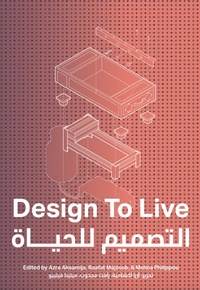
Design To Live
Everyday Inventions from a Refugee Camp
Published on 19. October 2021
Book
Paperback/Softback
344 pages
978-0-262-54287-6 (ISBN)
Description
The power of design to create a life worth living even in a refugee camp: designs, inventions, and artworks from the Azraq Refugee Camp in Jordan.
This book shows how, even in the most difficult conditions--forced displacement, trauma, and struggle--design can help create a life worth living. Design to Live documents designs, inventions, and artworks created by Syrian refugees living in the Azraq Refugee Camp in Jordan. Through these ingenious and creative innovations--including the vertical garden, an arrangement necessitated by regulations that forbid planting in the ground; a front hall, fashioned to protect privacy; a baby swing made from recycled desks; and a chess set carved from a broomstick--refugees defy the material scarcity, unforgiving desert climate, and cultural isolation of the camp.
Written in close collaboration with the residents of the camp, with text in both English and Arabic, Design to Live, reflects two perspectives on the camp: people living and working in Azraq and designers reflecting on humanitarian architecture within the broader field of socially engaged art and design. Architectural drawings, illustrations, photographs, narratives, and stories offer vivid testimony to the imaginative and artful ways that residents alter and reconstruct the standardized humanitarian design of the camp--and provide models that can be replicated elsewhere. The book is the product of a three-year project undertaken by MIT Future Heritage Lab, researchers and students with Syrian refugees at the Azraq Refugee Camp, CARE, Jordan, and the German-Jordanian University.
Copublication with Future Heritage Lab, MIT
This book shows how, even in the most difficult conditions--forced displacement, trauma, and struggle--design can help create a life worth living. Design to Live documents designs, inventions, and artworks created by Syrian refugees living in the Azraq Refugee Camp in Jordan. Through these ingenious and creative innovations--including the vertical garden, an arrangement necessitated by regulations that forbid planting in the ground; a front hall, fashioned to protect privacy; a baby swing made from recycled desks; and a chess set carved from a broomstick--refugees defy the material scarcity, unforgiving desert climate, and cultural isolation of the camp.
Written in close collaboration with the residents of the camp, with text in both English and Arabic, Design to Live, reflects two perspectives on the camp: people living and working in Azraq and designers reflecting on humanitarian architecture within the broader field of socially engaged art and design. Architectural drawings, illustrations, photographs, narratives, and stories offer vivid testimony to the imaginative and artful ways that residents alter and reconstruct the standardized humanitarian design of the camp--and provide models that can be replicated elsewhere. The book is the product of a three-year project undertaken by MIT Future Heritage Lab, researchers and students with Syrian refugees at the Azraq Refugee Camp, CARE, Jordan, and the German-Jordanian University.
Copublication with Future Heritage Lab, MIT
More details
Language
English
Place of publication
Cambridge (Massachusetts)
United States
Publishing group
MIT Press Ltd
Product notice
Paperback (trade)
Unsewn / adhesive bound
Illustrations
165 figures
Dimensions
Height: 237 mm
Width: 168 mm
Thickness: 22 mm
Weight
762 gr
ISBN-13
978-0-262-54287-6 (9780262542876)
Copyright in bibliographic data and cover images is held by Nielsen Book Services Limited or by the publishers or by their respective licensors: all rights reserved.
Schweitzer Classification
Other editions
Additional editions
Azra Aksamija | Raafat Majzoub | Melina Philippou
Design to Live
Everyday Inventions from a Refugee Camp
E-Book
10/2021
MIT Press
€32.49
Available for download
Persons
Azra Aksamija, an artist and architectural historian, is Director and Founder of the MIT Future Heritage Lab (FHL) and Associate Professor in the MIT Department of Architecture and the Program in Art, Culture, and Technology. Raafat Majzoub, an architect, artist, and writer, is Director of The Khan: The Arab Association for Prototyping Cultural Practices, and Lecturer in the Architecture and Design Department at the American University of Beirut. Melina Philippou is an urban designer, Program Director of FHL, and a teaching fellow in the Department of Architecture at the University of Cyprus.