

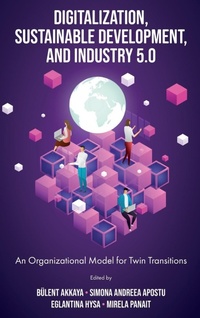
Digitalization, Sustainable Development, and Industry 5.0
An Organizational Model for Twin Transitions
Published on 20. November 2023
Book
Hardback
384 pages
978-1-83753-191-2 (ISBN)
Description
The business world finds itself in a state of transition, driven in tandem by the strategies of digitalization and sustainable development. A complex process, various stakeholders approach the transition with different tools. Public authorities create the legal and institutional framework, companies fuel the process of technological innovation but also promote sustainable development in their activity. Social responsibility has become a key element of the business strategy also embraced by portfolio investors, universities, consumers.
Digitalization, Sustainable Development, and Industry 5.0 offers cutting-edge multidisciplinary research, with expert insights on the technologies and strategies businesses use in the twin transition process. The challenges of a Society 5.0-based new normal organizational model and the contributors' solutions both inform and teach regarding the present, as well as illuminate the path ahead. Understanding the best practices that have emerged in the twin transition allows researchers and practitioners alike to become more effective and serve as a launching point for future generations.
The chapters present strategies for academics, researchers, managers, practitioners, and entrepreneurs looking to use new information technologies for business development while protecting the environment. Administrators, educational leaders, policymakers, researchers and other professionals can utilize the extensive research on managing organizations and providing valuable leading and professional development initiatives as well as implementing the latest administrative technologies.
Digitalization, Sustainable Development, and Industry 5.0 offers cutting-edge multidisciplinary research, with expert insights on the technologies and strategies businesses use in the twin transition process. The challenges of a Society 5.0-based new normal organizational model and the contributors' solutions both inform and teach regarding the present, as well as illuminate the path ahead. Understanding the best practices that have emerged in the twin transition allows researchers and practitioners alike to become more effective and serve as a launching point for future generations.
The chapters present strategies for academics, researchers, managers, practitioners, and entrepreneurs looking to use new information technologies for business development while protecting the environment. Administrators, educational leaders, policymakers, researchers and other professionals can utilize the extensive research on managing organizations and providing valuable leading and professional development initiatives as well as implementing the latest administrative technologies.
More details
Language
English
Place of publication
Bingley
United Kingdom
Target group
Professional and scholarly
Dimensions
Height: 235 mm
Width: 157 mm
Thickness: 25 mm
Weight
706 gr
ISBN-13
978-1-83753-191-2 (9781837531912)
Copyright in bibliographic data and cover images is held by Nielsen Book Services Limited or by the publishers or by their respective licensors: all rights reserved.
Schweitzer Classification
Other editions
Additional editions
Buelent Akkaya | Simona Andreea Apostu | Eglantina Hysa
Digitalization, Sustainable Development, and Industry 5.0
An Organizational Model for Twin Transitions
E-Book
11/2023
Emerald Publishing Limited
€105.99
Available for download
Persons
Buelent Akkaya is Associate Professor and Head of the Department of Office Management & Secretary at Ahmetli VHS of the Manisa Celal Bayar University, Turkey.
Simona Andreea Apostu is Lecturer at the Department of Statistics and Econometrics, Bucharest University of Economic Studies, Romania, and a Scientific Researcher at the Institute of National Economy.
Eglantina Hysa is Associate Professor of Economics at Epoka University, Albania, & International Expert for Higher Education and Bologna System.
Mirela Panait is Professor at Faculty of Economic Sciences, Petroleum-Gas University of Ploiesti, Romania.
Simona Andreea Apostu is Lecturer at the Department of Statistics and Econometrics, Bucharest University of Economic Studies, Romania, and a Scientific Researcher at the Institute of National Economy.
Eglantina Hysa is Associate Professor of Economics at Epoka University, Albania, & International Expert for Higher Education and Bologna System.
Mirela Panait is Professor at Faculty of Economic Sciences, Petroleum-Gas University of Ploiesti, Romania.
Content
Chapter 1. Implementation of key enabling technologies (KETS) in nursing care processes in viewpoint of digital transformation; Sema UEstgoeruel
Chapter 2. Digital transformation and management of VUCA-RR environments in perspective of industry 5.0; Goezde Mert, Bulent Akkaya, and Apostu Simona Andreea
Chapter 3. Digital and sustainable products to achieve sustainable business goals along the path to industry 5.0; Iza Gigauri and Laeeq Razzak Janjua
Chapter 4. Human capital management and digitalization - From good practices and traditions to sustainable development; Valentin Vasilev, Dimitrina Stefanova, and Catalin Popescu
Chapter 5. Digital financial literacy and entrepreneurial performance: A percipience from a developing economy; Hiranya Dissanayake, Anuradha Iddagoda, Thanushka Rukshan, and Thilini Dehika
Chapter 6. AI and XR (AIXR) marketing in industry 5.0 or society 5.0; Osman Koroglu
Chapter 7. A framework for dealing with cybersecurity risks as part of information security; Monia Spagnolo, Valentina Ndou, Davide Giribaldi, and Valentina Arena
Chapter 8. Human resources in the context of digitalization; Gina-Cristina Dimian, Mirela-Ionela Aceleanu, and Ioana-Manuela Mindrican
Chapter 9. Implementing lean manufacturing approach in SMES. A case study from the food processing industry in Albania; Esmir Demaj and Denis Mehillaj
Chapter 10. Improving energy efficiency, after EU enlargement toward Eastern Europe, a first step toward smart energy consumption; Gradinaru Giani-Ionel, ?i?an Emilia, Batrincea Ana-Maria, and Mihai Mihaela
Chapter 11. Online interaction with public authorities in the EU countries: What makes a difference; Maria Denisa Vasilescu, Larisa Stanila, Amalia Cristescu, and Eva Militaru
Chapter 12. Exploring the relationship between digitalisation, sustainable development and industry. A bibliometric analysis; Adriana AnaMaria Davidescu, Eduard Mihai Manta, Andrei Pisica, and Diana Popa
Chapter 13. A scientometric overview of industry 5.0: The research developments in the European union; Maddalena della Volpe, Monica Yuleni Castro Pena, Alexandra Jaramillo-Gutierrez, and Lloyd Herbert Morris Molina
Chapter 14. Driving technologies of industry 5.0 in the medical field; Surjeet Dalal, Bijeta Seth, and Magdalena Radulescu
Chapter 15. The dynamics of energy transition policies in the times of covid-19 crisis and the conflict in Ukraine; Diana Joi?a, Carmen Elena Dobrota, and Raquel Fernandez-Gonzalez
Chapter 16. The quintuple helix, industrial 5.0. and society 5.0; Ayse Meric Yazici
Chapter 17. Technostress and bornout of female employees: A review for the healthcare field in perspective of digital transition; OEzge Topsakal and Hatice Irmak
Chapter 18. Crisis management for sustainable development: Converting business crises into benefit; Melis Attar and Aleem Abdul-Kareem
Chapter 2. Digital transformation and management of VUCA-RR environments in perspective of industry 5.0; Goezde Mert, Bulent Akkaya, and Apostu Simona Andreea
Chapter 3. Digital and sustainable products to achieve sustainable business goals along the path to industry 5.0; Iza Gigauri and Laeeq Razzak Janjua
Chapter 4. Human capital management and digitalization - From good practices and traditions to sustainable development; Valentin Vasilev, Dimitrina Stefanova, and Catalin Popescu
Chapter 5. Digital financial literacy and entrepreneurial performance: A percipience from a developing economy; Hiranya Dissanayake, Anuradha Iddagoda, Thanushka Rukshan, and Thilini Dehika
Chapter 6. AI and XR (AIXR) marketing in industry 5.0 or society 5.0; Osman Koroglu
Chapter 7. A framework for dealing with cybersecurity risks as part of information security; Monia Spagnolo, Valentina Ndou, Davide Giribaldi, and Valentina Arena
Chapter 8. Human resources in the context of digitalization; Gina-Cristina Dimian, Mirela-Ionela Aceleanu, and Ioana-Manuela Mindrican
Chapter 9. Implementing lean manufacturing approach in SMES. A case study from the food processing industry in Albania; Esmir Demaj and Denis Mehillaj
Chapter 10. Improving energy efficiency, after EU enlargement toward Eastern Europe, a first step toward smart energy consumption; Gradinaru Giani-Ionel, ?i?an Emilia, Batrincea Ana-Maria, and Mihai Mihaela
Chapter 11. Online interaction with public authorities in the EU countries: What makes a difference; Maria Denisa Vasilescu, Larisa Stanila, Amalia Cristescu, and Eva Militaru
Chapter 12. Exploring the relationship between digitalisation, sustainable development and industry. A bibliometric analysis; Adriana AnaMaria Davidescu, Eduard Mihai Manta, Andrei Pisica, and Diana Popa
Chapter 13. A scientometric overview of industry 5.0: The research developments in the European union; Maddalena della Volpe, Monica Yuleni Castro Pena, Alexandra Jaramillo-Gutierrez, and Lloyd Herbert Morris Molina
Chapter 14. Driving technologies of industry 5.0 in the medical field; Surjeet Dalal, Bijeta Seth, and Magdalena Radulescu
Chapter 15. The dynamics of energy transition policies in the times of covid-19 crisis and the conflict in Ukraine; Diana Joi?a, Carmen Elena Dobrota, and Raquel Fernandez-Gonzalez
Chapter 16. The quintuple helix, industrial 5.0. and society 5.0; Ayse Meric Yazici
Chapter 17. Technostress and bornout of female employees: A review for the healthcare field in perspective of digital transition; OEzge Topsakal and Hatice Irmak
Chapter 18. Crisis management for sustainable development: Converting business crises into benefit; Melis Attar and Aleem Abdul-Kareem