

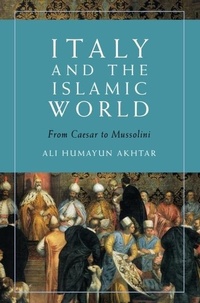
Italy and the Islamic World
From Caesar to Mussolini
Published on 31. March 2024
Book
Hardback
288 pages
978-1-3995-1961-8 (ISBN)
Description
Italy and the Islamic World tells the story of how Italian cities have been centres of international exchange for centuries, linking Europe with the most storied marketplaces of the Middle East and North Africa. From the Ancient Roman period and the Renaissance to the rise of the Italian Republic, Italy has been a global crossroads for more than two millennia. In Ali Humayun Akhtar's new picture of European history, Italy's debates about trade with its southern neighbours evoke an earlier era of encounters - one that sheds light on where the EU is heading today.
Reviews / Votes
This book is an ambitious and innovative work of transnational history, for its narrative extends for one and a half millennia: 476 - 1952 AD. Its careful scholarship is enhanced by impressive documentation in both European and Islamic languages (Italian, French, Arabic and Turkish), full of kaleidoscopic and arresting detail. An extensive glossary covers place names, famous persons and technical terminology. The book places certain Italian cities at the front and centre of international commerce over many centuries, linking Europe with key areas of the Middle East and North Africa, a feature with tap roots in the ancient world, revealing, for example, how Carthage and Arabia fostered a global trade between West and East. Later chapters are enlivened by European travellers' accounts of the long contact between Italy and the Muslim world, documenting the commercial links that Venice and Florence established with the Mamluks of Cairo and the Ottomans of Istanbul. Time and again, the author demonstrates how the interface between Orient and Occident surprised, fascinated and enriched both cultures. -- Carole Hillenbrand, University of Edinburgh Ali Humayun Akhtar's Italy and the Islamic World: From Caesar to Mussolini is an ambitious and innovative work of transnational history. It distils an expansive body of scholarship and research into an engaging and accessible narrative that illustrates the centrality and the enduring impact of Italy's long and fruitful relationship with the Islamic world from Imperial Rome to Fascist Italy and beyond. -- Eric Dursteler, Brigham Young University This book fills a gap in existing literature and a textbook in English with the focus on Italy and the Islamic World will be especially welcome by undergraduate history and culture teachers. -- Ines Asceric-Todd, University of Edinburgh Italy and the Islamic World makes for fascinating reading and enables us to think about the history of the Mediterranean and the interconnectedness of societies over the centuries...ideal for the casual reader and, for the more specialist reader, it might provoke a new way of thinking about these communities and connections between countries. -- Usman Butt * Middle East Monitor *More details
Language
English
Place of publication
Edinburgh
United Kingdom
Target group
Professional and scholarly
Product notice
sewn/stitched
Cloth over boards
Illustrations
33 colour illustrations
Dimensions
Height: 234 mm
Width: 156 mm
Thickness: 18 mm
Weight
581 gr
ISBN-13
978-1-3995-1961-8 (9781399519618)
Copyright in bibliographic data and cover images is held by Nielsen Book Services Limited or by the publishers or by their respective licensors: all rights reserved.
Schweitzer Classification
Other editions
Additional editions
E-Book
03/2024
1st Edition
Edinburgh University Press
€25.49
Available for download
Person
Ali Humayun Akhtar is the author of 1368: China and the Making of the Modern World (Stanford UP, 2022). He is Professor of Global History & Islamic Arts and Humanities and Faculty in the Hillary Clinton Center for Women's Empowerment at Al Akhawayn University in Ifrane (AUI), and Visiting Scholar of International Studies at the University of Wisconsin-Madison.
Content
List of FiguresAcknowledgementsGlossaryTimelinePreface
1 Italians in the East (Levante) and the Making of Modern Europe
2 After Caesar: The Roman Empire and its Arabian Frontiers
3 The Formation of the Papal State during the Early Caliphates
4 A New Turn to Carthage (Tunisia) and the Start of the Crusades
5 Pisan Trade Hubs from Seville to Crusader Syria
6 Genoese Commerce across the Habsburg-Ottoman Mediterranean
7 The Venetian Republic Turns Global
8 Florentine Commerce and the Renaissance
9 Livornans in North Africa during Italian Unification
10 Italian Citizens between Rome and the East (Levante)
11 The Last Levantines (Gli Italiani Levantini)
Epilogue: Memories of the Levant in Exile
NotesSources: Texts, Objects, ArtsIndex
1 Italians in the East (Levante) and the Making of Modern Europe
2 After Caesar: The Roman Empire and its Arabian Frontiers
3 The Formation of the Papal State during the Early Caliphates
4 A New Turn to Carthage (Tunisia) and the Start of the Crusades
5 Pisan Trade Hubs from Seville to Crusader Syria
6 Genoese Commerce across the Habsburg-Ottoman Mediterranean
7 The Venetian Republic Turns Global
8 Florentine Commerce and the Renaissance
9 Livornans in North Africa during Italian Unification
10 Italian Citizens between Rome and the East (Levante)
11 The Last Levantines (Gli Italiani Levantini)
Epilogue: Memories of the Levant in Exile
NotesSources: Texts, Objects, ArtsIndex