

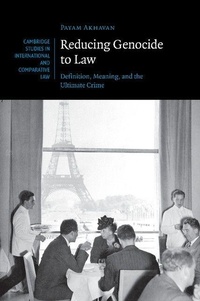
Reducing Genocide to Law
Definition, Meaning, and the Ultimate Crime
Published on 1. January 2015
Book
Paperback/Softback
210 pages
978-1-107-48005-6 (ISBN)
Description
Could the prevailing view that genocide is the ultimate crime be wrong? Is it possible that it is actually on an equal footing with war crimes and crimes against humanity? Is the power of the word genocide derived from something other than jurisprudence? And why should a hierarchical abstraction assume such importance in conferring meaning on suffering and injustice? Could reducing a reality that is beyond reason and words into a fixed category undermine the very progress and justice that such labelling purports to achieve? For some, these questions may border on the international law equivalent of blasphemy. This original and daring book, written by a renowned scholar and practitioner who was the first Legal Advisor to the UN Prosecutor at The Hague, is a probing reflection on empathy and our faith in global justice.
Reviews / Votes
'Without a doubt, the first half of the book is the best, as it deals with what Akhavan clearly knows inside and out: domestic and international criminal law ... Akhavan provides an excellent analysis of the International Criminal Tribunal for the Former Yugoslavia and International Criminal Tribunal for Rwanda's jurisprudence on the crime of genocide as well as a solid review of the many debates surrounding the meaning, legal and otherwise, of this particular atrocity.' Maureen S. Hiebert, Canadian Yearbook of International LawMore details
Series
Language
English
Place of publication
Cambridge
United Kingdom
Target group
Professional and scholarly
Product notice
Paperback (trade)
Illustrations
Worked examples or Exercises; Printed music items
Dimensions
Height: 229 mm
Width: 152 mm
Thickness: 12 mm
Weight
312 gr
ISBN-13
978-1-107-48005-6 (9781107480056)
Copyright in bibliographic data and cover images is held by Nielsen Book Services Limited or by the publishers or by their respective licensors: all rights reserved.
Schweitzer Classification
Other editions
Additional editions

E-Book
02/2012
1st Edition
Cambridge University Press
€26.49
Available for download
Book
01/2012
1st Edition
Cambridge University Press
€132.80
Shipment within 15-20 days
Person
Payam Akhavan is Professor of International Law at McGill University in Montreal, Canada. He was the first Legal Advisor to the Prosecutor's Office of the International Criminal Tribunals for the former Yugoslavia and Rwanda at The Hague (1994-2000) and has served with the United Nations in Cambodia, East Timor and Guatemala. He is also the author of the Report on the Work of the Office of the Special Advisor of the United Nations Secretary-General on the Prevention of Genocide (2005), has served as Chairman of the Global Conference on the Prevention of Genocide (2007) and is Co-Producer of the documentary film 'Genos.Cide: The Great Challenge' (2009).
Content
1. The power of a word; 2. The taxonomy of crimes; 3. The core elements of international crimes; 4. A hierarchy of international crimes?; 5. Naming the nameless crime; 6. Who owns 'genocide'?; 7. Contesting 'genocide' in jurisprudence; 8. Silence, empathy, and the potentialities of jurisprudence.