

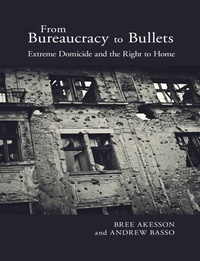
From Bureaucracy to Bullets
Extreme Domicide and the Right to Home
Published on 11. February 2022
Book
Paperback/Softback
286 pages
978-1-9788-0271-1 (ISBN)
Description
There are currently a record-setting number of forcibly displaced persons in the world. This number continues to rise as solutions to alleviate humanitarian catastrophes of large-scale violence and displacement continue to fail. The likelihood of the displaced returning to their homes is becoming increasingly unlikely. In many cases, their homes have been destroyed as the result of violence. Why are the homes of certain populations targeted for destruction? What are the impacts of loss of home upon children, adults, families, communities, and societies? If having a home is a fundamental human right, then why is the destruction of home not viewed as a rights violation and punished accordingly? From Bureaucracy to Bullets answers these questions and more by focusing on the violent practice of extreme domicide, or the intentional destruction of the home, as a central and overlooked human rights issue.
Reviews / Votes
"Tracking the widespread and often unseen practices of domicide - the deliberate destruction of home - this book forces us to rethink the meaning of home as a human right. Clear, rigorous, and persuasive, it makes the need for a Convention Against Domicide an urgent and necessary endeavor."- Michael Vicente Perez, assistant professor of anthropology at the University of Memphis"This innovative and noteworthy book adds an important perspective to human rights scholarship with valuable insight into the use of domicide as a political and military strategy."- Scott Harding, associate professor, University of Connecticut
More details
Language
English
Place of publication
New Brunswick NJ
United States
Target group
College/higher education
Product notice
Paperback (trade)
Unsewn / adhesive bound
Illustrations
27 b-w images
Dimensions
Height: 234 mm
Width: 155 mm
Thickness: 18 mm
Weight
431 gr
ISBN-13
978-1-9788-0271-1 (9781978802711)
Copyright in bibliographic data and cover images is held by Nielsen Book Services Limited or by the publishers or by their respective licensors: all rights reserved.
Schweitzer Classification
Persons
BREE AKESSON is the Canada Research Chair (Tier II) in Global Adversity and Wellbeing and the associate director of the Centre for Research on Security Practices (CRSP) at Wilfrid Laurier University in Brantford, Ontario.
ANDREW R. BASSO is a researcher affiliated with the Laurier Institute for the Study of Public Opinion and Policy (LISPOP) at Wilfrid Laurier University in Waterloo, Ontario and was a Social Sciences and Humanities Research Council Postdoctoral Fellow at the Centre for Transitional Justice and Post-Conflict Reconstruction and the Department of Political Science at Western University in London, Ontario. He researches political violence, human rights, and transitional justice.
ANDREW R. BASSO is a researcher affiliated with the Laurier Institute for the Study of Public Opinion and Policy (LISPOP) at Wilfrid Laurier University in Waterloo, Ontario and was a Social Sciences and Humanities Research Council Postdoctoral Fellow at the Centre for Transitional Justice and Post-Conflict Reconstruction and the Department of Political Science at Western University in London, Ontario. He researches political violence, human rights, and transitional justice.
Content
Part I: Introduction
1. Castles and Cages: A Theory of Home and Home Loss
2. The Difference Between Life and Death: The Human Right to Home
3. A Causal Pathway and Typology of Extreme Domicide
Part II: From Bureaucracy To Bullets
4. "And Leave Them Burning Our Homes": The Mau Mau Uprising in Kenya (1952-1960)
5. No Place to Call Home: Mutually Assured Domicide in Cyprus (1974)
6. "The Cruelest Work I Ever Knew": Domicide and The Cherokee Trail of Tears (1838-1839)
7. Reducing Homes to Keys: The Occupation of Palestine and the Matrix of Control (1945-present)
8. "Their Home Will Be Razed Down to the Basement": Chechnya's Generations of Domicide (1944-2009)
9. Manufacturing Homogeneity: Domicide in Bosnia (1992-1995)
10. Wiping Neighborhoods Off the Map: The Syrian War (2011-present)
11. "All the Villages We Saw on the Way to the Sea Were Burning": The Rohingya in Myanmar (2012-present)
Part III: Conclusions
12. You Can't Go Home Again: Justice, Reconciliation, and a Convention Against Domicide
13. Home Matters: Lessons Learned While Studying Extreme Domicide
Acknowledgments
Notes
Index
1. Castles and Cages: A Theory of Home and Home Loss
2. The Difference Between Life and Death: The Human Right to Home
3. A Causal Pathway and Typology of Extreme Domicide
Part II: From Bureaucracy To Bullets
4. "And Leave Them Burning Our Homes": The Mau Mau Uprising in Kenya (1952-1960)
5. No Place to Call Home: Mutually Assured Domicide in Cyprus (1974)
6. "The Cruelest Work I Ever Knew": Domicide and The Cherokee Trail of Tears (1838-1839)
7. Reducing Homes to Keys: The Occupation of Palestine and the Matrix of Control (1945-present)
8. "Their Home Will Be Razed Down to the Basement": Chechnya's Generations of Domicide (1944-2009)
9. Manufacturing Homogeneity: Domicide in Bosnia (1992-1995)
10. Wiping Neighborhoods Off the Map: The Syrian War (2011-present)
11. "All the Villages We Saw on the Way to the Sea Were Burning": The Rohingya in Myanmar (2012-present)
Part III: Conclusions
12. You Can't Go Home Again: Justice, Reconciliation, and a Convention Against Domicide
13. Home Matters: Lessons Learned While Studying Extreme Domicide
Acknowledgments
Notes
Index