

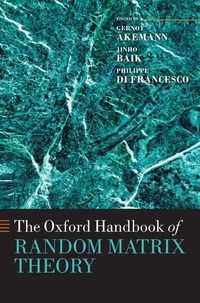
The Oxford Handbook of Random Matrix Theory
Published on 28. July 2011
Book
Hardback
952 pages
978-0-19-957400-1 (ISBN)
Description
With a foreword by Freeman Dyson, the handbook brings together leading mathematicians and physicists to offer a comprehensive overview of random matrix theory, including a guide to new developments and the diverse range of applications of this approach.
In part one, all modern and classical techniques of solving random matrix models are explored, including orthogonal polynomials, exact replicas or supersymmetry. Further, all main extensions of the classical Gaussian ensembles of Wigner and Dyson are introduced including sparse, heavy tailed, non-Hermitian or multi-matrix models. In the second and larger part, all major applications are covered, in disciplines ranging from physics and mathematics to biology and engineering. This includes standard fields such as number theory, quantum chaos or quantum chromodynamics, as well as recent developments such as partitions, growth models, knot theory, wireless communication or bio-polymer folding.
The handbook is suitable both for introducing novices to this area of research and as a main source of reference for active researchers in mathematics, physics and engineering.
In part one, all modern and classical techniques of solving random matrix models are explored, including orthogonal polynomials, exact replicas or supersymmetry. Further, all main extensions of the classical Gaussian ensembles of Wigner and Dyson are introduced including sparse, heavy tailed, non-Hermitian or multi-matrix models. In the second and larger part, all major applications are covered, in disciplines ranging from physics and mathematics to biology and engineering. This includes standard fields such as number theory, quantum chaos or quantum chromodynamics, as well as recent developments such as partitions, growth models, knot theory, wireless communication or bio-polymer folding.
The handbook is suitable both for introducing novices to this area of research and as a main source of reference for active researchers in mathematics, physics and engineering.
More details
Series
Language
English
Place of publication
Oxford
United Kingdom
Target group
College/higher education
Suitable for mathematicians, physicists, statisticians and engineers. This handbook serves as a reference book for those already familiar with the field, as a guide to the field for newcomers and as an introduction to the wider applications of random matrix theory.
Illustrations
4 colour halftones, 7 black and white halftones, 92 black and white line drawings
Dimensions
Height: 250 mm
Width: 175 mm
Thickness: 55 mm
Weight
1790 gr
ISBN-13
978-0-19-957400-1 (9780199574001)
Copyright in bibliographic data and cover images is held by Nielsen Book Services Limited or by the publishers or by their respective licensors: all rights reserved.
Schweitzer Classification
Other editions
Additional editions
Gernot Akemann | Jinho Baik | Philippe Di Francesco
The Oxford Handbook of Random Matrix Theory
Book
09/2015
Oxford University Press
€61.26
Shipment within 15-20 days
Persons
Gernot Akemann gained his PhD in theoretical physics at Leibniz Universitaet Hannover in 1996. He was an EU Marie-Curie Fellow from 1996 until 1998. He has worked at MPIK Heidelberg and later at CEA SPhT, where he held a Heisenberg fellowship. He is currently Professor for Mathematical Physics at the Faculty of Physics, Bielefeld University, Germany.
Jinho Baik gained his PhD in mathematics at New York University in 1999. He has been the recipient of the AMS Centennial Fellowship, the Sloan Research Fellowship and he won the CMFT2005 Young Researcher Award. He is currently an associate professor in the Department of Mathematics, University of Michigan.
Philippe Di Francesco gained his PhD in theoretical physics in 1989 at the Universite Pierre et Marie Curie (Paris 6). He completed his habilitation in mathematics in 2004 at the Universite Paris Diderot (Paris 7). He was a postdoctoral researcher in the Department of Mathematics, Princeton and a professor with the Department of Mathematics, University of North Carolina. He has been a research member of IPHT, CEA Saclay since 1989.
Jinho Baik gained his PhD in mathematics at New York University in 1999. He has been the recipient of the AMS Centennial Fellowship, the Sloan Research Fellowship and he won the CMFT2005 Young Researcher Award. He is currently an associate professor in the Department of Mathematics, University of Michigan.
Philippe Di Francesco gained his PhD in theoretical physics in 1989 at the Universite Pierre et Marie Curie (Paris 6). He completed his habilitation in mathematics in 2004 at the Universite Paris Diderot (Paris 7). He was a postdoctoral researcher in the Department of Mathematics, Princeton and a professor with the Department of Mathematics, University of North Carolina. He has been a research member of IPHT, CEA Saclay since 1989.
Content
I INTRODUCTION; II PROPERTIES OF RANDOM MATRIX THEORY; III APPLICATIONS OF RANDOM MATRIX THEORY