

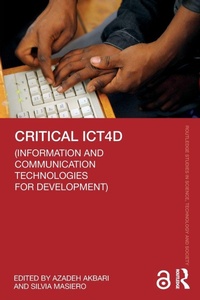
Critical ICT4D (Information and Communication Technologies for Development)
1st Edition
Published on 2. January 2025
Book
Paperback/Softback
200 pages
978-1-032-49894-2 (ISBN)
Description
The edited volume Critical ICT4D highlights the need for a paradigm change in theorising, designing, and researching Information and Communication Technologies for Development (ICT4D). Engaging authors from the Majority World and entering a process of restoring epistemic justice in knowledge production and ownership, the text:
Reflects on the histories and narratives around development programmes, their deep-rooted socio-political background, and the power relations integrated into or induced by such measures
Problematises the current scholarship and practices through decolonial and pluralistic approaches built with an explicit perspective of resisting epistemic violence
Constructs justice-enacting engagements of technologies with society.
Offering thematic discussions in many development sectors with up-to-date case studies informed by recent research in the field, it sheds light on constructive contributions of critical ICT4D research. Written in accessible language, the book will appeal to postgraduate students, fellow researchers, policymakers in the fields of sociology, development studies, STS, critical data studies, surveillance studies, international relations, public administration, and information systems.
The Open Access version of this book, available at http://www.taylorfrancis.com, has been made available under a Creative Commons Attribution (CC-BY) 4.0 license.
Reflects on the histories and narratives around development programmes, their deep-rooted socio-political background, and the power relations integrated into or induced by such measures
Problematises the current scholarship and practices through decolonial and pluralistic approaches built with an explicit perspective of resisting epistemic violence
Constructs justice-enacting engagements of technologies with society.
Offering thematic discussions in many development sectors with up-to-date case studies informed by recent research in the field, it sheds light on constructive contributions of critical ICT4D research. Written in accessible language, the book will appeal to postgraduate students, fellow researchers, policymakers in the fields of sociology, development studies, STS, critical data studies, surveillance studies, international relations, public administration, and information systems.
The Open Access version of this book, available at http://www.taylorfrancis.com, has been made available under a Creative Commons Attribution (CC-BY) 4.0 license.
More details
Series
Language
English
Place of publication
London
United Kingdom
Publishing group
Taylor & Francis Ltd
Target group
College/higher education
General, Postgraduate, and Undergraduate Advanced
Illustrations
1 s/w Zeichnung, 2 s/w Tabellen, 3 s/w Abbildungen, 2 s/w Photographien bzw. Rasterbilder
2 Tables, black and white; 1 Line drawings, black and white; 2 Halftones, black and white; 3 Illustrations, black and white
Dimensions
Height: 234 mm
Width: 156 mm
Thickness: 12 mm
Weight
333 gr
ISBN-13
978-1-032-49894-2 (9781032498942)
Copyright in bibliographic data and cover images is held by Nielsen Book Services Limited or by the publishers or by their respective licensors: all rights reserved.
Schweitzer Classification
Other editions
Additional editions
Azadeh Akbari | Silvia Masiero
Critical ICT4D (Information and Communication Technologies for Development)
Book
01/2025
1st Edition
Routledge
€206.20
Shipment within 10-20 days
Persons
Azadeh Akbari is Assistant Professor of Public Administration and Digital Transformation at the University of Twente, the Netherlands. She is a European Union's Marie Sklodowska-Curie Actions Global fellow for her project on Authoritarian Smart Cities. She is a member of the board of directors at the International Surveillance Studies Network and the founder and director of Surveillance in the Majority World Research Network. Her research focuses on digital authoritarianism, the use of surveillance technologies in urban spaces especially against women, and data justice.
Silvia Masiero is Associate Professor of Information Systems at the University of Oslo, Norway. Her research focuses on ICT4D, particularly on the role of digital platforms in socio-economic development processes, digital social protection, platform-mediated surveillance and decolonial approaches to information systems research. She is Editor-in-Chief of Information Technology for Development and Chair of the IFIP Working Group 9.4 on the Implications of Information and Digital Technologies for Development.
Silvia Masiero is Associate Professor of Information Systems at the University of Oslo, Norway. Her research focuses on ICT4D, particularly on the role of digital platforms in socio-economic development processes, digital social protection, platform-mediated surveillance and decolonial approaches to information systems research. She is Editor-in-Chief of Information Technology for Development and Chair of the IFIP Working Group 9.4 on the Implications of Information and Digital Technologies for Development.
Content
1. Introduction
Part 1: Reflect
2. Digital Development Dilemma: From Progress to Control
3. The Evolution of ICT4D: Content, Context, Process (Interview with Shirin Madon)
4. Bringing Critical ICT4D From The Margin To The Centre
5. The Interface Position of ICT4D research
Part 2: Problematise
6. The Violence of Algorithmic Systems in Social Policy in Colombia: (Re) Localising the Digital Welfare State in the Postcolonial Context
7. Digital Humanitarianism: Orthodoxy and Lived Realities
8. Reimaging Smart City Transplants for the Global South: A Post-colonial Lens on Human Rights and Digital Sovereignty
Part 3: Reconstruct
9. From Data Governance to Data Ethics: Invoking Epistemological Plurality for Enabling a Critical Turn in ICT4D
10. Design for Water Justice: Co-Developing Tools for Equitable Cities
11. Social Media and Sisterhood in Latin America: Discourse and Practice
Part 1: Reflect
2. Digital Development Dilemma: From Progress to Control
3. The Evolution of ICT4D: Content, Context, Process (Interview with Shirin Madon)
4. Bringing Critical ICT4D From The Margin To The Centre
5. The Interface Position of ICT4D research
Part 2: Problematise
6. The Violence of Algorithmic Systems in Social Policy in Colombia: (Re) Localising the Digital Welfare State in the Postcolonial Context
7. Digital Humanitarianism: Orthodoxy and Lived Realities
8. Reimaging Smart City Transplants for the Global South: A Post-colonial Lens on Human Rights and Digital Sovereignty
Part 3: Reconstruct
9. From Data Governance to Data Ethics: Invoking Epistemological Plurality for Enabling a Critical Turn in ICT4D
10. Design for Water Justice: Co-Developing Tools for Equitable Cities
11. Social Media and Sisterhood in Latin America: Discourse and Practice