

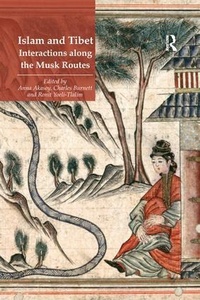
Islam and Tibet - Interactions along the Musk Routes
1st Edition
Published on 3. October 2016
Book
Paperback/Softback
438 pages
978-1-138-24704-8 (ISBN)
Description
The first encounters between the Islamic world and Tibet took place in the course of the expansion of the Abbasid Empire in the eighth century. Military and political contacts went along with an increasing interest in the other side. Cultural exchanges and the transmission of knowledge were facilitated by a trading network, with musk constituting one of the main trading goods from the Himalayas, largely through India. From the thirteenth century onwards the spread of the Mongol Empire from the Western borders of Europe through Central Asia to China facilitated further exchanges. The significance of these interactions has been long ignored in scholarship. This volume represents a major contribution to the subject, bringing together new studies by an interdisciplinary group of international scholars. They explore for the first time the multi-layered contacts between the Islamic world, Central Asia and the Himalayas from the eighth century until the present day in a variety of fields, including geography, cartography, art history, medicine, history of science and education, literature, hagiography, archaeology, and anthropology.
Reviews / Votes
'... the diversity of scholarly approaches - anthropological, historical, philological and archaeological, together with the variety of the cultural interactions surveyed - combine to give a good overall perspective regarding the central pertinent fields of study. The reader thus receives a well-rounded view of the relations between Islam and Tibet... This intriguing collection of articles covers rich and fresh materials for the study of a relatively neglected aspect of world history, and is thus a valuable contribution to the study of Islam and its place in Asia.' Jerusalem Studies in Arabic and IslamMore details
Language
English
Place of publication
London
United Kingdom
Publishing group
Taylor & Francis Ltd
Target group
College/higher education
Product notice
Paperback (trade)
Unsewn / adhesive bound
Dimensions
Height: 233 mm
Width: 154 mm
Thickness: 27 mm
Weight
759 gr
ISBN-13
978-1-138-24704-8 (9781138247048)
Copyright in bibliographic data and cover images is held by Nielsen Book Services Limited or by the publishers or by their respective licensors: all rights reserved.
Schweitzer Classification
Other editions
Additional editions
Anna Akasoy | Charles Burnett | Ronit Yoeli-Tlalim
Islam and Tibet - Interactions along the Musk Routes
E-Book
12/2016
1st Edition
Routledge
€78.99
Available for download
Anna Akasoy | Charles Burnett | Ronit Yoeli-Tlalim
Islam and Tibet - Interactions along the Musk Routes
E-Book
12/2016
1st Edition
Routledge
€78.99
Available for download
Anna Akasoy | Charles Burnett | Ronit Yoeli-Tlalim
Islam and Tibet - Interactions along the Musk Routes
Book
01/2011
1st Edition
Routledge
€237.70
Shipment within 10-20 days
Persons
Anna Akasoy is British Academy Postdoctoral Fellow at the Oriental Institute, University of Oxford, UK; Charles Burnett is Professor of the History of Islamic Influences in Europe at the Warburg Institute, University of London, and is a Fellow of the British Academy, UK; Ronit Yoeli-Tlalim is a Wellcome Trust University Award holder at the History Department, Goldsmiths, University of London.
Content
Contents: Preface; Islam and Tibet: cultural interactions - an introduction, Ronit Yoeli-Tlalim; Tibet in Islamic geography and cartography: a survey of Arabic and Persian sources, Anna Akasoy; The Bactrian background of the Barmakids, Kevin van Bladel; Iran to Tibet, Assadullah Souren Melikian-Chirvani; Greek and Islamic medicines' historical contact with Tibet: a reassessment in view of recently available but relatively early sources on Tibetan medical eclecticism, Dan Martin; Tibetan musk and medieval Arab perfumery, Anya King; The Sarvastivadin Buddhist scholastic method in medieval Islam and Tibet, Christopher I. Beckwith; Notes on the religions in the Mongol empire, Peter Zieme; Tibetans, Mongols and the fusion of Eurasian cultures, Paul D. Buell; Three rock-cut cave sites in Iran and their Ilkhanid Buddhist aspects reconsidered, Arezou Azad; The Muslim Queens of the Himalayas: princess exchanges in Baltistan and Ladakh, Georgios T. Halkias; The discovery of the Muslims of Tibet by the first Portuguese missionaries, Marc Gaborieau; So close to Samarkand, Lhasa: Sufi hagiographies, founder myths and sacred space in Himalayan Islam, Alexandre Papas; Between legend and history: about the 'conversion' to Islam of two prominent Lamaists in the 17th-18th centuries, Thierry Zarcone; Ritual theory across the Buddhist-Muslim divide in late imperial China, Johan Elverskog; Trader, middleman or spy? The dilemmas of a Kashmiri Muslim in early 19th-century Tibet, John Bray; Do all the Muslims of Tibet belong to the Hui nationality?, Diana Altner; Greater Ladakh and the mobilization of tradition in the contemporary Baltistan movement, Jan Magnusson; Index of proper names.