

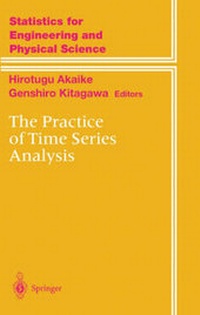
The Practice of Time Series Analysis
Published on 14. December 1998
Book
Hardback
XVIII, 386 pages
978-0-387-98658-6 (ISBN)
Description
A collection of applied papers on time series, appearing here for the first time in English. The applications are primarily found in engineering and the physical sciences.
More details
Other editions
Additional editions
Hirotugu Akaike | Genshiro Kitagawa
The Practice of Time Series Analysis
Book
11/2011
Springer
€53.49
Shipment within 15-20 days
Content
1 Control of Boilers for Thermoelectric Power Plants by Means of a Statistical Model.- 1.1 Introduction.- 1.2 Problems in Controlling Multi variable System.- 1.3 System Analysis and Control by Means of Statistical Model.- 1.4 Practical Procedure for Optimal Controller Design.- 1.5 Application Results at Actual Plants.- 1.6 Closing Remarks.- 2 Feedback Analysis of a Living Body by a Multivariate Autoregressive Model.- 2.1 Introduction.- 2.2 Body Liquid Control and Feedback.- 2.3 Example of the Relative Power Contribution and Impulse Response.- 2.4 Using an Autoregressive Model for Feedback Analysis.- 2.5 Obtaining the Power Contribution.- 2.6 State Equation and Impulse Response.- 2.7 Impulse Response of the Closed and Open Systems.- 2.8 Confirmation by a Virtual Feedback System.- 2.9 Conclusions.- 3 Factor Decomposition of Economic Time Series Fluctuations - Economic and Statistical Models in Harmony.- 3.1 Introduction.- 3.2 Model 1 (Model with Stochastic Components Only).- 3.3 Model 2 (the Model Including Deterministic Components).- 3.4 Model 3 (the Model by Which Macroeconomic Policy Effect can Also be Measured).- 3.5 Has Fine Tuning been Successful?.- 3.6 Is Prediction Ability Available?.- 3.7 Conclusions and Subjects in the Future.- 4 The Statistical Optimum Control of Ship Motion and a Marine Main Engine.- 4.1 Introduction.- 4.2 Outline of the Control of the Motion of the Hull and Main Engine.- 4.3 Statistical Model of Ship Motions and Its Control.- 4.4 Design of Optimum Autopilot System Based on the Control-Type Autoregressive Model.- 4.5 Noise-Adaptive Control System.- 4.6 Rudder-Roll Control System.- 4.7 Application to the Marine Main Engine Governor System.- 4.8 Conclusions.- 5 High Precision Estimation of Seismic Wave Arrival Times.- 5.1 Introduction.- 5.2 Locally Stationary AR Model.- 5.3 Automatic Division of a Locally Stationary Interval.- 5.4 Precision Estimation of Seismic Wave Arrival Times.- 5.5 Application: Earthquake Location and Velocity Structure Determination from Precise Arrival Time Estimates.- 5.6 Conclusions.- 6 Analysis of Dynamic Characteristics of a Driver-Vehicle System.- 6.1 Introduction.- 6.2 Dynamics of Automobile under Later al-Wind Disturbance.- 6.3 Application of Multivariate AR Model to Driver-Vehicle System.- 6.4 Dynamics of Driver-Vehicle System under Lateral-Wind.- 6.5 Conclusions.- 7 Estimation of Directional Wave Spectra Using Ship Motion Data.- 7.1 Introduction.- 7.2 Cross-spectrum Analysis by a Multivariate AR Model.- 7.3 Relation Between the Directional Wave Spectrum and the Ship Motions.- 7.4 Estimation of the Directional Wave Spectrum Using a Bayesian Model.- 7.5 Results of the Tank Test Using a Model Ship.- 7.6 Conclusions.- 8 Control of Filature Production Process.- 8.1 Dropping-end Control and Gap Process.- 8.2 Size Control of Raw Silk.- 8.3 Dwell Time in a Black Box.- 9 Application to Pharmacokinetic Analysis.- 9.1 Introduction.- 9.2 Pharmacokinetic Model.- 9.3 Monte Carlo Estimation of Maximum Log Likelihood.- 9.4 Example.- 9.5 Concluding Remarks.- 10 State Space Modeling of Switching Time Series.- 10.1 Introduction.- 10.2 Time Series Data with Pulses and the Existing Methods.- 10.3 The State Space Model for Time Series with Pulses.- 10.4 Conclusions.- 11 Time Varying Coefficient AR and VAR Models.- 11.1 Introduction.- 11.2 Time Varying Coefficient AR Models.- 11.3 Time Varying Coefficient VAR Models.- 11.4 An Example of Seismic Data Analysis.- 12 Statistical Control of Cement Process.- 12.1 Introduction.- 12.2 Cement Plant.- 12.3 Identification and Control of the Kiln Process.- 12.4 Collection and Identification of the Data under the On-line Control.- 12.5 Optimal Production Level and Pursuit Control.- 12.6 Conclusions.- 13 Analysis of a Human/2-Wheeled-Vehicle System by ARdock.- 13.1 Introduction.- 13.2 Data.- 13.3 AR Model and ARdock.- 13.4 Numerical Results.- 13.5 Analysis of the Hands-Free Steering.- 13.6 The Optimum Control.- 14 Vibration Data Analysis of Automobiles.- 14.1 Preface.- 14.2 Road Surface Input-Wear of Component Material and Riding Comfort.- 14.3 Separation of Correlated Power Components in a Multiple Input System by Means of Power Contributions.- 14.4 Decision of Continuity of Data Properties.- 14.5 Identification of Nonlinear Vibration System Through Bispectral Analysis.- 14.6 Continuous Measurement of Time-variant Spectrum.- 14.7 Afterword.- 15 Auto-Regressive Spectral Analysis of RR-Interval Time Series in Healthy Fetus and Newborn Infants.- 15.1 Introduction.- 15.2 Subjects and Methods.- 15.3 Results.- 15.4 Discussion.- 15.5 Conclusions.- 16 Information Processing Mechanisms in the Mammalian Brain: Analysis of Spatio-Temporal Neural Response in the Auditory Cortex.- 16.1 Introduction.- 16.2 Instrumentation of and Information Processing in the Brain.- 16.3 Optical Multipoint Observation in the Mammalian Auditory Cortex.- 16.4 Spatio-Temporal Neural Activity Observation.- 16.5 Functional Modules in the Auditory Cortex.- 16.6 Pattern Time Series Analysis.- 16.7 Neural Correlation of and Neural Binding.- 16.8 Evaluation of Cortical Neural Binding.- 16.9 Characteristics of Stationary Stochastic Response.- 16.10 Conclusions.- 17 Time Series Analysis of Financial Asset Price Fluctuations.- 17.1 Introduction.- 17.2 Nonstationary Nature of Financial Asset Prices.- 17.3 Multivariate Analysis of the Time Series Model.- 17.4 Conclusion.- 18 Dynamic Analysis of Economic Time Series.- 18.1 Introduction.- 18.2 Trend of the Economic Time Series and the Fluctuation Around the Trend.- 18.3 Analysis of Abrupt Change of Trend.- 18.4 Analysis of the Economic System by a Multivariate Nonstationary Time Series Model.- 18.5 Conclusions.- 19 Processing of Time Series Data Obtained by Satellites.- 19.1 Introduction.- 19.2 Problems to be Dealt With.- 19.3 Approach by a Bayesian Model -Simple Model.- 19.4 Example of a Simple Model.- 19.5 Point Noise Source Model.- 19.6 Conclusions.- 20 Analysis of Earth Tides Data.- 20.1 What are Earth Tides?.- 20.2 Analysis Model.- 20.3 Tidal Analysis Program BAYTAP-G.- 20.4 Focal Points in the Analysis.- 20.5 Concluding Remarks.- 21 Detection of Groundwater Level Changes Related to Earthquakes.- 21.1 Introduction.- 21.2 Observation Data.- 21.3 Data Analysis Method.- 21.4 Analysis of Actual Data.- 21.5 Conclusions.- 22 Processing of Missing Observations and Outliers in Time Series.- 22.1 Missing Observations and Outliers.- 22.2 Processing of Missing Observations.- 22.3 Processing of Outliers.- 22.4 Conclusions.- 23 Mental Preparation for Time Series Analysis.- 23.1 Introduction.- 23.2 Time Series Analysis and Statistical Science.- 23.3 Prediction and Expectation.- 23.4 Ultimate Truth and Models.- 23.5 Evaluation of a Model and Information Criterion.- 23.6 Confirmation of Validity.- 23.7 Conclusions.