

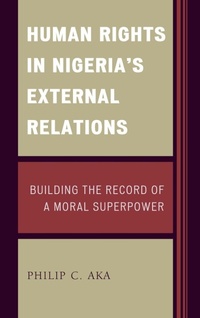
Human Rights in Nigeria's External Relations
Building the Record of a Moral Superpower
Published on 20. December 2016
Book
Hardback
324 pages
978-1-4985-3355-3 (ISBN)
Description
This book is a broad-ranging argument for thorough reforms at home and abroad in Nigeria as the only antidote to the nation-building dilemmas Nigeria confronts in the first quarter of the twenty-first century. Because of its enormous material and human endowments, Nigeria is dubbed the "Giant of Africa." It is a moniker many of its leaders take seriously. Yet, Nigeria is a state rife with instability, some of it periodically erupting into violence. Given still-ongoing national security challenges in the land that notoriously includes a bloody religion-oriented terrorism, the Fourth Republic since 1999, the longest period of continuous democratic rule since independence-key to the timeline of this book-has not been insulated from the spell of instability.
The main argument of this work is that internationally agreed-upon ethical standards embedded in human rights can save Nigeria. This book is a methodologically and theoretically-grounded, seminal discourse on Nigerian foreign relations that spells out the human rights or lack thereof in those relations, including underlying and impinging domestic forces.
This work is set around six issues of application embedded in a temple of Nigeria's human rights foreign policy, comprising two steps and four pillars: reconstructed national interest, increased human rights at home, redesigned peacekeeping, reshaped foreign policy machinery, increased bilateralism in foreign relations, and the use of ECOWAS as human rights tool. Although focused on the period since independence, for proper understanding of events from the past that shape the current patterns of politics in the land, this book also embodies a historical background chapter that overviews the pre-colonial and colonial eras.
The main argument of this work is that internationally agreed-upon ethical standards embedded in human rights can save Nigeria. This book is a methodologically and theoretically-grounded, seminal discourse on Nigerian foreign relations that spells out the human rights or lack thereof in those relations, including underlying and impinging domestic forces.
This work is set around six issues of application embedded in a temple of Nigeria's human rights foreign policy, comprising two steps and four pillars: reconstructed national interest, increased human rights at home, redesigned peacekeeping, reshaped foreign policy machinery, increased bilateralism in foreign relations, and the use of ECOWAS as human rights tool. Although focused on the period since independence, for proper understanding of events from the past that shape the current patterns of politics in the land, this book also embodies a historical background chapter that overviews the pre-colonial and colonial eras.
Reviews / Votes
Aka has created a remarkably detailed analysis of Nigeria's human rights situation and an equally thorough plan to improve upon it. . . Aka has created a compelling theoretical model for Nigeria's future and a possible model for other nations. Scholars and graduate students of African history, modern human rights policy, and international affairs should enjoy this book. * Journal of Global South Studies * Aka presents a timely, compelling and rigorous analysis of Nigeria's role in defending both domestic and international human rights. Aka makes his case through a masterful narrative that weaves the strands of history, law and politics into a compelling argument why Nigeria needs to let "charity begin at home". This is a must-read for scholars, activists and students interested in understanding the past, present and future of Nigeria's political and legal trajectory in the international system. -- J. Jarpa Dawuni, Howard University Brilliantly written. Dr. Philip Aka, a legal and political science scholar and professor, has finally emerged with a classic book that grapples with incessant human rights abuses and challenges in Nigeria. This book will be useful inside and outside the academy. Here's the volume of readings and ideas that directs us towards the much needed human rights famished country: Nigeria. -- Emeka Nwadiora, Temple UniversityMore details
Series
Language
English
Place of publication
United States
Publishing group
Bloomsbury Publishing Plc
Target group
Professional and scholarly
Illustrations
2 b/w illustrations; 7 tables
Dimensions
Height: 235 mm
Width: 157 mm
Thickness: 24 mm
Weight
681 gr
ISBN-13
978-1-4985-3355-3 (9781498533553)
Copyright in bibliographic data and cover images is held by Nielsen Book Services Limited or by the publishers or by their respective licensors: all rights reserved.
Schweitzer Classification
Other editions
Additional editions
E-Book
12/2016
1st Edition
Lexington Books
€107.99
Available for download
E-Book
12/2016
1st Edition
Lexington Books
€107.99
Available for download
Person
Philip C. Aka is professor of political science at Chicago State University and adjunct professor of law at the Robert H. McKinney School of Law at Indianapolis.
Content
Chapter 1: Introduction
Part I: Starting Points
Chapter 2: Conceptual Framework
Chapter 3: Theoretical Framework
Chapter 4: Activities that Shape the Current Patterns of Politics: Historical Backdrop on Human Rights in Nigeria's External Relations
Part II: Temple of Nigeria's Human Rights Foreign Policy (Six Key Issues Relating to the Application of Human Rights in Nigeria's Foreign Policy)
Chapter 5: Reconstructing Nigeria's National Interest in a More Human Rights-Sensitive Direction
Chapter 6: Charity Begins at Home: Increased Respect for Human Rights in Nigeria
Chapter 7: Redesigning Peacekeeping to Make it More Human Rights-Compliant
Chapter 8: Reshaping Nigeria's Foreign Policy Machinery in a More Human Rights-Sensitive Direction
Chapter 9: The Need for More Symmetry Between Multilateral and Bilateral Activities in Nigeria's External Relations
Chapter 10: The Economic Community of West African States (ECOWAS) and Human Rights in Nigeria's External Relations
Part III: Conclusions
Chapter 11: Enacting Serious Reforms at Home and Abroad
Chapter 12: But So What? Two Objections to the Argument in this Work and Two Rebuttals to Those Objections
References
Appendix I: Biblical Passages Related to Human Rights
Appendix II: Maps
Part I: Starting Points
Chapter 2: Conceptual Framework
Chapter 3: Theoretical Framework
Chapter 4: Activities that Shape the Current Patterns of Politics: Historical Backdrop on Human Rights in Nigeria's External Relations
Part II: Temple of Nigeria's Human Rights Foreign Policy (Six Key Issues Relating to the Application of Human Rights in Nigeria's Foreign Policy)
Chapter 5: Reconstructing Nigeria's National Interest in a More Human Rights-Sensitive Direction
Chapter 6: Charity Begins at Home: Increased Respect for Human Rights in Nigeria
Chapter 7: Redesigning Peacekeeping to Make it More Human Rights-Compliant
Chapter 8: Reshaping Nigeria's Foreign Policy Machinery in a More Human Rights-Sensitive Direction
Chapter 9: The Need for More Symmetry Between Multilateral and Bilateral Activities in Nigeria's External Relations
Chapter 10: The Economic Community of West African States (ECOWAS) and Human Rights in Nigeria's External Relations
Part III: Conclusions
Chapter 11: Enacting Serious Reforms at Home and Abroad
Chapter 12: But So What? Two Objections to the Argument in this Work and Two Rebuttals to Those Objections
References
Appendix I: Biblical Passages Related to Human Rights
Appendix II: Maps