

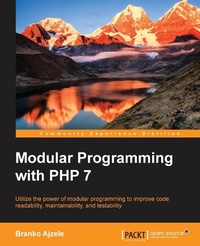
Modular Programming with PHP 7
Utilize the power of modular programming to improve code readability, maintainability, and testability
Published on 9. September 2016
Book
Paperback/Softback
332 pages
978-1-78646-295-4 (ISBN)
Description
Utilize the power of modular programming to improve code readability, maintainability, and testability
Key Features
[*] This book demonstrates code reusability and distributed development to get high speed, maintainable, and fast applications
[*] It illustrates the development of a complete modular application developed using PHP7 in detail
[*] This book provides a high-level overview of the Symfony framework, a set of tools and a development methodology that are needed to build a modular web shop application
Book DescriptionModular design techniques help you build readable, manageable, reusable, and more efficient codes. PHP 7, which is a popular open source scripting language, is used to build modular functions for your software. With this book, you will gain a deep insight into the modular programming paradigm and how to achieve modularity in your PHP code.
We start with a brief introduction to the new features of PHP 7, some of which open a door to new concepts used in modular development. With design patterns being at the heart of all modular PHP code, you will learn about the GoF design patterns and how to apply them. You will see how to write code that is easy to maintain and extend over time with the help of the SOLID design principles.
Throughout the rest of the book, you will build different working modules of a modern web shop application using the Symfony framework, which will give you a deep understanding of modular application development using PHP 7.
What you will learn
[*] Discover the new features of PHP 7 that are relevant to modular application development
[*] Write manageable code based on the GoF design patterns and SOLID principles
[*] Define the application requirements of a working modular application
[*] Explore the ins and outs of the Symfony framework
[*] Build a set of modules based on the Symfony framework that comprise a simple web shop app
[*] Use core modules to set the structure and dependencies for other modules to use
[*] Set up entities that are relevant to the module functionality and see how to manage these entities
Who this book is forThis step-by-step guide is divided into two sections. The first section explores all the fundamentals of modular design technique with respect to PHP 7. The latter section demonstrates the practical development of individual modules of a web shop application.
Key Features
[*] This book demonstrates code reusability and distributed development to get high speed, maintainable, and fast applications
[*] It illustrates the development of a complete modular application developed using PHP7 in detail
[*] This book provides a high-level overview of the Symfony framework, a set of tools and a development methodology that are needed to build a modular web shop application
Book DescriptionModular design techniques help you build readable, manageable, reusable, and more efficient codes. PHP 7, which is a popular open source scripting language, is used to build modular functions for your software. With this book, you will gain a deep insight into the modular programming paradigm and how to achieve modularity in your PHP code.
We start with a brief introduction to the new features of PHP 7, some of which open a door to new concepts used in modular development. With design patterns being at the heart of all modular PHP code, you will learn about the GoF design patterns and how to apply them. You will see how to write code that is easy to maintain and extend over time with the help of the SOLID design principles.
Throughout the rest of the book, you will build different working modules of a modern web shop application using the Symfony framework, which will give you a deep understanding of modular application development using PHP 7.
What you will learn
[*] Discover the new features of PHP 7 that are relevant to modular application development
[*] Write manageable code based on the GoF design patterns and SOLID principles
[*] Define the application requirements of a working modular application
[*] Explore the ins and outs of the Symfony framework
[*] Build a set of modules based on the Symfony framework that comprise a simple web shop app
[*] Use core modules to set the structure and dependencies for other modules to use
[*] Set up entities that are relevant to the module functionality and see how to manage these entities
Who this book is forThis step-by-step guide is divided into two sections. The first section explores all the fundamentals of modular design technique with respect to PHP 7. The latter section demonstrates the practical development of individual modules of a web shop application.
More details
Language
English
Place of publication
Birmingham
United Kingdom
Target group
Professional and scholarly
US School Grade: College Graduate Student
Dimensions
Height: 235 mm
Width: 191 mm
Thickness: 19 mm
Weight
622 gr
ISBN-13
978-1-78646-295-4 (9781786462954)
Copyright in bibliographic data and cover images is held by Nielsen Book Services Limited or by the publishers or by their respective licensors: all rights reserved.
Schweitzer Classification
Other editions
Additional editions
Branko Ajzele
Modular Programming with PHP 7
Utilize the power of modular programming to improve code readability, maintainability, and testability
E-Book
07/2025
Packt Publishing
from
€41.99
Available for download
Person
Branko Ajzele is a respected and highly accomplished software developer, book author, solution specialist, consultant, and team leader. He currently works for Interactive Web Solutions Ltd (iWeb), where he holds the role of senior developer and is the director of iWeb's Croatia office.
Branko holds several respected IT certifications, including Zend Certified PHP Engineer, Magento Certified Developer, Magento Certified Developer Plus, Magento Certified Solution Specialist, Magento 2 Certified Solution Specialist, Magento 2 Certified Professional Developer, to mention just a few.
He was crowned the e-commerce Developer of the Year by the Digital Entrepreneur Awards in October 2014 for his excellent knowledge and expertise in e-commerce development.
Branko holds several respected IT certifications, including Zend Certified PHP Engineer, Magento Certified Developer, Magento Certified Developer Plus, Magento Certified Solution Specialist, Magento 2 Certified Solution Specialist, Magento 2 Certified Professional Developer, to mention just a few.
He was crowned the e-commerce Developer of the Year by the Digital Entrepreneur Awards in October 2014 for his excellent knowledge and expertise in e-commerce development.
Content
Table of Contents
Ecosystem Overview
GoF Design Patterns
SOLID Design Principles
Requirement Specification for Modular Web Shop App
Symfony at a glance
Building Core Module
Building Catalog Module
Building Customer Module
Building Payment Module
Building Shipment Module
Building Sales Module
Integrating and Distributing Modules
Ecosystem Overview
GoF Design Patterns
SOLID Design Principles
Requirement Specification for Modular Web Shop App
Symfony at a glance
Building Core Module
Building Catalog Module
Building Customer Module
Building Payment Module
Building Shipment Module
Building Sales Module
Integrating and Distributing Modules