

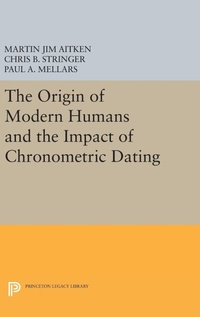
The Origin of Modern Humans and the Impact of Chronometric Dating
Will be published approx. on 19. April 2016
Book
Hardback
256 pages
978-0-691-63327-5 (ISBN)
Description
This volume of papers delivered to The Royal Society in February of 1992 explores the debate over the "single center" hypothesis of human origins versus "multi-regional evolution." Over the last five years there has been growing support for a recent "Out of Africa" origin of modern humans--based on fresh interpretations of the palaeoanthropological and archaeological evidence, new applications of physical dating techniques to important sites, and a greatly increased genetic data base on recent human variation and its geographical patterning. But there has also been a parallel growth of doubts about interpretations of the new evidence from some workers. This book provides a review of recent progress and allows some of these doubts to be aired and discussed. In addition to the editors, the contributors are O. Bar-Yosef, A. M. Bowcock, P. Brown, H. J. Deacon, L. L. Cavalli-Sforza, J. D. Clark, R. Grun, J.-J. Hublin, A. A. Lin, G. H. Miller, J. L. Mountain, H. P. Schwarcz, N. J. Shackleton, F. H. Smith, and M. Stoneking. Originally published in 1993.
The Princeton Legacy Library uses the latest print-on-demand technology to again make available previously out-of-print books from the distinguished backlist of Princeton University Press. These editions preserve the original texts of these important books while presenting them in durable paperback and hardcover editions. The goal of the Princeton Legacy Library is to vastly increase access to the rich scholarly heritage found in the thousands of books published by Princeton University Press since its founding in 1905.
The Princeton Legacy Library uses the latest print-on-demand technology to again make available previously out-of-print books from the distinguished backlist of Princeton University Press. These editions preserve the original texts of these important books while presenting them in durable paperback and hardcover editions. The goal of the Princeton Legacy Library is to vastly increase access to the rich scholarly heritage found in the thousands of books published by Princeton University Press since its founding in 1905.
More details
Series
Language
English
Place of publication
New Jersey
United States
Target group
College/higher education
Professional and scholarly
Product notice
Trade binding
Illustrations
43 illus.
Dimensions
Height: 240 mm
Width: 161 mm
Thickness: 18 mm
Weight
552 gr
ISBN-13
978-0-691-63327-5 (9780691633275)
Copyright in bibliographic data and cover images is held by Nielsen Book Services Limited or by the publishers or by their respective licensors: all rights reserved.
Schweitzer Classification
Other editions
Additional editions
Martin Jim Aitken | Chris B. Stringer | Paul A. Mellars
The Origin of Modern Humans and the Impact of Chronometric Dating
Origin of Modern Humans and the Impact of Chronometric Dating
E-Book
07/2014
1st Edition
Princeton University Press
€57.49
Available for download
Persons
Edited by M. J. Aitken, C. B. Stringer, & P. A. Mellars
Content
Outlining the problem3Uranium-series dating and the origin of modern man12Luminescence dating relevant to human origins27Electron spin resonance (ESR) dating of the origin of modern man40Pleistocene geochronology and palaeothermometry from protein diagenesis in ostrich eggshells: implications for the evolution of modern humans49Evolution of modern humans: evidence from nuclear DNA polymorphisms69New approaches to dating suggest a recent age for the human mtDNA ancestor84Southern Africa and modern human origins104Recent human evolution in northwestern Africa118The role of western Asia in modern human origins132African and Asian perspectives on the origins of modern humans148Reconstructing recent human evolution179Archaeology and the population - dispersal hypothesis of modern human origins in Europe196Recent human evolution in East Asia and Australasia217Models and realities in modern human origins: the African fossil evidence234