

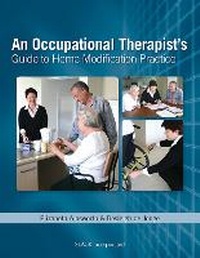
An Occupational Therapist's Guide to Home Modification Practice
Published on 15. November 2010
Book
Paperback/Softback
400 pages
978-1-55642-852-4 (ISBN)
Description
With the integration of people with disabilities into society, there has been increasing interest in modifying homes to enable them to live independently in the community. The aging population has also raised concerns about how well homes can support older peoples' health and safety as they age. Occupational therapists require skills and knowledge to assess the modification needs of these clients including consideration of their current and future requirements and the nature and use of the home environment.
An Occupational Therapist's Guide to Home Modification Practice by Elizabeth Ainsworth and Desleigh De Jonge, uses a transactional approach to examine the person in their home environment. The text assists occupational therapists in addressing the needs of consumers, including consideration of their current and future requirements, the nature and use of the home environment, understanding the technical aspects of the built environment, design approaches, and the application of a range of products and finishes to determine appropriate modification solutions.
An Occupational Therapist's Guide to Home Modification Practice provides occupational therapists with valuable information and expertise for identifying home modification requirements. The text discusses how to consider the personal, cultural, social, temporal, and physical aspects of the home in decision making and provides occupational therapists with a systematic process for identifying and evaluating home-based interventions.
Inside you'll find:
A detailed understanding of aspects of the home environment that impact home modification decisions
A review of legislative environment and funding systems that facilitate service delivery
An overview of home modification services, as well as future trends
An in-depth examination of the home modification process, including discussion about approaches to evaluation, measuring and drawing the environment, identifying and evaluating interventions, the relevance and application of design standards, and reporting and legal issues
Comprehensive case studies - illustrated by photographs - will assist occupational therapists in understanding the range of issues and conceptualizing solutions
With content that is essential to occupational therapy practice that is not currently addressed in any other text, plus a systematic approach to identifying and evaluating home-based interventions, An Occupational Therapist's Guide to Home Modification Practice is a vital text for occupational therapy educators and students, as well as both novice and experienced clinicians.
An Occupational Therapist's Guide to Home Modification Practice by Elizabeth Ainsworth and Desleigh De Jonge, uses a transactional approach to examine the person in their home environment. The text assists occupational therapists in addressing the needs of consumers, including consideration of their current and future requirements, the nature and use of the home environment, understanding the technical aspects of the built environment, design approaches, and the application of a range of products and finishes to determine appropriate modification solutions.
An Occupational Therapist's Guide to Home Modification Practice provides occupational therapists with valuable information and expertise for identifying home modification requirements. The text discusses how to consider the personal, cultural, social, temporal, and physical aspects of the home in decision making and provides occupational therapists with a systematic process for identifying and evaluating home-based interventions.
Inside you'll find:
A detailed understanding of aspects of the home environment that impact home modification decisions
A review of legislative environment and funding systems that facilitate service delivery
An overview of home modification services, as well as future trends
An in-depth examination of the home modification process, including discussion about approaches to evaluation, measuring and drawing the environment, identifying and evaluating interventions, the relevance and application of design standards, and reporting and legal issues
Comprehensive case studies - illustrated by photographs - will assist occupational therapists in understanding the range of issues and conceptualizing solutions
With content that is essential to occupational therapy practice that is not currently addressed in any other text, plus a systematic approach to identifying and evaluating home-based interventions, An Occupational Therapist's Guide to Home Modification Practice is a vital text for occupational therapy educators and students, as well as both novice and experienced clinicians.
Reviews / Votes
"The reader, either student or therapist, would have no difficulty following the flow of information within the text. It would be possible, at the end of a thorough reading, to participate in home evaluation and service delivery. I strongly recommend this book to therapists who are involved in service delivery of home modifications and to instructors of occupational therapy students, for use in the classroom. It is excellent and provides many resources." -Sandi Spaulding, Canadian Journal of Occupational Therapy"The authors are to be commended for their attention to detail, and I would recommend it as a useful reference as I feel it conveys the importance and value of occupational therapists in the home modification/adaptation process." -Shane Elliott, The British Journal of Occupational Therapy
"This is a book that should be on the bookshelf in every clinic... and should be a core text for students." -Carolyn Baum, PhD, OTR/L, FAOTA
More details
Language
English
Place of publication
United States
Publishing group
Taylor & Francis Inc
Target group
College/higher education
Professional and scholarly
Illustrations
illustrations
ISBN-13
978-1-55642-852-4 (9781556428524)
Copyright in bibliographic data and cover images is held by Nielsen Book Services Limited or by the publishers or by their respective licensors: all rights reserved.
Schweitzer Classification
Other editions
New editions
Elizabeth Ainsworth | Desleigh de Jonge
An Occupational Therapist's Guide to Home Modification Practice
Book
10/2018
2nd Edition
SLACK Incorporated
€117.10
Shipment within 3-4 weeks
Persons
Elizabeth Ainsworth, MOccThy, Grad Cert Health Sci graduated in 1989 with a bachelor of occupational therapy (honors) degree and completed a master's in occupational therapy (contemporary clinical practice at the University of Queensland) and a graduate certificate in health science (occupational therapy at the University of Sydney) in 2000. She is the Principal Occupational Therapist in Housing and Homelessness Practice Improvement at the Queensland Department of Communities, leading a highly competent team of occupational therapists who specialize in working with older people and people with disabilities applying for or who live in social housing and who might experience barriers in the home environment. Elizabeth also provides home modification and universal design education and training in a private capacity to occupational therapy university undergraduate and postgraduate students and to occupational therapy clinicians working in a range of settings in the community. She is an active member of the Australian Network for Universal Housing Design (ANUHD) and the Australian Access Consultants Association (ACAA).
Desleigh de Jonge, MPhil (OccThy), Grad Cert Soc Sci graduated in 1978 with a bachelor of occupational therapy from the University of Queensland and completed a master's in philosophy from this university in 2001. She currently lectures in the School of Health and Rehabilitation Sciences at the University of Queensland and developed the curriculum on assistive technology and environmental design for the undergraduate, graduate entry, and postgraduate programs. Desleigh's national and international reputation in consumer-oriented analysis of assistive technologies, environmental design, and home modifications has earned her invitations to present at international conferences on assistive technology and home modification services and outcomes in the United States and Australia, and she has been published in national and international journals. Her teaching and research is focused on interventions and outcome measures that recognize consumer goals and priorities. She is a research associate of the Housing Policy Research Program at the University of Queensland's Social Research Centre and a member of the research team that recently completed an Australian Housing and Urban Research Institute (AHURI)-funded project on the role of home maintenance and modification services in achieving health, community care, and housing outcomes in later life. Desleigh is also a member of the Editorial Board for Disability and Rehabilitation: Assistive Technology and a member of the research review panel for the Home Modification Information Clearinghouse at the University of New South Wales.
Elizabeth and Desleigh have worked together during the past 11 years to provide training to occupational therapy students and practitioners. They have presented at national and international conferences on home modifications and universal design to a broad range of people from various backgrounds. This is the first book they have produced together.
Desleigh de Jonge, MPhil (OccThy), Grad Cert Soc Sci graduated in 1978 with a bachelor of occupational therapy from the University of Queensland and completed a master's in philosophy from this university in 2001. She currently lectures in the School of Health and Rehabilitation Sciences at the University of Queensland and developed the curriculum on assistive technology and environmental design for the undergraduate, graduate entry, and postgraduate programs. Desleigh's national and international reputation in consumer-oriented analysis of assistive technologies, environmental design, and home modifications has earned her invitations to present at international conferences on assistive technology and home modification services and outcomes in the United States and Australia, and she has been published in national and international journals. Her teaching and research is focused on interventions and outcome measures that recognize consumer goals and priorities. She is a research associate of the Housing Policy Research Program at the University of Queensland's Social Research Centre and a member of the research team that recently completed an Australian Housing and Urban Research Institute (AHURI)-funded project on the role of home maintenance and modification services in achieving health, community care, and housing outcomes in later life. Desleigh is also a member of the Editorial Board for Disability and Rehabilitation: Assistive Technology and a member of the research review panel for the Home Modification Information Clearinghouse at the University of New South Wales.
Elizabeth and Desleigh have worked together during the past 11 years to provide training to occupational therapy students and practitioners. They have presented at national and international conferences on home modifications and universal design to a broad range of people from various backgrounds. This is the first book they have produced together.