

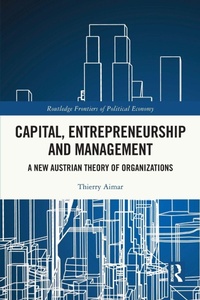
Capital, Entrepreneurship and Management
A New Austrian Theory of Organizations
1st Edition
Will be published approx. on 20. July 2026
Book
Paperback/Softback
136 pages
978-1-032-44195-5 (ISBN)
Description
Economic and organizational literature has long separated the figure of the capitalist and the manager, but it often continues to assimilate that of the capitalist and the entrepreneur around the notion of risk-bearing. Yet confusion between the two prevents any understanding of the essence of capitalism and delivers an erroneous and negative image of the private corporation.
Taking care to distinguish individuals and functions, creators and beneficiaries of revenues, this book examines the respective places of both entrepreneurs and capitalists within the organization. It considers where these roles come into partnership and conflict, demonstrating the circumstances in which entrepreneur and capitalist interests can diverge. It also explores under what circumstances corporate capitalists can impede the efficiency of market mechanisms and shows that in certain kinds of organizations, managers can be the real entrepreneurs. We also explore the consequences on the institutional environment of the relations between entrepreneurs, capitalists and managers within the organization and propose an original approach to the theme of the destructive entrepreneur.
The book will be of great interest to readers of economic organization, corporate governance and entrepreneurship.
Taking care to distinguish individuals and functions, creators and beneficiaries of revenues, this book examines the respective places of both entrepreneurs and capitalists within the organization. It considers where these roles come into partnership and conflict, demonstrating the circumstances in which entrepreneur and capitalist interests can diverge. It also explores under what circumstances corporate capitalists can impede the efficiency of market mechanisms and shows that in certain kinds of organizations, managers can be the real entrepreneurs. We also explore the consequences on the institutional environment of the relations between entrepreneurs, capitalists and managers within the organization and propose an original approach to the theme of the destructive entrepreneur.
The book will be of great interest to readers of economic organization, corporate governance and entrepreneurship.
More details
Series
Language
English
Place of publication
London
United Kingdom
Publishing group
Taylor & Francis Ltd
Target group
College/higher education
Postgraduate
Dimensions
Height: 234 mm
Width: 156 mm
ISBN-13
978-1-032-44195-5 (9781032441955)
Copyright in bibliographic data and cover images is held by Nielsen Book Services Limited or by the publishers or by their respective licensors: all rights reserved.
Schweitzer Classification
Other editions
Additional editions
E-Book
01/2025
1st Edition
Routledge
€60.49
Available for download
Book
01/2025
1st Edition
Routledge
€205.70
Shipment within 10-20 days
E-Book
01/2025
1st Edition
Routledge
€60.49
Available for download
Person
Thierry Aimar is an Assistant Professor of Economics at the University of Lorraine (BETA) and Sciences Po Paris. He specializes in the Austrian School, Entrepreneurship, Corporate Governance and Market Systems.
Content
General Introduction Part I: Entrepreneur, or (and) Capitalist? 1. Some Elements of an Austrian Debate 2.A Functional Distribution of Incomes 3.The Catallactic Functions in "Real World Markets" 4.From Discoveries to Creations: An Extension of Entrepreneurship 5.Pure Profit and Capital Part II: Entrepreneurship and Management 6. The Manager, What Definition? 7. The Entrepreneur in Corporate Firms: Alertness and Judgment Reconsidered 8. In Open Corporations, Who Is the Entrepreneur 9.The Advantages of a Reassessment 10. A Genealogy of the Firm Part III: The Organization Versus Entrepreneurship 11. An Austrian Understanding of the Exploration-Exploitation Dilemma 12. From Organizations to Institutions 13.From Destructive Entrepreneur to Destructive Capitalist 14.Entrepreneurs versus Capitalists General Conclusion References Index